German beef marinated for three days in red wine and vinegar, then braised with gingerbread that dissolves into the sauce, Central Europe's answer to beef bourguignon.
About Sauerbraten
Germany's royal pot roast: beef marinated for up to three days in a bath of red wine, vinegar, onion, juniper and bay leaf until it absorbs a deep, sour-sweet character; slow-braised in the marinade with gingerbread (Lebkuchen) which melts into the sauce to give it a dark, complex sweetness; Germany's answer to beef bourguignon.
The Marinade
Germany's great pot roast begins days before cooking. A cut of beef, usually top round or silverside, is submerged in a marinade of red wine vinegar, red wine, onion, juniper, clove and bay and left for two to three days. The acid slowly breaks down the connective tissue while the aromatics work through the meat. What emerges tastes fundamentally different from beef marinated for an hour.
“A cut of beef, usually top round or silverside, is submerged in a marinade of red wine vinegar, red wine, onion, juniper, clove and bay and left for two to three days.”
The Sauce
The braising liquid becomes the sauce, strained and traditionally thickened with crumbled Lebkuchen, a spiced gingerbread that dissolves to add dark, sweet depth against the vinegar's edge. The balance of sour and sweet is the dish's signature, a sauce more complex than almost anything else in the German repertoire. It is spooned generously over the sliced meat.
Regional Versions
Sauerbraten changes from region to region. The Rhineland version, the best known, stirs raisins into the sauce for extra sweetness and once used horse meat rather than beef. Franconian and Swabian cooks make their own drier or tangier variations. The constant is the long marinade and the sweet-sour sauce that defines it.
The Plate
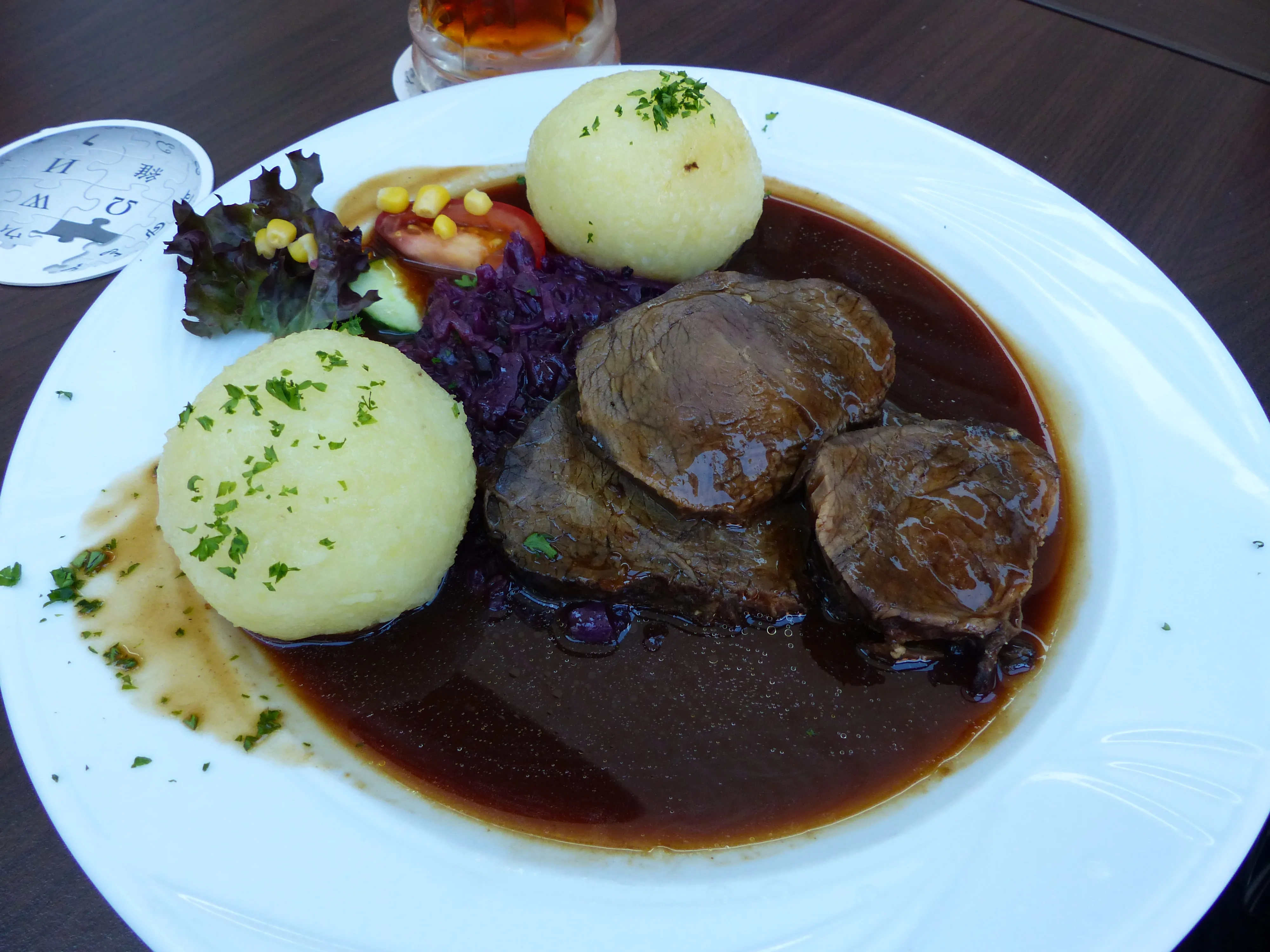
Sauerbraten is served with sides built to soak up the sauce: braised red cabbage, and potato dumplings or boiled potatoes. The meat is dark and tender, the cabbage deep burgundy, the dumplings soft and absorbent. With a glass of German Pinot Noir, it shows the slow, deeply flavoured side of the kitchen that the country's faster street foods rarely reveal.
What to Expect
The Sauerbraten slice is dark mahogany, the grain of the meat visible in the cross-section. The sauce poured over it is complex (sour, sweet, spiced and dark) and coats everything on the plate. The red cabbage is braised to a deep burgundy. The potato dumplings are large, steamed and absorb the sauce.
Why Try It
Sauerbraten reveals the sophistication of traditional German cooking in a way that Currywurst and Schweinshaxe don't. The three-day marinade is a technique that requires planning and commitment, and the result is the kind of deeply flavoured, slow-developed dish that the German kitchen does better than most.
Insider Tips
- Zum Alten Markt in Cologne makes one of the most authentic Rhineland versions, the Cologne style uses raisins in the sauce.
- The three-day marinade is non-negotiable. A 24-hour version is a different dish.
- Red wine should be poured alongside, a Spätburgunder (German Pinot Noir) from the Ahr valley.