“A crumbling brick factory in the middle of the Pernambuco forest was reborn as a terracotta fortress where two thousand ceramic creatures keep watch over a dead master’s private kingdom.”
About Brennand Ceramic Museum
Francisco Brennand returned to his family's abandoned 1917 tile factory in 1971, finding a ruin that he would spend forty-eight years turning into a monumental art complex. He utilized the existing industrial architecture, repurposing the massive kilns as galleries and the vast sheds as workshops for his prolific output. The site grew organically, funded by the Brennand family's industrial wealth but fueled entirely by Francisco's fascination with sexuality, mythology, and the cycles of life and death. In 1999, the artist further expanded the experience by creating the nearby Francisco Brennand Sculpture Park on a reef in the Port of Recife, but the Oficina remains the true heart of his creative output. Since his passing in late 2019, the museum has been managed by his institute, preserving the sprawling twenty-square-kilometer estate as a sanctuary where art and the Atlantic Forest have achieved a permanent, symbiotic embrace.
Brennand Ceramic Museum in Brazil
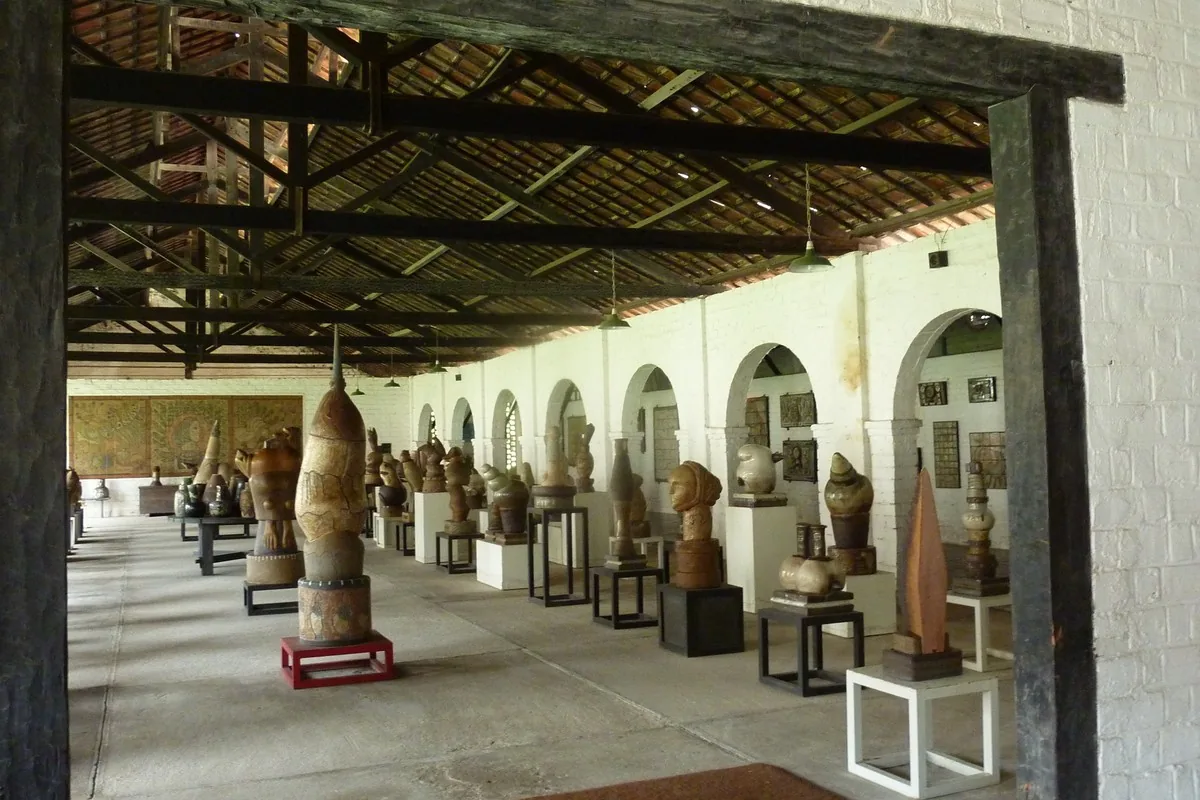
Deep in the Várzea district of Recife, where the urban sprawl finally surrenders to the dense, humid embrace of the Atlantic Forest, lies a sprawling gothic fantasy built from red clay and obsession. Francisco Brennand, perhaps Brazil’s most enigmatic sculptor, spent nearly half a century transforming his family’s ruined early-20th-century brick factory into a sprawling cathedral of ceramics. Walking into the Oficina Cerâmica Francisco Brennand feels like discovering a lost civilization that worships strange, primordial gods. Thousands of sculptures, towering totems, mythological beasts, and enigmatic phallic forms, populate the courtyards and colonnades. The architecture itself mimics a castle or a temple, with sun-baked brick walls that radiate heat and a central reflecting pool that mirrors a sky often heavy with tropical rain.
Deep in the Várzea district of Recife, where the urban sprawl finally surrenders to the dense, humid embrace of the Atlantic Forest, lies a sprawling gothic fantasy built from red clay and obsession.
João brick factory, 1971
Francisco Brennand inherited the São João brick factory in 1971, a site originally established by his father in 1917 that had fallen into total disrepair. Rather than restoring it to its utilitarian roots, Brennand saw the crumbling kilns and vast industrial sheds as a stage for his artistic rebirth. He began a lifelong project of 'reconstruction,' using the very clay that once made simple bricks to populate the grounds with a cast of thousands of ceramic inhabitants. Brennand was deeply influenced by Greco-Roman mythology, alchemy, and the raw fertility of the Brazilian northeast, blending these themes into a singular, often provocative visual language. For decades, he worked in semi-seclusion here, slowly expanding the site into a labyrinth of plazas and galleries that eventually gained global recognition. Upon his death in 2019, the workshop remained exactly as he left it, a monument to the idea that an artist’s work is never finished.
A peculiar scent of damp
A peculiar scent of damp earth and woodsmoke, a lingering ghost of the kilns that still fire the artist’s designs. First, the silence is not empty; it is filled with the dripping of water from moss-covered fountains and the rustle of lizards darting between terracotta limbs. The light in the 'Accademia' gallery is particularly theatrical, filtering through high windows to illuminate the glazed surfaces of larger-than-life sculptures that seem to watch you passing. Visitors often overlook the back gardens, where the forest begins to reclaim the outer walls, creating a beautiful tension between the manicured art and the wild jungle. Walking through the Temple of Central Space, The sheer scale of Brennand's ambition. The symmetry of the reflecting pools and the repetition of the totems create a meditative, almost hypnotic rhythm. You might find yourself alone in a long corridor of ceramic masks, each with a different expression of agony or ecstasy. The heat of the Recife afternoon is tempered by the thick brick walls, but the humidity remains a constant companion, making the glazed ceramics glow with a perpetual, sweaty sheen. It is an experience that is at once deeply unsettling and profoundly beautiful, leaving you with the sense that you have trespassed into a private, terracotta dream.
Reaching the workshop requires a deliberate trek
Reaching the workshop requires a deliberate trek from the coastal skyscrapers of Boa Viagem into the western suburbs. People typically find that a private car or ride-share is the only practical way to navigate the winding roads of the Várzea forest. The approach involves driving down a long, palm-lined avenue that is a sensory transition from the chaotic noise of the city to the monastic quiet of the grounds. Arriving in the late afternoon is ideal, as the lowering sun turns the red brick to a deep, burnt orange, providing the perfect light for seeing the textures of the unglazed clay before the gates close at sunset.
Reaching the workshop requires a deliberate trek from the coastal skyscrapers of Boa Viagem into the western suburbs.
The Experience
The echo of your own footsteps on the terracotta tiles is the primary soundtrack here, occasionally broken by the sharp cry of a tropical bird from the surrounding canopy. The cool, solid weight of the brick walls when you lean in to inspect a frieze, noticing how the humidity has allowed moss to paint its own green patterns over Brennand's glazes. Most visitors rush through the main hall, but the moment that stays with you is standing by the reflecting pool in the Plaza of the Temple, where the stillness of the water makes the towering ceramic totems look twice as large. First, the smell of the nearby Capibaribe River, a mix of fresh water and mangroves, which drifts through the open-air courtyards. It feels less like a museum and more like a sacred site for an ancient, unknown religion, where every corner holds a sculpture that demands a second, perhaps uncomfortable, look.
Why It Matters
This site represents a rare instance where industrial heritage has been completely subsumed by a singular artistic vision. It matters because it is one of the few places in Brazil where the European influence of ceramic art was successfully grafted onto the raw, mythological imagery of the Northeast. Beyond its artistic value, the museum protects a significant parcel of the Atlantic Forest, serving as a cultural and ecological lung for the city of Recife.
Why Visit
Worth it because you will never see another place where industrial ruin and high art collide with such ferocious commitment. While the beaches of Recife are beautiful, the Brennand Museum offers a psychological landscape that is entirely unique. You go there to lose yourself in a maze of clay that feels older than the country itself, finding a quietude that is impossible to locate on the coast.
✦ Insider Tips
- 1
Do not confuse this site with the Ricardo Brennand Institute; they are cousins but offer vastly different experiences, with the Oficina focusing on Francisco's raw ceramic work.
- 2
Look for the smaller, unlabelled sculptures tucked into the high rafters of the old factory sheds; Brennand often hid pieces in the shadows.
- 3
Bring a high-quality insect repellent, as the proximity to the river and the dense forest makes the museum a preferred haunt for local mosquitoes.
- 4
Walk all the way to the back of the grounds to see the old kilns, where you can still see the char marks on the brick from decades of firing.
- 5
Have lunch at the onsite cafe, as the surrounding neighborhood of Várzea offers few tourist-friendly dining options and the drive back to the center is long.