Twenty-seven hundred meters of falling river create a roar so profound that Eleanor Roosevelt reportedly looked upon the scene and could only offer a sympathetic 'Poor Niagara.'
About Cataratas do Iguaçu
Indigenous Guarani tribes lived along these banks for centuries, calling the site 'Iguazú' or 'Great Water' long before European boots touched the mud. In 1541, Álvar Núñez Cabeza de Vaca recorded the first Western account of the falls during an expedition toward Paraguay, though he viewed them more as a navigational nightmare than a natural wonder. The modern era of the park began in earnest following the 1916 visit of Santos Dumont, who was appalled that such a site was in the hands of a single landowner. His advocacy led to the establishment of the National Park in 1939, eventually resulting in a UNESCO World Heritage designation in 1986. Today, the park serves as a rare success story of binational cooperation, with Brazil and Argentina managing their respective sides to protect the surrounding subtropical rainforest from the encroaching agricultural landscape.
Cataratas do Iguaçu
Nature rarely performs with such violent, sustained theater as it does where the Iguaçu River decides to fall off a basalt plateau. Spanning nearly three kilometers, this semicircular curtain of water consists of roughly 275 individual falls, depending on the season’s rainfall. While the Argentine side offers the intimacy of walking over the water, the Brazilian side provides the panoramic scale, a wide-angle perspective that forces you to realize the sheer insignificance of human engineering against the weight of a river. Here, A permanent weight of humidity, vibrating with a low-frequency hum that in your chest long before the mist actually hits your skin.
“Nature rarely performs with such violent, sustained theater as it does where the Iguaçu River decides to fall off a basalt plateau.”
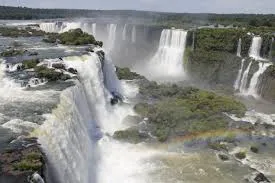
Cataratas do Iguaçu, Brazil
Geologists trace the origins
Geologists trace the origins of the falls back to a massive volcanic eruption roughly 130 million years ago, which cracked the earth and left behind the stepped basalt layers that today create the multiple tiers of the cascade. Local Guarani legend speaks of a vengeful serpent god named Boi, who sliced the riverbed in half to catch a pair of fleeing lovers. To the outside world, the falls remained a secret of the indigenous people until the Spanish explorer Álvar Núñez Cabeza de Vaca happened upon them in 1541. Despite his journals describing a wall of water that terrified his men, the site saw little development until Santos Dumont, the famed Brazilian aviator, visited in 1916. Struck by the fact that the land was then private property, he lobbied the government of Paraná to expropriate the area and create a public park for all Brazilians.
The trail begins at the pink-hued Belmond Hotel das Cataratas, winding through a dense canopy of Atlantic Forest where coatis, mischievous, long-nosed mammals, scramble across the path looking for handouts. As you descend toward the river, the visual noise of the jungle gives way to a singular, deafening roar. Yellow butterflies often congregate in the thousands near the wet stones, creating flickers of gold against the deep green foliage. The climax occurs at the Garganta do Diabo, or Devil’s Throat, where a walkway extends directly into the heart of the mist. Here, the water doesn't just fall; it pulverizes itself into a white abyss. You will leave this walkway soaked to the bone, tasting the river on your lips and feeling the raw, cool breath of the earth.
Reaching the park involves a short
Reaching the park involves a short drive from Foz do Iguaçu, followed by a ride on the park’s double-decker buses. These vehicles carry visitors from the entrance deep into the forest to the trailhead. While many opt for the helicopter flights that hover over the rim, the true soul of the place is found on the lower walkways at sunrise. Arriving exactly when the gates open allows you to witness the morning sun catch the spray, creating double and triple rainbows that arc across the chasm before the midday crowds arrive to break the spell.
“Reaching the park involves a short drive from Foz do Iguaçu, followed by a ride on the park’s double-decker buses.”
The Experience
A fine, persistent drizzle coats everything within a mile of the rim, making the handrails slick and the air smell of crushed moss and wet stone. Beginning with the way the light fractures through the spray at roughly four in the afternoon, turning the white water into a pale, iridescent orange. The coatis are constant companions on the trails, and while they look cuddly, their sharp claws and obsession with backpacks remind you that the jungle is never far away. Most visitors rush to the main lookout, but the quietest moments are found on the wooded paths between the larger drops, where the sound of the falls becomes a rhythmic pulsing rather than a constant roar. The vibration of the Devil’s Throat is something you carry back to the hotel; even in the silence of your room, your inner ear still echoes with the thrum of millions of liters of water hitting the rocks below.
Why It Matters
This site serves as the world’s most powerful reminder of the hydrological cycle's scale. Beyond the visual spectacle, it is a critical sanctuary for the Atlantic Forest, housing endangered species like the giant otter and the jaguar. It represents a geological scar that has become a spiritual landmark, proving that nature’s most violent disruptions can result in its most profound beauty.
Why Visit
Niagara is a manicured park and Victoria is a sheer drop, but Iguaçu is an entire world of water. It offers a 360-degree immersion in a way no other waterfall can replicate. You don't just look at these falls from a distance; you stand inside them, surrounded by a semi-circle of thunder that makes the rest of the world’s wonders feel remarkably quiet.
Insider Tips
- 1
Bring a waterproof dry-bag for your electronics, as the spray at the Devil's Throat penetrates even the best supposedly water-resistant jackets.
- 2
Walk the trail backward starting from the elevator to experience the crescendos of sound in reverse, which often lets you avoid the thickest groups of tourists.
- 3
Look for the Great Dusky Swifts, birds that incredibly choose to nest on the wet rock faces directly behind the falling curtains of water.
- 4
Keep your park ticket and valid ID handy if you plan to cross the Tancredo Neves Bridge to see the Argentine side the following day for a discounted entry.