Building a theater from two thousand tons of steel pipes in just seventy-five days sounds like an industrial accident, yet it produced a glass lantern that floats inside a volcanic crater.
About Opera de Arame
The theater was a radical experiment in rapid construction, born from Curitiba’s 1990s push for innovative urban design under Mayor Jaime Lerner. Architect Domingos Bongestabs drew inspiration from the transparency of the Crystal Palace, but adapted the concept for a humid, rocky environment. Between late 1991 and early 1992, crews worked around the clock to sink the foundations into the lakebed and bolt the modular steel frame together. The project was so successful that it spurred the development of the adjacent Pedreira Paulo Leminski, a massive open-air arena that has since hosted everyone from David Bowie to Paul McCartney. Despite its skeletal appearance, the structure has survived decades of southern Brazil's erratic weather, standing as a permanent monument to the idea that architecture should touch the earth lightly.
About Ópera de Arame
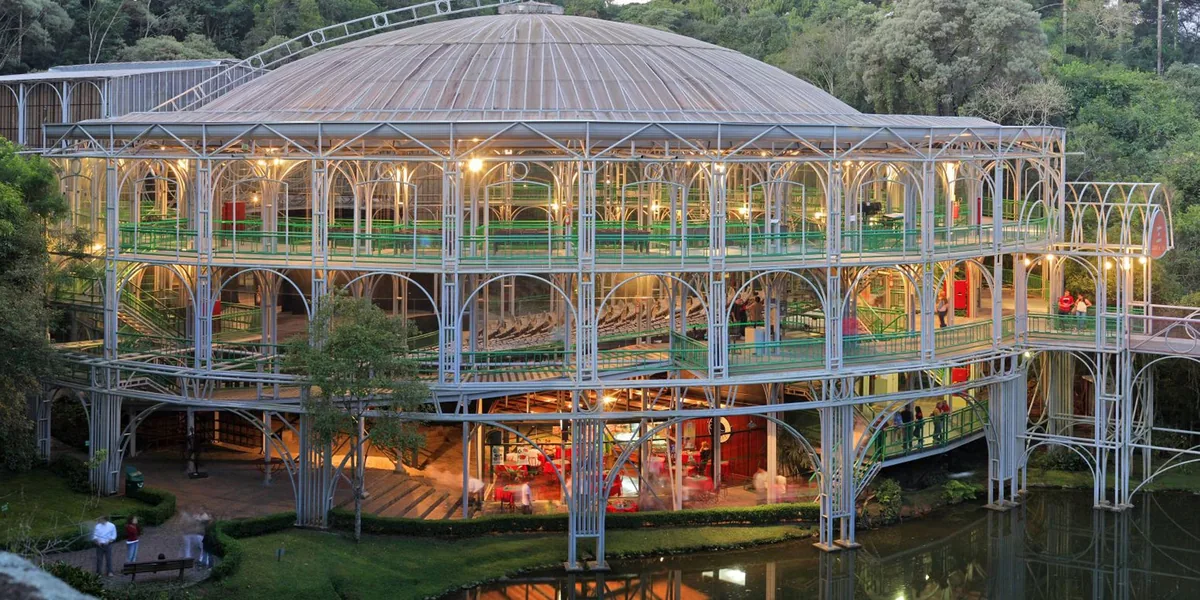
A cage of white steel tubes rises from the basin of an abandoned quarry in Curitiba, appearing more like a delicate frozen cobweb than a traditional theater. Known as the Ópera de Arame, or Wire Opera House, this circular structure sits surrounded by the raw, vertical rock walls of the Parque das Pedreiras. It is a masterpiece of transparent architecture that refuses to separate the performer from the pine trees or the audience from the lake. The building floats above water, connected to the shore by a high walkway that makes as though you are boarding a futuristic ship of glass and iron. During a performance, the boundary between the orchestrated music inside and the rhythmic splashing of the nearby waterfall completely dissolves.
an impossible challenge, 1992
Architect Domingos Bongestabs faced an impossible challenge in 1992: the city wanted a grand theater built in a discarded crater in just seventy-five days. He eschewed heavy concrete and traditional masonry, opting instead for a modular system of steel pipes and transparent polycarbonate sheets. This industrial approach allowed the skeleton to be assembled with frantic speed, yet the result possesses an almost miraculous lightness. The site itself was once a jagged scar on the landscape, a granite quarry that had outlived its industrial utility. By placing this ethereal glass cylinder at its heart, the city transformed a site of extraction into one of creation. It was a centerpiece for the 300th anniversary of Curitiba, proving that urban renewal could be both lightning-fast and deeply poetic.
The hollow ring of your footsteps
The hollow ring of your footsteps on the metal grid walkway is the first movement of the experience. Instantly, the temperature drop moving over the water, where It smells of damp stone and the lush, subtropical ferns that cling to the quarry walls. The light inside the auditorium is never the same twice; it shifts with the passing clouds, casting long, geometric shadows across the 1,500 seats. When the sun begins to set, the entire structure begins to glow from within like a giant lantern, reflecting its lattice-work ribs on the dark surface of the lake. Standing on the lower levels, the spray from the 10-meter waterfall that cascades just behind the stage. Many visitors rush to find their seats, but the moment that stays with you is leaning over the railing of the peripheral balcony, watching the carp circle in the water below while the wind whistles through the steel tubes. The acoustics are surprisingly sharp. It is a sensory paradox where industrial materials feel soft and a reclaimed industrial pit is like a secluded forest sanctuary. Reaching the theater involves a drive to the northern reaches of Curitiba, far from the high-rise clusters of the city center. The Linha Turismo, a dedicated sightseeing bus, drops you at the entrance of the Parque das Pedreiras, where a winding path leads down into the quarry. Those visiting find that arriving an hour before a show allows for a walk through the surrounding gardens and the 'Vale da Música,' a floating stage where live instrumentalists perform throughout the day. Taxis are plentiful, but the walk from the bus stop allows for a gradual reveal of the theater as you descend into the stone amphitheater.
The Experience
The waterfall acts as a constant white noise that silences the distant city, leaving you alone with the rustle of the Araucaria pines. The slight vibration of the metal floor as people move across the balconies, a mark of the building’s delicate, floating nature. Most people miss the small art gallery tucked into the lower level, where the granite walls of the quarry actually form the interior boundaries of the room. Initially, the contrast between the cold, white steel and the vibrant green of the moss creeping over the walkway supports. The bit that defines the visit is looking up through the transparent ceiling as the rain begins to fall; you see the droplets hitting the polycarbonate and hear the drum-like patter above, feeling completely sheltered yet entirely immersed in the storm. It is a rare architectural trick that makes you feel both protected and exposed.
Why It Matters
Ópera de Arame matters as a global benchmark for sustainable urban planning and the creative reuse of industrial brownfields. It proved that a derelict quarry could be salvaged without erasing its history, using architecture to heal the landscape rather than hide it. Culturally, it remains the soul of Curitiba’s artistic identity, embodying the city’s reputation for being thirty years ahead of the rest of the country in design and ecology.
Why Visit
The sheer impossibility of the setting. While Brazil has many beautiful theaters, none allow you to watch a concert while a waterfall thunders behind the curtains and a cliff face serves as the backdrop. You go to see how steel and glass can mimic the fragility of the natural world while sitting in a hole once blasted out by dynamite.
✦ Photo Gallery
Best Season
🌤 Time your visit for April or May when the humidity of the Paraná summer has broke and the southern sun is low enough to illuminate the quarry walls with a rich, golden hue.
Quick Facts
Best time to visit
Time your visit for April or May when the humidity of the Paraná summer has broke and the southern sun is low enough to illuminate the quarry walls with a rich, golden hue.
Getting there
In Curitiba, Brazil; reach Curitiba first, then continue to the site.
Location
Curitiba, Brazil
Type
attraction
Insider Tips
- 1
Check the schedule for the 'Vale da Música' to ensure you catch the floating stage performances that happen daily on the lake itself.
- 2
Bring a light jacket even in summer; the depths of the quarry and the surrounding water keep the theater significantly cooler than the street level.
- 3
Walk the full perimeter of the outer balcony to see the massive bolts that hold the structure to the rock face; it’s a feat of engineering hidden in plain sight.
- 4
Avoid the peak school-tour hours between 2:00 PM and 4:00 PM if you want to experience the acoustics of the empty theater in silence.
- 5
Use the Linha Turismo bus pass, as it allows you to combine this with a visit to the nearby Tanguá Park, another spectacular reclaimed quarry.