“Four hundred tons of gold leaf line the interior of a single church here, a blinding display of colonial wealth built by the very people the district was named to punish.”
About Pelourinho
Tomé de Sousa founded the city on these heights in 1549, making it the administrative center of the Portuguese empire in the Americas. Throughout the 1600s, Salvador became the primary port for the transatlantic slave trade, a dark history that paradoxically fueled the architectural splendor of the district. The Jesuits and Franciscans competed to build the most ornate sanctuaries, resulting in the high-baroque density that remains today. Following a long period of decay in the mid-20th century, a massive restoration project in the 1990s saved the pastel mansions from collapse, though it also sparked a complex debate about the displacement of the local community in favor of tourism. Today, the area is a living classroom where the architecture of the oppressor has been repurposed as a stage for the cultural triumphs of the Afro-Brazilian people.
What Pelourinho actually is
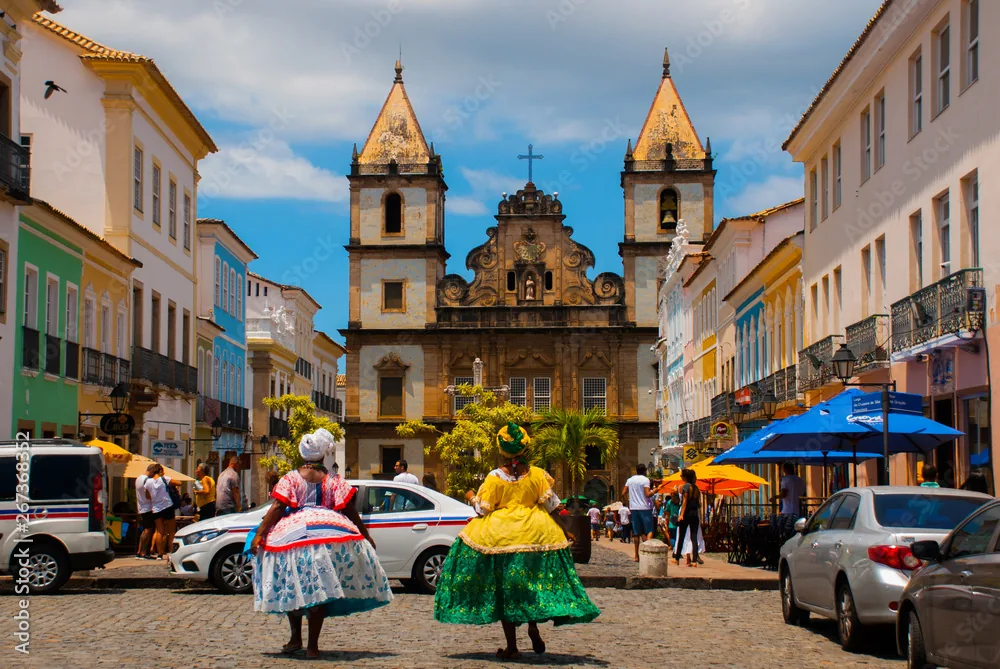
Salvador’s upper city sits perched on a sharp bluff overlooking the Bay of All Saints, anchored by a neighborhood where the cobblestones seem to vibrate with the echoes of five hundred years. Pelourinho, the historic soul of Bahia, presents a dizzying shifting mix of Portuguese colonial architecture painted in shades of ochre, sky blue, and pistachio. While the facade suggests a Mediterranean postcard, the atmosphere is purely African. The scent of dendê palm oil sizzling in street-side pans mingles with the sharp salty tang of the Atlantic, creating a sensory threshold that marks your entry into Brazil's most resilient cultural heart.
Salvador’s upper city sits perched on a sharp bluff overlooking the Bay of All Saints, anchored by a neighborhood where the cobblestones seem to vibrate with the echoes of five hundred years.
this hilltop fortress, 1549
Portuguese settlers established this hilltop fortress in 1549 to serve as the first capital of Brazil, choosing the high ground for its strategic defense against Dutch and French invaders. The neighborhood takes its name from the stone whipping post, or pelourinho, that once stood in the central plaza as a grim instrument of colonial punishment for enslaved people. By the 18th century, the area had transformed into an opulent residential district for the wealthy, who commissioned gilded cathedrals like the Igreja de São Francisco to showcase their sugar-funded fortunes. When the capital moved to Rio in 1763, the elite followed, leaving these baroque mansions to be reclaimed by the marginalized communities whose descendants transformed the district into a famous center for Afro-Brazilian arts, music, and resistance.
Planning
Morning in the Pelourinho belongs to the sweep of brooms on stone and the distant clatter of silverware from open windows. As the heat builds, the soundscape shifts toward the percussive; a single berimbau might start a rhythm that eventually draws a circle of capoeira players into the Terreiro de Jesus. Right away, the texture of the walls, where layers of paint have peeled back to reveal centuries of repair and weathered stone. Looking up, the wrought-iron balconies are often draped with colorful laundry or white lace, while the Baianas de Acarajé stand like guardians in their voluminous white hoop skirts. The humidity can feel heavy, yet the sea breeze usually finds its way through the narrowest alleys to offer a momentary reprieve.
Ascending from the lower port district
Ascending from the lower port district via the Elevador Lacerda provides the most dramatic entrance, a vertical lift that deposits you directly onto the Praça Tomé de Souza. Alternatively, walking up the Ladeira do Carmo allows for a slower immersion into the neighborhood’s residential fringes where the commercial sheen fades. Navigating these steep, uneven inclines requires a steady pace and an acceptance that you will inevitably lose your way. Each wrong turn usually leads to a small courtyard or a workshop where someone is carving a drum or painting a canvas, making the act of getting lost the most rewarding part of the journey.
Ascending from the lower port district via the Elevador Lacerda provides the most dramatic entrance, a vertical lift that deposits you directly onto the Praça Tomé de Souza.
The Experience
The sound of Olodum drummers practicing in a nearby square creates a physical pulse that you feel in the soles of your feet long before you see the musicians. It becomes clear how the steep streets trap the afternoon heat, making the cold glass of a freshly squeezed caju juice feel like a small miracle. Most visitors overlook the quiet cloisters of the Third Order of Saint Francis, where the blue-and-white azulejo tiles tell stories of a Lisbon that no longer exists. There is a specific moment at dusk when the street lamps flicker to life and the pastel walls turn a deep, saturated violet. The scent of fried bean cakes and hot peppers fills the air, and for a few minutes, the distance between the colonial past and the vibrant present seems to vanish entirely. You realize that Pelourinho isn't a museum; it is a neighborhood that refused to be forgotten.
Why It Matters
Pelourinho stands as the geographical epicenter of the African Diaspora in the New World. It is the place where Candomblé traditions, capoeira, and samba were preserved and polished under the weight of history. Culturally, it represents the victory of identity over erasure, housed within a architectural ensemble that remains the most complete example of Portuguese colonial urbanism in existence.
Why Visit
Forget the sanitized theme parks of modern travel; Pelourinho offers a raw, unfiltered encounter with the soul of Bahia. You visit because this is the only place where you can touch 16th-century stones while dancing to a rhythm that was born in West Africa and perfected in the Brazilian sun. It provides a sensory overload that no beach resort can ever match.
✦ Insider Tips
- 1
Attend the Tuesday night blessing at the Igreja de Nossa Senhora do Rosário dos Pretos to hear a Catholic mass sung to the beat of African drums.
- 2
Avoid the main squares for lunch and seek out the 'restaurantes a quilo' tucked into the residential side streets for authentic moqueca.
- 3
Wear footwear with significant grip, as the centuries-old cobblestones have been polished to a glass-like slickness by millions of footsteps.
- 4
Look for the atelier of local artist Menelaw Sete; his workshop offers a glimpse into the modern Bahian art scene far beyond the souvenir shops.
- 5
Use the Elevador Lacerda for a few cents to transition between the upper and lower cities rather than taking expensive taxis for short distances.