Twelve stone giants stand on a mountain terrace in Minas Gerais, carved by a man who had to strap chisels to his wrists because his hands had withered away.
About Santuário do Bom Jesus de Matosinhos
Feliciano Mendes initiated the project in 1757 as a personal act of penance, following a tradition of hilltop sanctuaries common in his native Portugal. The church itself was completed in 1772, but the true artistic soul of the place arrived with Aleijadinho in the late 1790s. Between 1796 and 1799, he carved sixty-six cedarwood figures for the chapels below, followed by the crowning achievement of the soapstone prophets between 1800 and 1805. These years were a race against the artist's own deteriorating health, as he worked in semi-seclusion to avoid prying eyes. The result was a masterpiece of the 'Mineiro' Baroque, blending European decorative traditions with a raw, local emotionality that finally earned the site UNESCO World Heritage status in 1985.
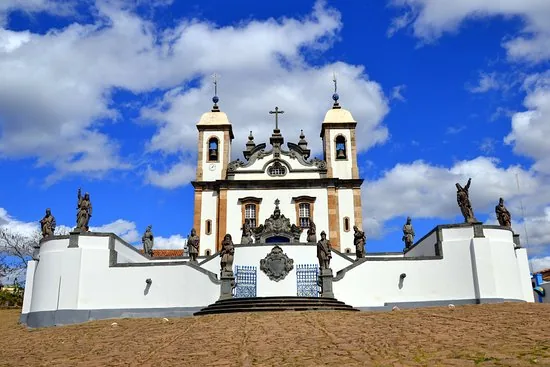
Twelve life-sized prophets carved from blue-grey soapstone stand guard on the terrace of Congonhas, their dramatic gestures frozen against the vast, iron-red hills of Minas Gerais. This sanctuary complex represents the absolute zenith of the Brazilian Baroque, a theatrical ensemble of architecture and sculpture that seems to pulse with a spiritual intensity rare even in this deeply religious region. Rising above the quiet town, the white-washed church and its zigzagging monumental stairway create a rhythmic ascent that culminates in the presence of these stone giants. The air here feels thinner and cleaner than in the coastal cities, often carrying the scent of dry grass and the faint, metallic tang of the surrounding iron mines.
Feliciano Mendes, a Portuguese immigrant who had fallen gravely ill while seeking his fortune in the gold mines, vowed to build a sanctuary dedicated to Bom Jesus if he survived. After his recovery in 1757, he began the work with little more than a begging bowl to fund his vision, sparking a devotional movement that would span decades. The most significant turning point occurred in 1796 when the Third Order of Saint Francis commissioned Antônio Francisco Lisboa, famously known as Aleijadinho, to create the sculptural program. Already suffering from a debilitating physical condition that left his hands practically useless, Aleijadinho labored until 1805 to finish the Twelve Prophets. He worked with tools strapped to his wrists, coaxing fluid movement and agonizingly human expressions from the soft soapstone, effectively creating a Bible in stone for a population that was largely illiterate.
Approaching the sanctuary involves a slow climb past six small chapels, each housing cedarwood scenes of the Passion of Christ carved by Aleijadinho and painted by his contemporary, Ataíde. You notice the transition in texture as you move from the warm, painted wood of the chapels to the cool, unyielding soapstone of the upper terrace. The prophets themselves are arranged in a complex, conversational geometry; they seem to be debating one another across the staircase, their robes billowing in a stone wind. Up close, the detail is startling, from the bulging veins in a neck to the intricate Hebrew inscriptions on the scrolls they hold.
Standing on the terrace at sunset offers a moment of profound sensory clarity. The white walls of the church reflect the fading orange light, while the grey-blue soapstone of the prophets takes on a ghostly, ethereal sheen. Below you, the red dust of the town begins to settle as the church bells signal the end of the day. You feel the immense physical effort it took to carve this majesty out of the mountainside. Most visitors overlook the intricate ironwork of the church gates, but the way the metal curls mirrors the same restless energy found in the stone carvings above.
Congonhas sits about 80 kilometers south of Belo Horizonte, making it an essential stop on the historical gold route between Ouro Preto and Tiradentes. Most travelers arrive via the winding BR-040 highway, where the landscape shifts from industrial outskirts to rolling, emerald highlands. Walking from the town center to the sanctuary requires a brisk uphill hike through streets lined with traditional colonial houses. Arriving in the early morning is highly recommended, as the mountain mist often clings to the prophets' shoulders, creating an atmosphere that feels less like a tourist site and more like an ancient, high-altitude monastery.
The Experience
The air around the terrace feels heavy with a centuries-old reverence, even when the crowds of pilgrims are thin. You feel the grit of the red earth under your shoes as you navigate the zigzagging stairs, noticing how the soapstone prophets seem to change position as you move, their eyes following you with a carved, prophetic intensity. Many travelers miss the subtle differences in the soapstone’s color; the lichen and rain have given each prophet a unique patina of greens and deep greys over the last two hundred years. You notice the smell of candle wax drifting from the open church doors, a sweet, heavy scent that anchors the airy mountain views. The moment that stays with you is standing at the feet of the Prophet Daniel and looking out over the iron-rich valley, realizing that the same earth that produced the gold which funded the church also provided the stone for its soul.
Why It Matters
Bom Jesus de Matosinhos matters as the definitive proof of a uniquely Brazilian artistic genius. It is the place where the Baroque style shed its European rigidity to embrace the movement and diversity of the New World. Culturally, it remains one of the most important pilgrimage sites in the country, proving that great art can function simultaneously as a high-culture landmark and a site of genuine, popular devotion.
Why Visit
Go to Congonhas to see what obsession looks like when it is rendered in stone. While Ouro Preto offers a whole town of history, this sanctuary offers a singular, concentrated burst of creative power that you won't find anywhere else. You visit to stand before the prophets and realize that even as his body failed him, Aleijadinho was creating the most energetic art on the continent.
✦ Photo Gallery
Best Season
🌤 Plan your visit for the month of September during the Jubilee of Bom Jesus, when thousands of pilgrims fill the square and the religious fervor brings the stone ensemble to its most vibrant, living state.
Quick Facts
Location
Brazil
Type
attraction
Insider Tips
- 1
Look closely at the faces of the figures in the Passion chapels; many are believed to be caricatures of the local colonial authorities Aleijadinho disliked.
- 2
Visit the Room of Miracles (Sala dos Milagres) to see the thousands of 'ex-votos'—small paintings and wax limbs left by believers who claim to have been healed here.
- 3
Bring a polarizing filter for your camera to capture the dramatic contrast between the white church walls and the deep blue of the high-altitude sky.
- 4
Eat a traditional 'frango com ora-pro-nóbis' in one of the small family restaurants at the base of the hill before your climb.
- 5
Note that the soapstone is extremely fragile; avoid the urge to touch the prophets, as the oils from your skin can permanently darken the porous rock.