“Red ochre silhouettes of jaguars and dancers have clung to these sun-baked Piauí cliffs for over thirty thousand years, silently mocking our modern concepts of when the New World began.”
About Serra da Capivara
While the world believed the Americas were unpeopled until 13,000 years ago, Niède Guidon’s excavations at the Pedra Furada site unearthed hearths and stone tools suggesting a human presence four times older. These findings ignited a fierce international debate that transformed this remote scrubland into a global archaeological flashpoint. The park was officially inaugurated in 1979, but it took years of Guidon’s relentless fundraising and the construction of the Museum of the American Man to secure its legacy. Today, the park manages over 1,300 archaeological sites, many featuring paintings made with a mixture of iron oxide and animal fat that has bonded permanently to the sandstone. This historical arc is not just about ancient bones, but about the modern struggle to protect a heritage that rewrite's the migration story of our entire species.
Serra da Capivara
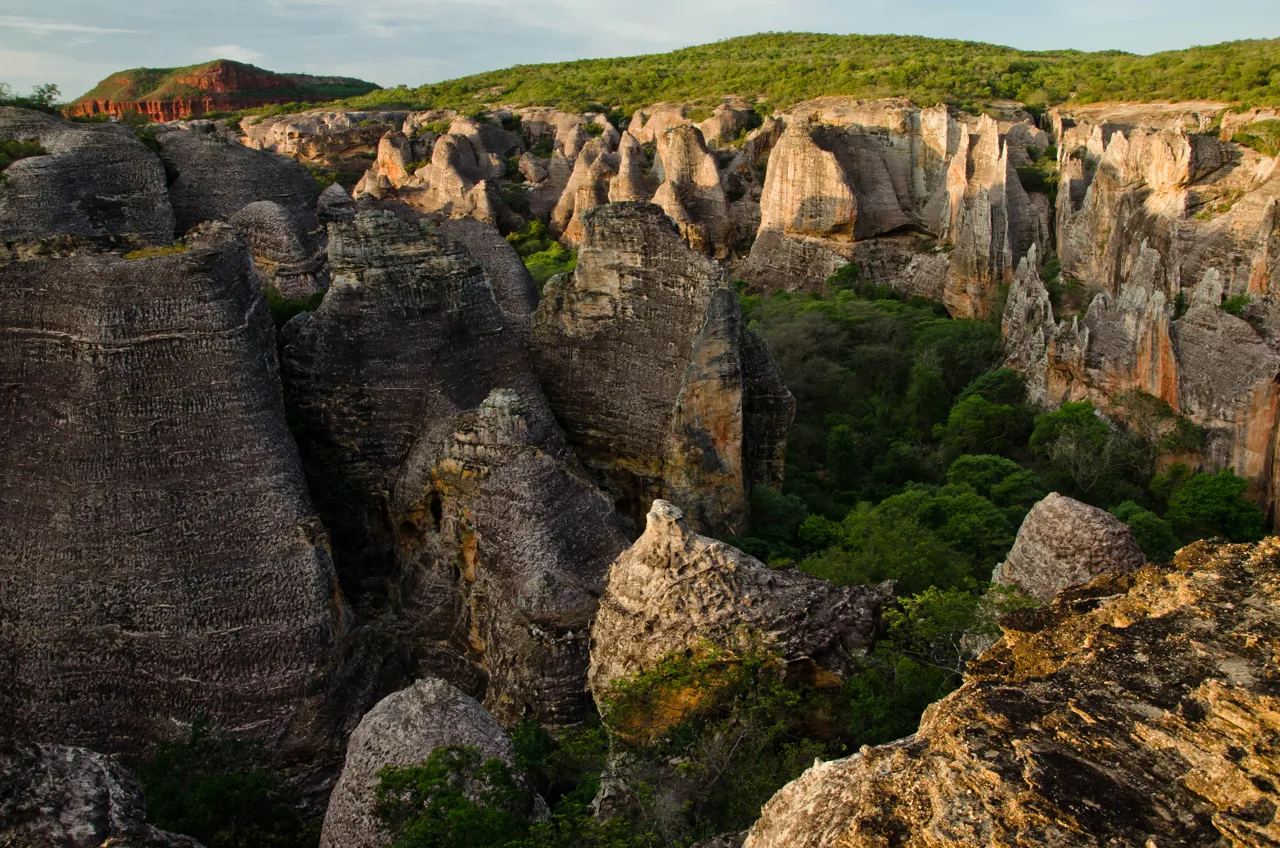
Deep in the sun-scalded caatinga of Piauí, the earth splits into a labyrinth of deep canyons and sandstone cliffs that guard the oldest art gallery in the Americas. Red ochre stick figures dance across rock shelters, depicting hunts, childbirth, and celestial battles that took place tens of thousands of years before the first European keel touched South American sand. This semi-arid wilderness feels ancient in a way that the Amazon does not, with its jagged mesas and the iconic Pedra Furada, a natural stone arch that frames the horizon like a doorway to another epoch. The surroundings are dry and carries the scent of baked stone and thorny scrub, creating a sharp, visceral stillness that is only broken by the occasional cry of a rock cavy.
Deep in the sun-scalded caatinga of Piauí, the earth splits into a labyrinth of deep canyons and sandstone cliffs that guard the oldest art gallery in the Americas.
History
Niède Guidon, a French-Brazilian archaeologist, arrived in this remote corner of northeast Brazil in the 1970s after being shown photos of rock paintings by local villagers. What she found challenged the long-held 'Clovis First' theory, suggesting that humans inhabited this landscape as far back as 50,000 years ago. Her decades of fierce advocacy led to the creation of the National Park in 1979, turning a neglected desert into a UNESCO-protected bastion of human history. The thousands of archaeological sites here represent a continuous record of human life, where prehistoric hunters used the naturally carved alcoves as canvases to document their daily reality and their deepest myths. Every charcoal smudge and ochre line tells the story of a people who thrived in a landscape that modern travelers find beautifully inhospitable.
Walking along the metal boardwalks that protect
Walking along the metal boardwalks that protect the delicate floor of the Boqueirão da Pedra Furada, The sheer verticality of the surrounding cliffs pressing inward. Right away you see how the light at mid-morning illuminates the iron-rich rock, making the ancient paintings glow with a startling, fresh clarity as if the pigment were applied only yesterday. The wind whistles through the crevices of the canyon, a low, melodic sound that underscores the absence of urban noise. Small lizards dart across the hot stone, their movements the only thing faster than the slow, geological crawl of the shifting sand. As the afternoon heat peaks, the shade of the rock shelters provides a cool, earthen sanctuary where you can sit and trace the silhouettes of giant sloths and armadillos that once roamed these plains. The sophisticated details in the art, such as the use of perspective and the depiction of communal rituals that suggest a complex social structure. Standing under the massive shadow of the Pedra Furada at dusk, There is a profound connection to the countless generations who watched the same sun set behind the same red mesas. It is a place that forces a quiet perspective on the scale of human time.
Reaching this prehistoric heartland requires
Reaching this prehistoric heartland requires a flight to the small airport in São Raimundo Nonato or a long, dusty drive from Petrolina. The final approach involves navigating roads that wind through the characteristic white forest of the caatinga, where the trees drop their leaves to survive the drought, leaving behind a ghost-like landscape of silver branches. Most who visit hire a local guide, often the children or grandchildren of the villagers who first led Niède Guidon to the sites, providing a layer of personal history to the archaeological wonder. The park's infrastructure is surprisingly modern, with well-maintained paths that lead you from the prehistoric silence back to the comfort of the Museum of Nature at the park's edge.
Reaching this prehistoric heartland requires a flight to the small airport in São Raimundo Nonato or a long, dusty drive from Petrolina.
The Experience
The heat in the canyon is a physical weight, but the moment you step into the shadow of a rock overhang, the temperature drops and the prehistoric world rushes in. You come across a rough, sandy texture of the canyon walls and notice the smell of dry earth and sun-bleached wood that defines the Piauí interior. The silence here is massive, interrupted only by the rhythmic clicking of your guide’s footsteps on the wooden stairs. Most visitors miss the way the paintings change color as the sun moves; a deer that looks faint at noon might burn a vivid blood-red by four in the afternoon. The tiny, hand-painted details of bows and arrows, realizing that the people who stood here thousands of years ago were observing the same thorny trees and jagged skylines you see today. It is a moment of deep, quiet recognition that stays with you long after you leave the dust of the park behind.
Why It Matters
Serra da Capivara is the most important concentration of prehistoric sites in the Western Hemisphere, serving as a vital archive of the earliest Americans. It challenges the colonial narrative of a 'new' world, proving that South America was a crowded center of culture and innovation long before the rise of the great Andean civilizations. Humanly, it represents the resilience of both ancient people and the modern scientists who fought to save their record from oblivion.
Why Visit
Check out this place because it is the closest you will ever come to a time machine. While the Amazon offers nature, Serra da Capivara offers the very beginning of the human soul in the Americas. You go to stand in a desert that was once a lush forest and realize that our ancestors were artists and storytellers long before they were subjects of history.
✦ Insider Tips
- 1
Ask your guide to take you to the 'Sítio do Meio' at sunset, where the rock formations create a natural amphitheater that captures the day's final golden light.
- 2
Visit the Museum of Nature at the park entrance first; its circular architecture helps you visualize the geological shifts of the region before you see the sites.
- 3
Carry at least two liters of water for even the shortest hikes, as the dry caatinga air dehydrates the body far faster than the humid coast.
- 4
Look for the 'Cerca do Elias' site to see some of the most complex and well-preserved group scenes in the entire park.
- 5
Stay in São Raimundo Nonato and eat at the local markets to try 'carne de sol' prepared in the traditional Piauí style.