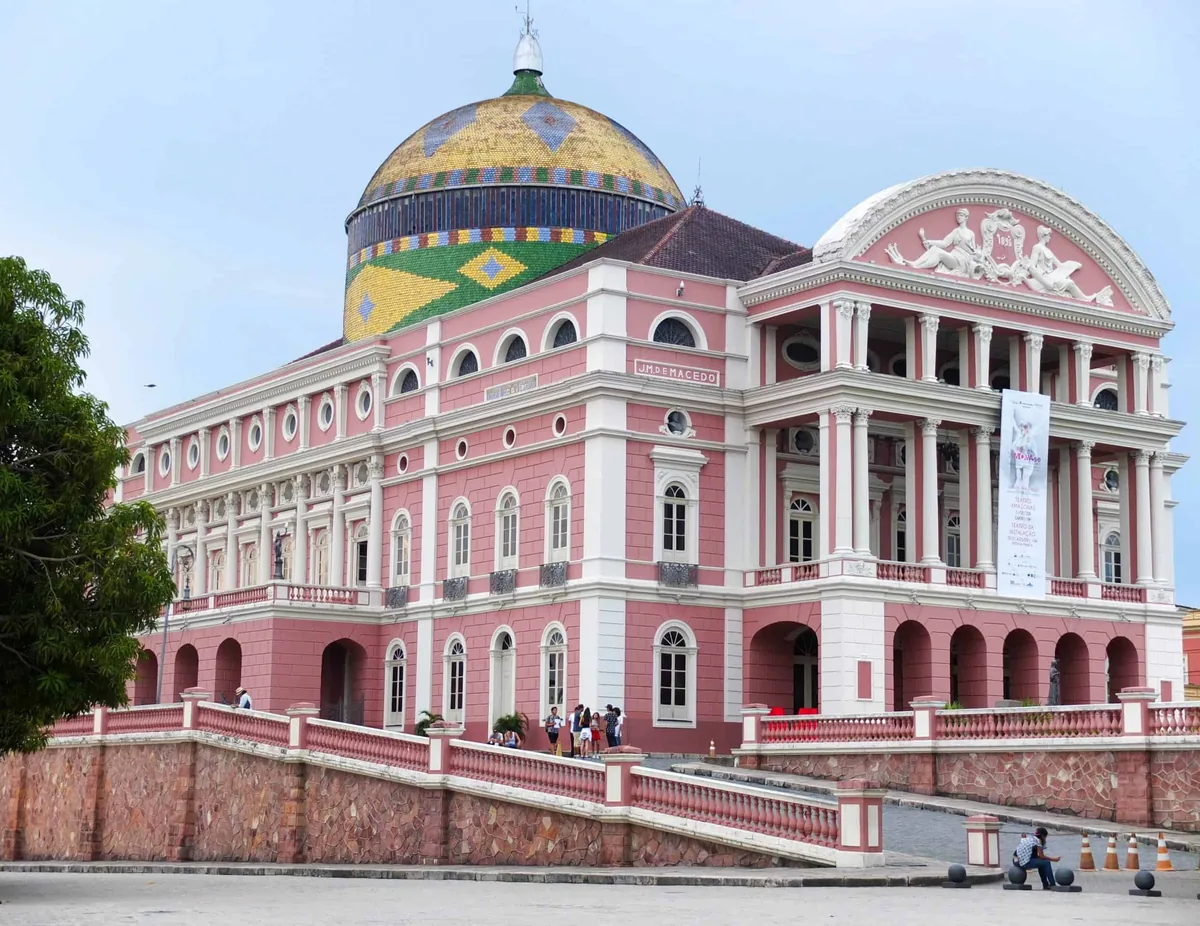
Thirty-six thousand mosaic tiles crown a dome so bright it was a navigational beacon for steamships carrying Parisian chandeliers deep into the sweltering heart of the jungle.
About Teatro Amazonas
Wealthy rubber magnates commissioned the theater in 1881, aiming to transform Manaus into a world-class cultural hub. They spared no expense, ordering Carrara marble for the staircases and Murano glass for the 198-piece central chandelier. The theater officially opened its doors on December 31, 1896, with a performance of La Gioconda, signaling the peak of the Amazonian Gilded Age. However, when the seeds of the Hevea brasiliensis tree were smuggled to Malaysia and the local rubber monopoly shattered, the theater fell into a period of melancholy neglect. It wasn't until a series of meticulous restorations in the late twentieth century that the frescoes and the iconic green-and-gold dome were returned to their former brilliance, allowing the Amazonas Opera Festival to revive the building's musical soul in 1997.
What Teatro Amazonas actually is
Deep within the emerald canopy of the world’s largest rainforest, a dome of thirty-six thousand glazed ceramic tiles in the colors of the Brazilian flag shimmers against the sweltering heat of Manaus. This Belle Époque masterpiece sits like a stranded jewel box at the center of a city carved out by the rubber boom. Its presence feels improbable, a pink sandstone temple of high European culture surrounded by the humid breath of the jungle and the vast, tea-colored waters of the Rio Negro. Stepping toward its entrance, the scent of rain-dampened tropical air gives way to the dry, aristocratic aroma of aged wood and velvet, signaling a transition into a world that once demanded tuxedos at the core of the tropics.
Commissioned by Architect Celestial
Rubber barons of the late nineteenth century possessed fortunes so vast they felt compelled to import an entire opera house from across the Atlantic to prove their civilization to the world. Ships arrived from Europe heavy with Italian marble for the stairs, French iron for the balconies, and English steel for the girders. Architect Celestial Sacardim envisioned a monument to the 'Paris of the Tropics,' and construction dragged on for fifteen years as the jungle fought back against every stone laid. When it finally opened in 1896, the legendary tenor Enrico Caruso was rumored to have performed, though the theater's glory was short-lived. As the rubber market collapsed and the wealthy fled back to Europe, the building sat silent for decades, its frescoed ceilings threatened by the very mold and humidity that characterize the Amazon basin.
The interior of the auditorium feels like being tucked inside a giant, gilded cello. Looking up, seeing the massive chandelier of Murano glass hanging beneath a ceiling painting that creates the illusion of being under the Eiffel Tower. The seats are made of jacaranda wood, a native timber that provides a deep, resonant warmth to the space. What registers is how the air feels remarkably still here, a deliberate contrast to the chaotic buzz of the surrounding markets and docks. During a performance, the acoustics are so precise that the softest rustle of a silk program can be heard from the nosebleed seats in the gallery. People generally forget to look down at the floor, where intricate marquetry blends different woods into patterns that mimic the swirling confluence of the local rivers. Navigating to the Praça São Sebastião is a passage through the gridlocked pulse of a city that lives and dies by its port. The theater sits on a square paved in black-and-white waves of limestone, a pattern that echoes the Meeting of the Waters just a few miles away. The walk across this plaza at midday can be blinding, but approaching the shadowed portico of the theater, the temperature seems to drop by design. Taking a local bus toward the 'Centro' district is the most authentic approach, allowing you to see the gritty reality of Manaus before being swept into the polished fantasy of the opera house.
The Experience
A heavy silence descends the moment you cross the threshold from the sun-scorched plaza into the cool, marble-clad foyer. The gravity of history in the velvet curtains, which were specifically designed to dampen the sound of tropical rain hitting the dome during performances. Initially, the intricate wall paintings that use local flora and fauna to reinterpret classical European themes, a subtle nod to the wilderness outside. The most haunting moment occurs in the empty ballroom, where the floorboards creak under your weight and the mirrors reflect a faded grandeur that feels both magnificent and deeply lonely. If you visit in the late afternoon, the low sun hits the stained-glass windows, casting long shadows of tropical birds across the Italian marble. It is a place of beautiful contradictions, where the art of the Old World is kept on life support by the energy of the New.
Why It Matters
Teatro Amazonas stands as the ultimate symbol of the rubber boom’s audacity and excess. It represents a brief, feverish moment in time when a remote river outpost became one of the wealthiest cities on the planet. Humanly, it matters because it has transitioned from a playground for the elite into a beloved civic icon that brings world-class opera to one of the most geographically isolated regions of the world.
Why Visit
You should visit because this is the only place on earth where you can watch a performance of Wagner while the calls of the rainforest echo just outside the doors. It offers a collision of worlds that shouldn't exist together, baroque opulence and untamed jungle, providing a sensory friction that you won't find in the opera houses of Milan or Vienna.
✦ Photo Gallery
Best Season
🌤 The ideal window is May to attend the Amazonas Opera Festival, when the acoustics are put to their best use and the humidity is slightly more bearable than the peak of summer.
Quick Facts
Best time to visit
The ideal window is May to attend the Amazonas Opera Festival, when the acoustics are put to their best use and the humidity is slightly more bearable than the peak of summer.
Getting there
In Manaus, Brazil; reach Manaus first, then continue to the site.
Location
Manaus, Brazil
Type
attraction
Insider Tips
- 1
Arrive an hour before a guided tour to sit in the square outside and watch the local 'tacacá' vendors serve spicy shrimp soup under the mango trees.
- 2
Book a seat in the lateral balconies rather than the center stalls to appreciate the hand-carved wood details and the proximity to the French ironwork.
- 3
Look closely at the masks on the balcony edges; they represent famous composers, though some were altered by the local craftsmen to look more like people they knew.
- 4
Visit the dressing rooms on the upper floors to see the original wicker furniture designed to allow air circulation in the pre-air-conditioning era.
- 5
Check the schedule for free rehearsals during the week, which allow you to experience the auditorium’s soul without the formal dress code of a gala night.