A former leper colony and high-security prison site, this car-free village now thrives as a sanctuary where the only sirens you hear are the melodic calls of tropical birds.
About Vila do Abraão
Vila do Abraão was once the first stop for thousands of European immigrants, who were detained at the Lazareto hospital in 1884 to prevent the spread of disease. By 1903, the facility evolved into a penal colony, and later, the infamous Cândido Mendes prison was established nearby, housing both common criminals and political prisoners during the military dictatorship. The prison was finally closed and imploded in 1994 by Governor Leonel Brizola, a move that essentially unlocked the island for the world. This transition from a place of confinement to a place of liberation is etched into the landscape, with the ruins of the prison and the aqueduct serving as silent witnesses to the island's secluded past. Today, the village maintains its rustic charm through strict environmental laws that prohibit the construction of large hotels or the introduction of motorized vehicles.
What Vila do Abraão actually is
Sandy streets devoid of car engines define the rhythmic soul of Vila do Abraão, the rustic capital of Ilha Grande. Positioned in a sweeping bay backed by the jagged, forest-clad peaks of the Serra do Mar, this village is an entry point to an island that has spent centuries perfecting the art of isolation. This space smells predominantly of salt spray and tropical fruit, occasionally punctuated by the scent of wood-fired ovens from local kitchens. Colorful schooners bob in the turquoise harbor while travelers navigate the unpaved lanes on foot or bicycle, their pace dictated by the tide rather than the clock. This settlement is a sensory bridge between the untamed Atlantic Forest and the warm waters of the Angra dos Reis archipelago.
“Sandy streets devoid of car engines define the rhythmic soul of Vila do Abraão, the rustic capital of Ilha Grande.”
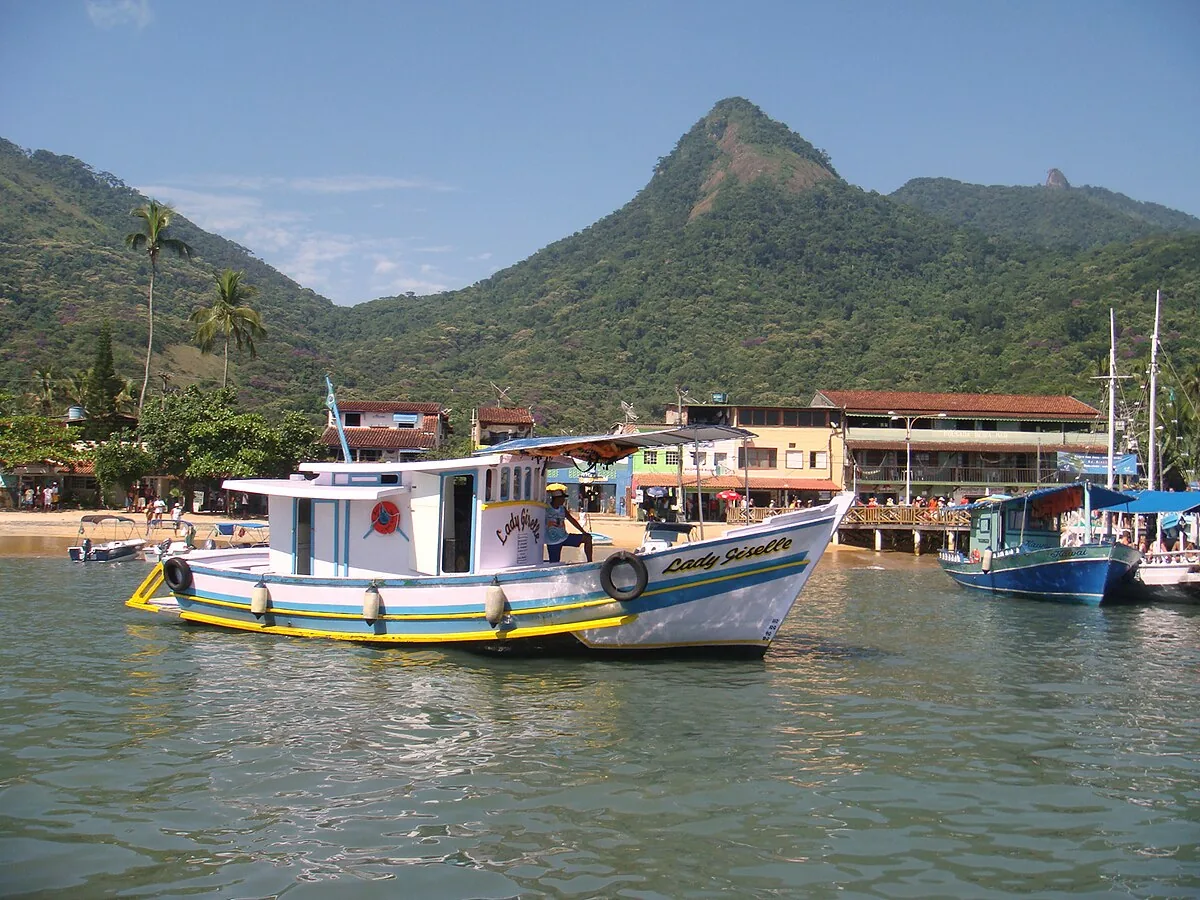
Vila do Abraão, Brazil
Abraão carries a history far darker than
Abraão carries a history far darker than its cheerful, sun-bleached facades suggest. In the late nineteenth century, the village was a quarantine station for immigrants arriving in Brazil, centered around the Lazareto, a lazaretto built to house those suspected of carrying cholera. This period of medical isolation was followed by an even grimmer chapter when the island became home to the Cândido Mendes high-security prison. For decades, the presence of the penitentiary acted as an accidental conservationist tool, deterring developers and keeping the island’s greenery pristine while the rest of the Rio coastline was rapidly urbanizing. Only after the prison’s demolition in 1994 did the village begin its metamorphosis into the eco-tourism hub it is today, though the ruins of the Lazareto remain on the outskirts, slowly being reclaimed by tangled roots.
The transition from the mainland boat
The transition from the mainland boat to the wooden pier of Abraão feels like a physical decompression. The absence of traffic noise immediately, replaced by the rhythmic crunch of sand underfoot and the melodic chatter of parakeets in the almond trees. Light filters through the dense canopy of the surrounding hills, casting long, emerald shadows over the village as the afternoon progresses. The surface of life here is found in the rough-hewn tables set directly on the beach, where you can dine with your toes in the cool sand as the tide nudges closer. Late evening brings a communal warmth to the central square, where live forró music often drifts from the bars, inviting a slow, swaying dance under the stars. The immense presence of the Pico do Papagaio towering behind the village, a granite sentinel that catches the first and last rays of the sun. While most visitors stay near the waterfront, walking just ten minutes inland reveals the ruins of the old aqueduct, where the humidity of the jungle intensifies and the sound of falling water provides a cool sanctuary. The element that stays with you is the walk back to your pousada at night, guided by the moon and the soft glow of lanterns, realizing that the modern world feels very far away. Arrival is strictly by sea, usually via a ferry or fast boat from Angra dos Reis, Mangaratiba, or Conceição de Jacareí. The crossing from Jacareí is the shortest, a fifteen-minute dash across the channel that deposits you directly into the vibrant chaos of the main pier. Since no private vehicles are allowed on the island, the only way to move your luggage to your accommodation is by hiring one of the local 'carreteiros', porters with brightly painted wooden carts who navigate the sandy alleys with practiced ease.
The Experience
The soundscape of Abraão is dominated by the gentle lap of water against the hulls of the schooners and the distant, echoing thud of a falling coconut. Right away you see how the village seems to expand and contract with the arrival of the ferries, yet it always returns to a state of sleepy equilibrium by mid-afternoon. Most visitors overlook the small stream that runs through the village, but following it inland leads to hidden pools where the water is ice-cold and crystalline. The mass of the shift in humidity as you leave the beach for the forest trails, the air becoming thick with the scent of damp moss and wild orchids. What truly defines the experience is watching the sunset from the beach, where the sky turns a dusty pink and the outline of the mountains becomes a jagged silhouette against the sea. It is a place that demands you slow down until your pulse matches the pace of the tide.
Why It Matters
Abraão matters as a successful experiment in sustainable living within a fragile ecosystem. It represents the cultural heart of the Atlantic Forest, preserving the 'caiçara' way of life while adapting to the demands of global tourism. Historically, it is born from how a landscape can be redeemed from a dark past of incarceration into a future of environmental conservation.
Why Visit
Visit Abraão to remember what a world without cars sounds like. While other coastal towns offer luxury, this village offers a raw, barefoot sophistication that you cannot find in the resorts of Rio. You come here to disappear into the trails and return to a village where the most important decision of the day is which schooner to board for a day of island hopping.
Insider Tips
- 1
Withdraw all the cash you need on the mainland, as there are no banks or ATMs on the entire island and power outages can occasionally disable credit card machines.
- 2
Hire a 'carreteiro' at the pier to transport your bags; the sandy streets are a graveyard for the wheels of traditional rolling suitcases.
- 3
Walk the trail to the Lazareto ruins at dawn to see the morning mist clinging to the stone arches before the day-trippers arrive.
- 4
Pack a reliable headlamp for walking back to your pousada at night, as street lighting is intentionally kept minimal to preserve the island's atmosphere.
- 5
Book a boat trip to Lopez Mendes early in the morning to enjoy one of Brazil's most famous beaches before the midday sun becomes too intense.