A 43-kilometre canal connecting Finland's largest lake system to the Gulf of Finland passes through territory ceded to Russia in 1940, still operating under a Finnish lease, still crossing an international border by water.
About Saimaa Canal
Opened in 1856 under Russian administration when Finland was a Grand Duchy, the Saimaa Canal was cut off when the southern section became Soviet territory in 1944. A lease agreement restored Finnish commercial access in 1968; the current lease extends to 2063.
The Saimaa Canal connects the Saimaa lake system , Finland's largest, a vast network of interconnected lakes covering the country's southeast, to the Gulf of Finland at Vyborg, passing through territory that was Finnish until 1940 and is now Russian. The canal runs 43 kilometres from Lappeenranta in Finland to Vyborg in Russia, with eight locks managing a height difference of 76 metres between the lake and the sea. Opened in its original form in 1856, rebuilt and expanded after World War II, and currently leased by Finland from Russia, it remains an active commercial waterway carrying timber and cargo.
“The canal runs 43 kilometres from Lappeenranta in Finland to Vyborg in Russia, with eight locks managing a height difference of 76 metres between the lake and the sea.”
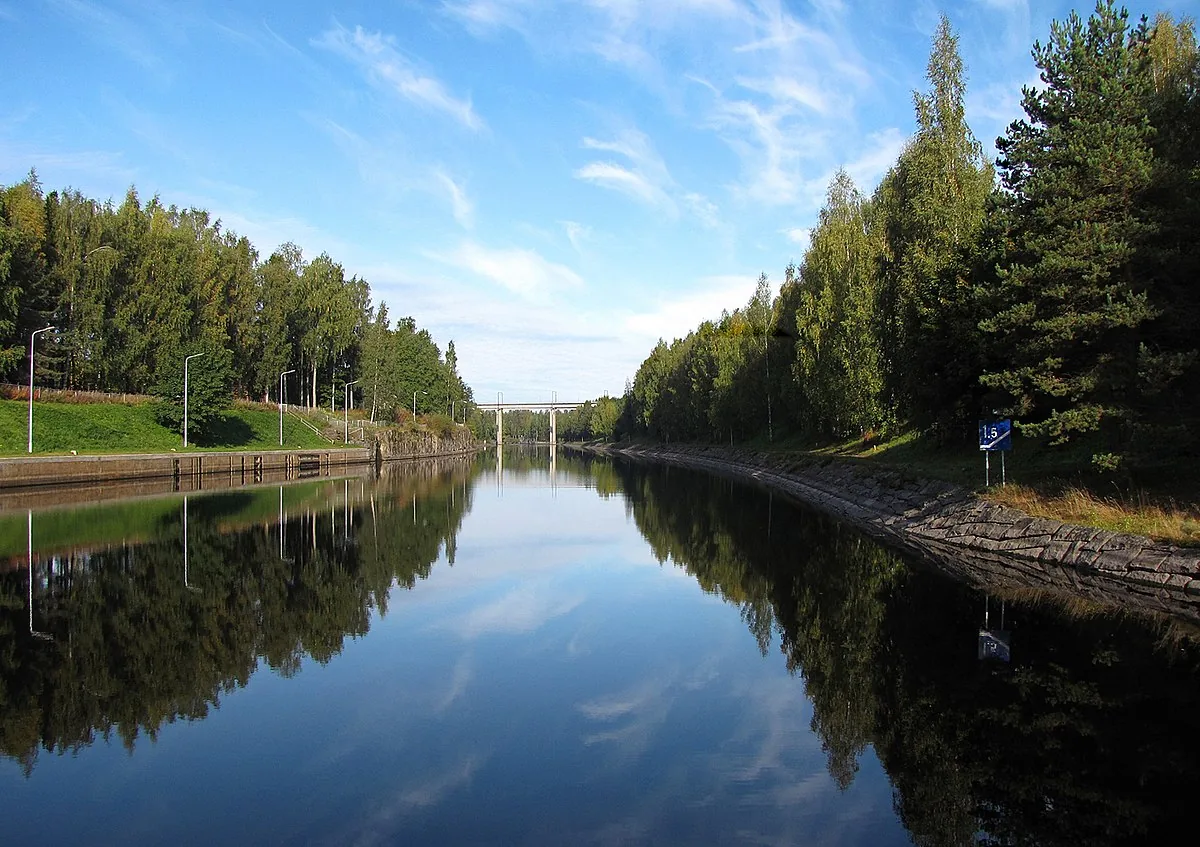
Saimaa Canal, Finland
The idea of connecting Saimaa to the sea had been discussed since the seventeenth century, the lake system's commercial potential, rich in timber and fish, was clear, but the political geography and engineering challenges delayed realization for two hundred years. The canal was finally built under Russian administration (Finland was then a Russian Grand Duchy) and opened in 1856. The Winter War and Continuation War of 1939-1944 resulted in Finland ceding the canal's southern section to the Soviet Union; the canal was closed for decades before a lease agreement allowed Finnish shipping to resume in 1968. The current lease runs until 2063.
Passenger cruise ships travel the full canal length from Lappeenranta to Vyborg in summer, offering a way to pass through the locks and cross the Russian border by water. The canal locks are impressive engineering, 43-metre chambers raising and lowering vessels through the topographic change. Lappeenranta, the Finnish end of the canal, has a summer harbor with market activity, a nineteenth-century fortress, and a beach that makes it a pleasant base. The Saimaa lake system itself, accessible by boat from Lappeenranta, is one of Finland's most extensive natural landscapes for boating and kayaking.
Lappeenranta is about two hours from Helsinki by train. Canal cruise bookings can be made through Finnish tour operators for summer departures; the Russia crossing requires a valid visa or Russian tourist permit.
“Lappeenranta is about two hours from Helsinki by train.”
The Experience
Travel the full canal on a summer passenger cruise from Lappeenranta to Vyborg through eight locks and across the Russian border, observe the lock engineering managing a 76-metre height difference, and use Lappeenranta's harbor and fortress as a base for Saimaa lake boating.
Why It Matters
One of Europe's most geopolitically complex waterways, an active commercial canal crossing an international border under a bilateral lease, connecting Finland's largest lake system to the Baltic Sea.
Why Visit
Passing through the Saimaa Canal locks by boat, watching the water level rise around you in a nineteenth-century stone chamber, is a specific engineering experience. The cross-border element, entirely by water, adds a dimension few European canal journeys offer.
Insider Tips
- 1
The Vyborg cruise requires a Russian visa or eVisa, plan the paperwork well in advance as processing times vary.
- 2
Lappeenranta's sand castle festival in summer turns the harbor beach into a temporary sculpture exhibition, an unexpected combination with the canal heritage.
- 3
Saimaa lake kayaking routes are extensive and well-documented; a multi-day kayak trip from Lappeenranta is one of Finland's finest paddling experiences.
- 4
The Saimaa ringed seal, one of the world's rarest seals, found only in this lake system, can occasionally be spotted on lake tours.