The mother church of Finland's Lutheran church has been a religious center since the country's Christianization in the twelfth century, and the Swedish queen buried here was born a common girl who became, briefly, Queen of Sweden.
About Turku Cathedral
Turku was Finland's historical capital and the cathedral its spiritual center. Bishop Henry, Finland's patron saint, is commemorated here. The 1827 great fire destroyed most of medieval Turku but left the cathedral standing; the subsequent restoration gave it its current neoclassical character.
What Turku Cathedral is
Turku Cathedral is the mother church of the Evangelical Lutheran Church of Finland and the most historically significant religious building in the country. Construction began in the late thirteenth century on a site that had been a religious center since Finland's Christianization, and the building has been modified and rebuilt multiple times, particularly after the great fire of Turku in 1827. The current appearance reflects both the medieval structure and the substantial nineteenth-century restoration work that followed the fire.
“Turku Cathedral is the mother church of the Evangelical Lutheran Church of Finland and the most historically significant religious building in the country.”
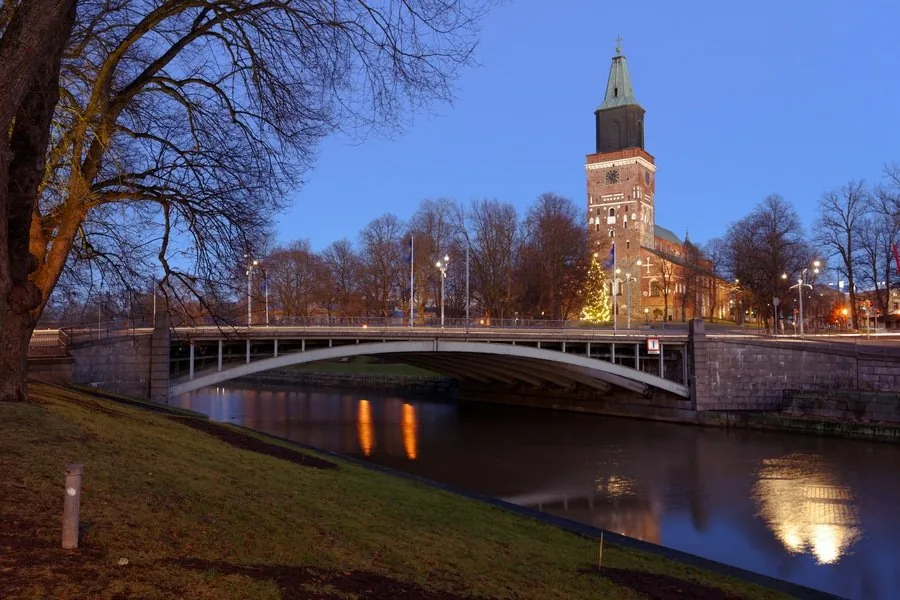
Turku Cathedral, Finland
Commissioned by Bishop Henry
Turku was Finland's most important city for most of its history, the seat of the bishop, the largest port, and the center of Swedish administration of Finland. The cathedral was the symbolic heart of this importance. Bishop Henry, the English-born missionary credited with Christianizing Finland in the twelfth century, is the patron saint of Finland and is commemorated here, his tomb and the altarpiece depicting his life are among the cathedral's most significant objects. The Reformation reached Finland in the sixteenth century and shifted the cathedral from Catholic to Lutheran use without major architectural modification. The 1827 fire, which destroyed most of medieval Turku, left the cathedral heavily damaged; the restoration gave it much of its current neoclassical interior character.
Background
The interior, tall and light-filled with neoclassical modifications sitting over a medieval structural skeleton, contains the tombs of several significant figures in Finnish history. Karin Månsdotter, the common-born wife of the Swedish king Erik XIV, who was briefly Queen of Sweden, is buried here, one of the most unusual royal tombs in Scandinavia. The medieval chapels retain fragments of original fresco painting. A museum in the cathedral presents the building's long history. The cathedral hill overlooking the Aura River is one of the oldest continuously inhabited sites in Finland. Turku is about two hours from Helsinki by train. The cathedral is a ten-minute walk from Turku's market square. Turku Castle is a fifteen-minute walk in the other direction, making both easily combined in a single day.
The Experience
Study the medieval chapel frescoes surviving beneath the neoclassical interior, find the tomb of Karin Månsdotter, the common-born Swedish queen, among the historical burials, and visit the cathedral museum covering thirteen centuries of Finnish religious history.
Why It Matters
The mother church of Finnish Lutheranism and the most historically loaded religious building in Finland, continuous religious use for over seven hundred years on a site active since the twelfth century.
Why Visit
The story of Karin Månsdotter, a commoner who became Queen of Sweden and ended her days buried in Turku, is one of the more unusual human narratives attached to any Scandinavian church. The medieval fresco fragments add an older layer to the more visible neoclassical interior.
Insider Tips
- 1
The cathedral museum in the galleries above the nave requires climbing stairs, ask at the entrance for access.
- 2
Karin Månsdotter's tomb is in a chapel on the south side; easy to walk past without noticing, look for the signage.
- 3
Combine the cathedral with Turku Castle (fifteen minutes' walk) and the medieval riverfront for a coherent full day.
- 4
The Aura River terrace restaurants below the cathedral hill are the standard Turku summer evening gathering point.