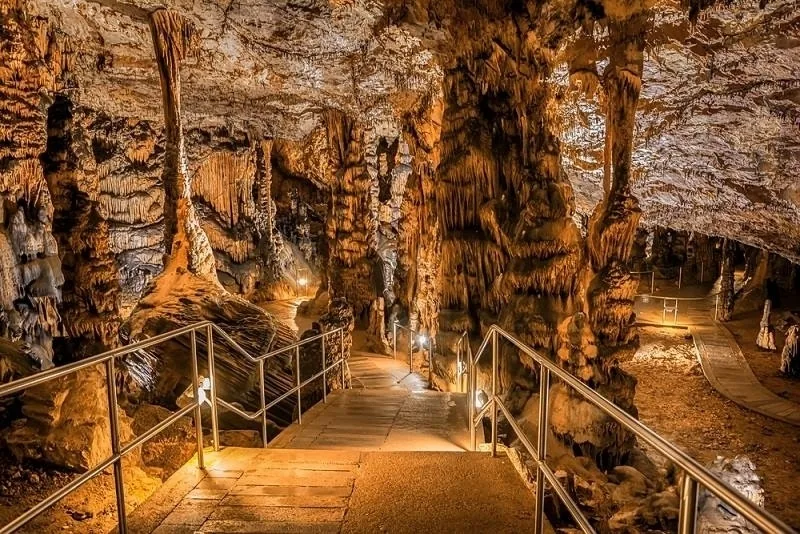
Silence here has a weight you can almost feel against your skin, punctuated only by a single drop of water that has taken a thousand years to travel through the limestone ceiling.
About Baradla Cave
Neolithic hunters once sat by fires at the cave’s mouth, leaving behind shards of pottery that remained undisturbed for over seven thousand years. The modern era of Baradla began in 1802 when the first professional survey was conducted, revealing a twenty-five kilometer network of tunnels that ignored the political boundaries of the surface. During the 19th century, it became a fashionable destination for the Austro-Hungarian aristocracy, who arrived in horse-drawn carriages to marvel at the dripstones by torchlight. These early tourists carved their names into the rock, a practice now forbidden but still visible in the soot-stained corridors. The cave’s survival through world wars and industrial expansion is a product of its remote location, tucked away in a corner of the country where the earth’s crust is thick enough to muffle the chaos of the surface. Since 1995, it has been protected as a World Heritage site, ensuring that the slow work of the Styx stream continues uninterrupted by human interference.
Baradla Cave
Deep within the limestone heart of the Aggtelek Karst, a subterranean cathedral carved by water over millions of years stretches across the border into Slovakia. Baradla Cave represents one of the most complex cave systems in the temperate zone, where the drip of mineral-rich water is the only metronome for a world that exists in eternal twilight. Here, the air here remains a constant ten degrees Celsius, smelling of damp earth and ancient minerals, a stark contrast to the humid Hungarian summer outside. Enormous stalactites hang like frozen chandeliers from ceilings that vanish into darkness, while the floor rises in bulbous, cauliflower-like formations of orange and white dripstone. Crossing these halls feels like navigating the digestive tract of the earth itself, a slow path through a silence so profound it makes the sound of your own breathing seem intrusive.
Humans have sought shelter
Humans have sought shelter in the mouth of Baradla since the Neolithic age, as evidenced by the blackened pottery and stone tools found near its entrance. The first written mention dates back to 1549, but it wasn't until the early 19th century that explorers like József Vass began to map the labyrinth in earnest. Vass famously spent days underground with nothing but a tallow candle and a compass, documenting the colossal chambers that would later bear his name. In the 1920s, engineers realized the acoustic potential of the cavernous 'Concert Hall,' installing a stage and seating to host performances where the stone walls provided a natural reverb no architect could replicate. The cave was eventually designated a UNESCO World Heritage site in 1995, recognizing it not just as a geological marvel but as a crucial repository of prehistoric history and unique cave-dwelling fauna.
Entering the cave through the Aggtelek portal , the world of light and wind is instantly replaced by a heavy, cool stillness. The surface of the handrails, slick with moisture, and the way the shadows dance against the jagged walls as the electric lights illuminate specific formations. The highlight of the journey is the Giants’ Hall, a space so immense that the torchlight barely reaches the ceiling, making like a speck of dust in a giant’s treasury. The rhythmic plink of water hitting a stagnant pool, a sound that has echoed through these chambers for millennia without change. Visitors often overlook the tiny, pale blind creatures that scuttle in the crevices, perfectly adapted to a life without a single ray of sun. The experience culminates in a moment of total darkness if the guide douses the lights, revealing a sensory vacuum that forces you to listen to the heartbeat of the mountain.
Reaching the cave requires a journey
Reaching the cave requires a journey into the northern tip of Hungary, about a three-hour drive from Budapest through rolling hills and small, quiet villages. Those visiting head for the main entrance at Aggtelek, though the Jósvafő entrance offers a shorter, equally dramatic path into the system. Local buses run from Miskolc, but the schedule can be sparse, making a car the preferred method for those who want to arrive before the tour groups. The border crossing into Slovakia at the Domica cave entrance is seamless, allowing you to walk into a different country underground if you choose the longest and most adventurous trekking tours.
The Experience
The humidity rise the deeper you descend, a paradox given the dropping temperature that makes your breath bloom in front of you. The lighting is deliberate, casting long, dramatic shadows that make the stalagmites look like petrified sentinels guarding the path. You register that the stone is rarely just grey; it ripples with hues of rust, cream, and deep ochre, colored by the various minerals dissolved in the mountain’s veins. In the Concert Hall, the guide often plays a short musical clip, and you notice how the sound wraps around you, enriched by the porous stone until it feels like the music is coming from inside your own head. It is a place that demands a slower pace, where every step reveals a new frozen waterfall of stone that most people walk past without a second glance.
Why It Matters
Baradla is the undisputed king of Central European caves, a geological masterpiece that has been a sanctuary for life since the Stone Age. It matters because it is one of the few places on the continent where the Earth’s evolutionary process is so visibly displayed, from the slow growth of calcite to the unique adaptation of cave-dwelling species. Culturally, it bridges the gap between Hungary and Slovakia, reminding us that nature does not recognize the lines we draw on maps.
Why Visit
Go because Baradla offers a scale of grandeur that makes the most ornate cathedrals feel like dollhouses. While the baths of Budapest are relaxing, the caves of Aggtelek are transformative, offering a rare encounter with the sheer, slow power of geological time. You won't find a more profound silence anywhere else in the country, nor a place that makes the modern world feel so fleeting and quiet.
✦ Photo Gallery
Best Season
🌤 Summer is the best time to visit, not for the weather inside which never changes, but for the relief of escaping the thirty-degree heat into the natural air conditioning of the abyss.
Quick Facts
Best time to visit
Summer is the best time to visit, not for the weather inside which never changes, but for the relief of escaping the thirty-degree heat into the natural air conditioning of the abyss.
Getting there
In Aggtelek, Hungary; reach Aggtelek first, then continue to the site.
What's nearby
Tokaj Wine Region, Hortobágy National Park and Royal Palace of Gödöllő are also in the area.
Location
Aggtelek, Hungary
Type
attraction
Coordinates
48.4667°, 20.5000°
Insider Tips
- 1
Wear a wool mid-layer even in August, as the ten-degree dampness will seep into your bones within twenty minutes.
- 2
Book the 'Special Adventure Tour' weeks in advance if you want to swap the paved paths for a helmet and a headlamp to crawl through the unlit sections.
- 3
Look for the 'Dragon’s Head' formation near the Aggtelek entrance, which is arguably the most anatomically correct rock sculpture in the system.
- 4
Keep your hands off the formations; the oils from your skin can permanently stop the growth of a stalactite that has been growing since before the Roman Empire.
- 5
Visit the nearby village of Jósvafő after your tour to see the Hucul horses, a rare breed of mountain pony that looks like it stepped out of a prehistoric cave painting.