Forty million bricks and nearly a hundred pounds of pure gold hold this limestone leviathan together, yet the architect who designed it never saw the finished work before he went blind.
About Hungarian Parliament Building
The dawn of the 1880s brought a fierce desire for a symbol that could match the burgeoning ego of Budapest. Imre Steindl beat out his rivals by proposing a structure that combined the verticality of Gothic spires with the grounded symmetry of a Renaissance dome. Work began in 1885, employing thousands of workers who carved intricate stone lace from porous limestone, a choice that gave the building its ethereal glow but left it permanently susceptible to the corrosive touch of city air. By the time the building was inaugurated for the 1896 millennium celebrations, it had become the third-largest parliament in the world. It survived the siege of 1944 and the bullet-riddled days of the 1956 Revolution, though the red star that once capped the dome during the communist era was unceremoniously removed in 1990. Today, the scars of history are hidden behind meticulous restorations that ensure the gold leaf never loses its luster.
Crossing the Margaret Bridge as dusk settles over
Crossing the Margaret Bridge as dusk settles over the Danube reveals a structure that seems less like a government office and more like a fever dream of the Gothic era. Forty kilograms of 24-carat gold leaf coat the interior, yet the building feels anchored by the heavy, humid scent of the river. This limestone giant, sprawling across nearly 18,000 square meters, is the permanent anchor of the Pest skyline. While most administrative buildings project a cold, functional stoicism, the Országház radiates a warmth fueled by a thousand years of Hungarian identity and the ambitious spirit of the 19th-century twilight.
“Crossing the Margaret Bridge as dusk settles over the Danube reveals a structure that seems less like a government office and more like a fever dream of the Gothic era.”
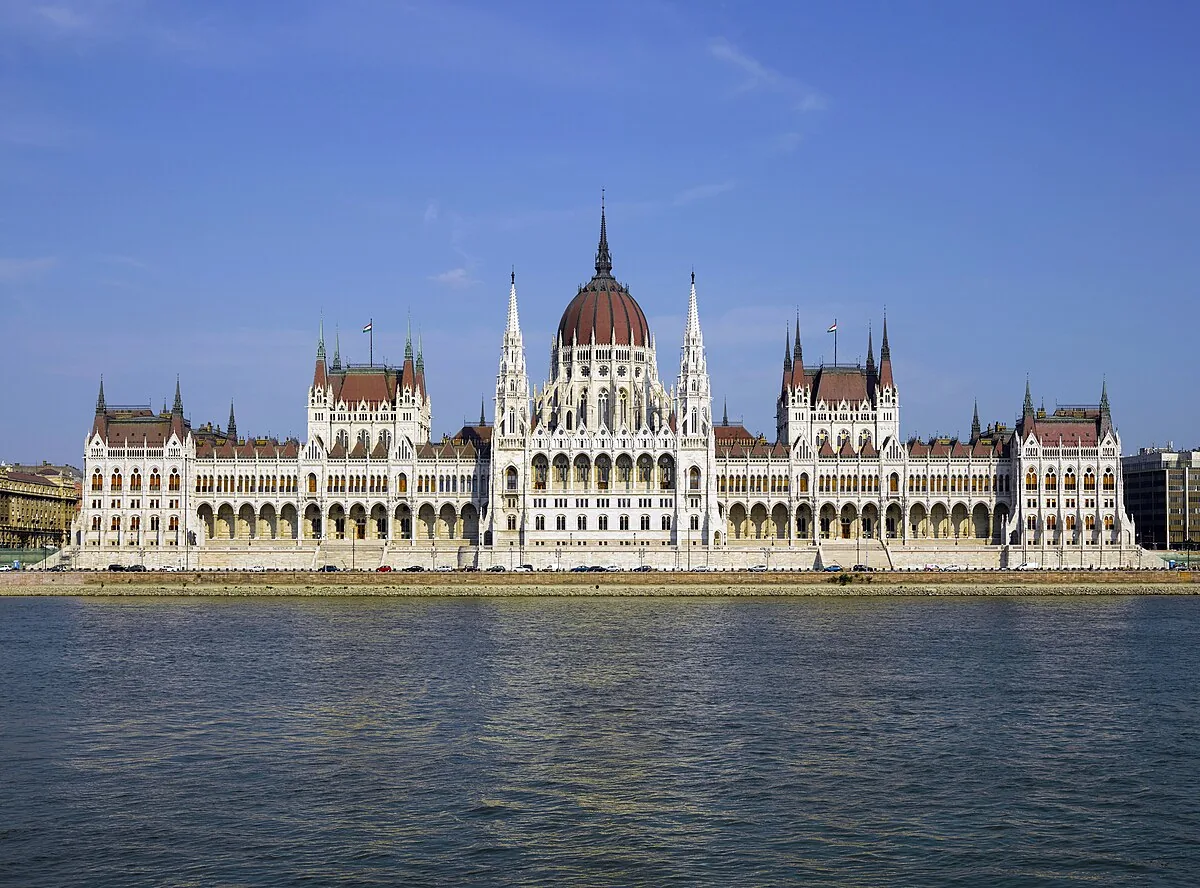
Hungarian Parliament Building, Hungary
the design competition, 1885
Imre Steindl, the architect who won the design competition in 1885, never lived to see his masterpiece completed. He went blind shortly before the final stones were laid, a tragic irony for the man who choreographed this visual symphony. The construction required a literal village of craftsmen and ten years of labor to finish the exterior alone. Steindl chose a Neo-Gothic style to echo London’s Westminster, signaling Hungary’s desire to be seen as a modern, democratic European power. Every piece of material, from the slag used in the foundation to the frescoes on the ceiling, was sourced from within the borders of the Hungarian Kingdom. The only exception remains the eight monolithic granite columns flanking the grand staircase, which were hauled from the distant quarries of Egypt.
Stepping through the heavy bronze doors , the air cools instantly, carrying a faint metallic tang from the gilding and the centuries-old stone. The Grand Staircase demands a slow ascent, framed by crimson carpets and ceiling frescoes that depict the allegories of governance. In the Hexadecagonal Central Hall, the atmosphere shifts from ceremonial to sacred. Here, the Holy Crown of St. Stephen sits beneath the dome, guarded by soldiers who stand so still they appear carved from the same marble as the walls. Dust motes dance in the shafts of light piercing the stained glass, illuminating the 242 statues of Hungarian rulers and commanders who watch over the proceedings. Audible here is one of hushed whispers and the rhythmic click of heels on polished parquet, punctuated by the occasional chime of a clock from the legislative chambers.
Arrival by the M2 metro line
Arrival by the M2 metro line at Kossuth Lajos tér offers the most dramatic reveal as you emerge from the underground directly into the shadow of the dome. Alternatively, the Number 2 tram provides a cinematic approach, rattling along the riverbank and offering a panoramic view of the facade’s 365 towers. Walking from the Chain Bridge at sunset allows the building to grow in scale with every step, the white limestone turning a bruised purple before the floodlights ignite the gold. Access to the interior requires pre-booked tickets, as the strict security measures and the active sessions of the National Assembly mean only small, guided groups can navigate the labyrinth of 691 rooms.
“Arrival by the M2 metro line at Kossuth Lajos tér offers the most dramatic reveal as you emerge from the underground directly into the shadow of the dome.”
The Experience
Standing beneath the 96-meter dome, you notice a strange silence that defies the bustle of the city outside. The light filters through windows designed by Miksa Róth, casting deep jewel tones across the marble floors. The gravity of a thousand years of history concentrated in the glass case holding the crown, where the air feels thick with the gravity of national identity. Look closely at the window sills in the corridors; you will find numbered cigar holders made of brass, remnants of a time when parliamentarians would leave their Havanas burning outside while they rushed in to vote. The smell is a mixture of floor wax, old paper, and the damp breeze off the Danube that sneaks in whenever a side door opens.
Why It Matters
Beyond the sheer architectural bravado, the building acts as a physical manifesto of Hungarian survival. It was built during the Austro-Hungarian height to prove that Budapest was a capital in its own right, not just a provincial shadow of Vienna. The number 96 recurs throughout its dimensions, marking the year 896 when the Magyar tribes first settled the Carpathian Basin, turning a government office into a massive limestone monument to a millennium of endurance.
Why Visit
Ignore the postcards that suggest you have seen it all from the outside. Entering the Parliament is the only way to understand the scale of 19th-century ambition, where even the ventilation shafts were works of art. While the Fisherman's Bastion offers a view, the Parliament offers a pulse. It is a rare chance to walk through a living relic that still functions as the beating heart of a nation’s lawmaking.
Insider Tips
- 1
Book the earliest morning tour to see the sun hitting the gilding in the Grand Stairway before the crowds dull the light.
- 2
Look for the shrapnel scars on the Ministry of Agriculture building directly across the square, a haunting contrast to the Parliament's polished exterior.
- 3
Check the legislative calendar; the changing of the guard ceremony is far more elaborate on national holidays.
- 4
Walk to the Batthyány tér station across the river at night for the only perspective that captures the building's perfect symmetry reflected in the water.
- 5
Study the copper cigar rests in the halls; the numbers allowed deputies to find their specific smoke after a heated debate.