Europe’s largest synagogue was designed by a Christian architect in a Moorish style to resemble an oriental palace, yet its courtyard is a somber graveyard for those who never left the ghetto.
About Dohány Street Synagogue
The mid-1800s in Budapest was a time of radical optimism for the Jewish community, who sought to build a house of prayer that reflected their growing status in Hungarian society. Ludwig Förster’s design was a masterpiece of the Neolog movement, blending Islamic architectural motifs with the structural requirements of a modern European cathedral. The synagogue opened in 1859, a symbol of a community that felt truly at home in the Austro-Hungarian Empire. This era of peace ended violently in 1944 when the building was used as a base for the pro-Nazi Arrow Cross Party and later as a crowded refugee center within the ghetto walls. Thousands of people who died during that brutal winter were buried in the synagogue’s own garden, violating religious tradition out of grim necessity. After decades of neglect during the socialist period, the synagogue underwent a total transformation in the late twentieth century, re-emerging as the shimmering cultural heart of the district.
What Dohány Street Synagogue actually is
Standing before the twin octagonal towers of the Great Synagogue, one is immediately struck by the Moorish geometry that seems to transport a slice of North Africa into the heart of Jewish Budapest. The red and yellow brickwork creates a shimmering striped effect under the afternoon sun, capped by copper domes that have aged into a deep, earthy green. This massive structure, the largest of its kind in Europe, anchors the Seventh District with a presence that is simultaneously celebratory and somber. While the exterior radiates the confidence of the mid-nineteenth century, the courtyard holds the heavy silence of the Holocaust. It acts as a living bridge between the architectural flamboyance of the Neolog movement and the tragic echoes of the wartime ghetto.
“Standing before the twin octagonal towers of the Great Synagogue, one is immediately struck by the Moorish geometry that seems to transport a slice of North Africa into the heart of Jewish Budapest.”
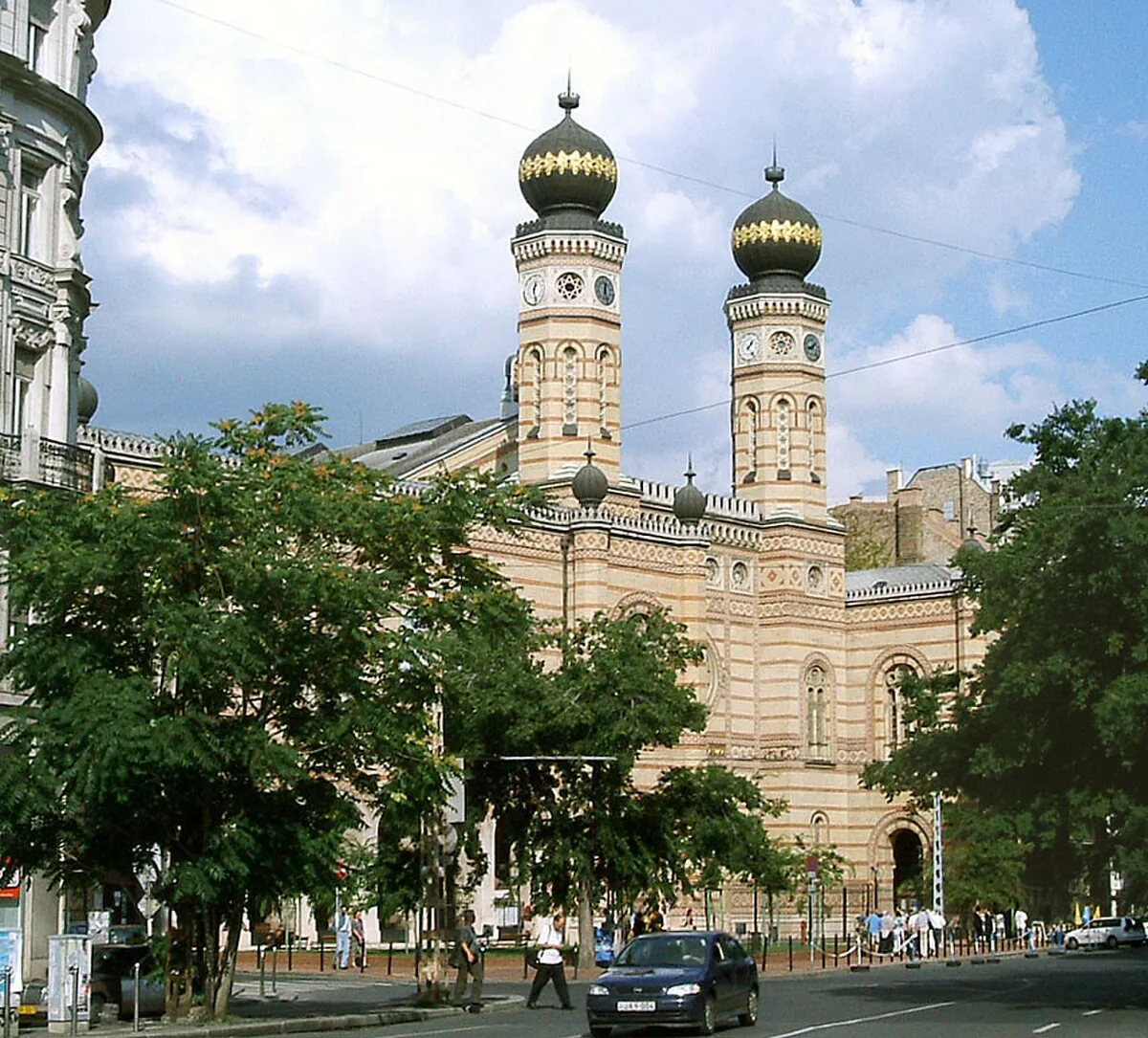
Dohány Street Synagogue, Hungary
Ludwig Förster, a Viennese architect, won
Ludwig Förster, a Viennese architect, won the commission to build this sanctuary in 1854, completing the monumental task in just five years. He chose a Romantic-Moorish style to honor the Middle Eastern roots of the Jewish people, yet he incorporated a pipe organ and a pulpit, reflecting the progressive, integrationist spirit of the Budapest Neolog community. The interior decoration fell to Frigyes Feszl, who swathed the walls in intricate geometric patterns that mirror the complexity of a Persian carpet. During the dark winter of 1944, the synagogue found itself trapped within the boundaries of the Budapest Ghetto, serving as a shelter and eventually a cemetery for thousands who perished from cold and hunger. In the post-war years, the building fell into a state of elegant decay until a massive restoration in the 1990s, funded largely by the diaspora, polished the gold leaf and repaired the stained glass to its former brilliance.
Walking into the nave, the sheer scale of the three-aisled interior forces the chin upward toward the glittering chandeliers and the vast, vaulted ceiling. What registers is the scent of old wood and the faint, cold metallic tang of the gilding that covers nearly every surface. The light filters through the high windows in dusty beams, illuminating the five thousand pipes of the grand organ that Franz Liszt once played. Moving toward the rear of the complex, the atmosphere shifts abruptly entering the Raoul Wallenberg Memorial Park. Here, the 'Tree of Life' functions as a metallic willow, its silver leaves inscribed with the names of the dead. Sound-wise is the soft clinking of the leaves in the wind, a sound like distant wind chimes that cuts through the hum of city traffic. The grandeur of the sanctuary meets the intimate sorrow of the mass graves in the courtyard, a rare instance where a place of worship also is a cemetery.
Reaching the synagogue involves a short walk
Reaching the synagogue involves a short walk from the Astoria metro station on the M2 line, or a journey on the 47 or 49 yellow trams that rattle along the Károly körút. The entrance sits at the intersection of Dohány Street and Wesselényi Street, marking the route into the Jewish Quarter. Most people arrive on foot from Deák Ferenc tér, allowing the transition from the modern city center to the historic cobblestones of the Seventh District to unfold slowly. Security is understandably tight, so expect a brief wait at the metal detectors before the red brick facade reveals its secrets.
“Reaching the synagogue involves a short walk from the Astoria metro station on the M2 line, or a journey on the 47 or 49 yellow trams that rattle along the Károly körút.”
The Experience
You feel a sudden hush as you pass from the chaotic traffic of the Small Boulevard into the cool, cavernous sanctuary. The acoustic quality of the space is legendary; even a whisper seems to travel up into the painted galleries where women once sat. The intricate star-shaped motifs on the ceiling, a dizzying array of blue and gold that feels like looking up into a geometric night sky. Behind the building, the 'Tree of Life' memorial offers a tactile contrast, its cold steel branches heavy with the names of families lost. You hear the rustle of these metal leaves, a haunting sound that remains long after you leave. It is a sensory journey that begins with the awe of royal architecture and ends with a profound, quiet reflection on human resilience.
Why It Matters
Dohány Street Synagogue is the spiritual epicenter of Central European Jewry and a monument to the complex identity of the Neolog movement. It matters because it is still a physical archive of both the highest achievements of Hungarian Jewish culture and the deepest scars of the Holocaust. It remains one of the few places in the world where the architecture of the nineteenth century and the memorials of the twentieth speak to one another with such clarity.
Why Visit
See this synagogue for the sheer paradox of its beauty and its pain. While the Parliament across town shows you the political power of Hungary, the Dohány Street sanctuary shows you the cultural soul of a community that survived against all odds. You come for the architecture that looks like the Alhambra, but you stay for the silver willow tree that sings in the wind.
Insider Tips
- 1
Look for the small, circular stained glass windows in the sanctuary that contain hidden geometric puzzles of Hebrew letters.
- 2
Visit the cemetery in the garden to see the only place in Jewish law where the dead are buried next to a house of worship, a permanent exception granted due to the war.
- 3
Book a guided tour in the late afternoon when the light through the Ark of the Covenant creates a glowing effect on the sanctuary floor.
- 4
Check the schedule for organ concerts; hearing the instrument Liszt and Saint-Saëns once played is an experience that goes beyond the typical tour.
- 5
Notice the bullet holes in the nearby apartment buildings on Wesselényi Street, preserved as silent witnesses to the 1944 ghetto battles.