Exactly twelve thousand square meters of red brick rose from the mud of a catastrophic flood to create a plaza with acoustics so perfect a whisper can travel the length of a cathedral.
About Dóm Square
Szeged’s residents pledged to build a landmark of unprecedented scale after the Tisza River breached its banks in 1879, leaving only three hundred houses standing. Construction of the Votive Church began in 1913, but the outbreak of World War I halted progress, leaving the skeletal towers to haunt the skyline for years. When work resumed in the late 1920s, the vision expanded from a single church to a total architectural environment. Architect Béla Rerrich was tasked with creating a space that could serve as both a religious center and a home for the university that had been exiled from Cluj-Napoca. He chose a dark, durable brick and a Romanesque-inspired aesthetic that stood in stark contrast to the colorful Secessionist style prevalent in the rest of the city. The completion of the square in 1932 coincided with the first season of the Open-Air Festival, cementing the site's role as a cultural forum that has survived through every political shift of the twentieth century.
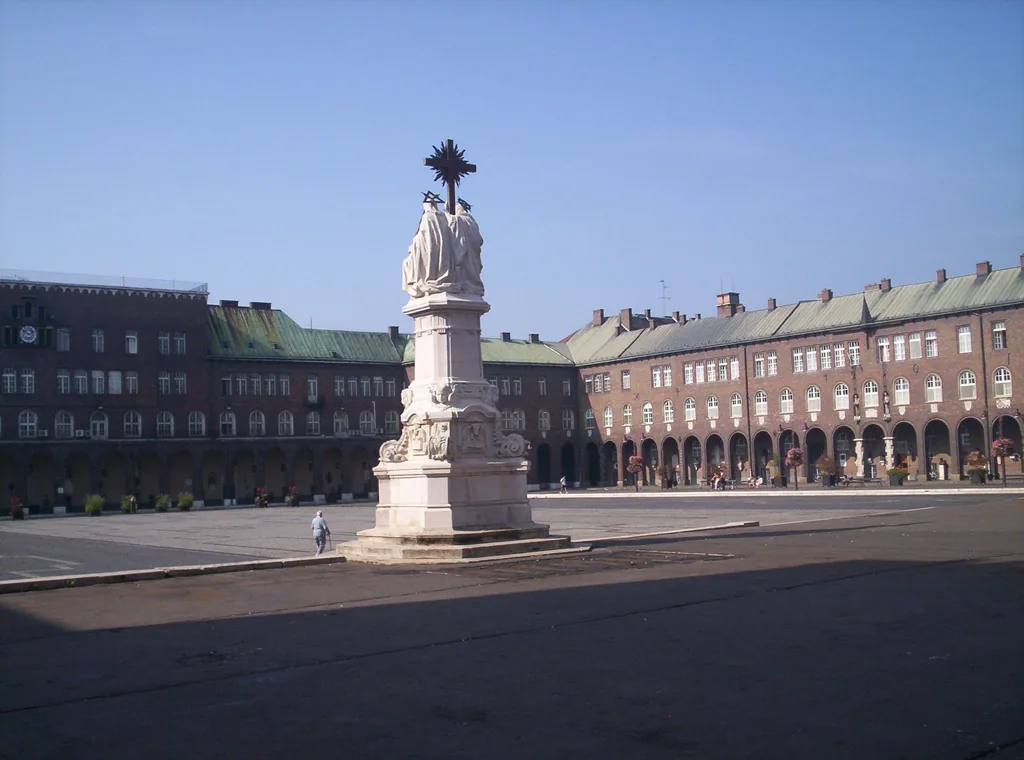
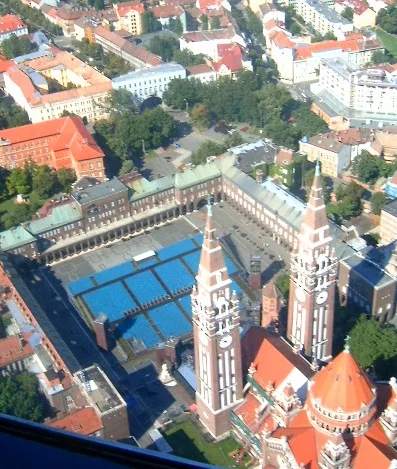
Encircled by red-brick arcades that mirror the somber elegance of a Venetian piazza, Dóm Square serves as the intellectual and spiritual anchor of Szeged. The space possesses a geometric precision that feels both expansive and protective, dominated by the towering twin spires of the Votive Church. Walking across the vast expanse of dark paving stones, you feel the heat of the southern sun radiating back from the masonry, even as the shadows of the surrounding university buildings offer a cool reprieve. The air here is often filled with the chime of the musical clock or the distant hum of students moving between lectures. This square was born of a great tragedy, yet it has become a stage for the city’s greatest triumphs, acting as an open-air cathedral where the lines between academic rigor and religious devotion blur into a single, cohesive masterpiece of urban design.
“Encircled by red-brick arcades that mirror the somber elegance of a Venetian piazza, Dóm Square serves as the intellectual and spiritual anchor of Szeged.”

Dóm Square, Hungary
Destruction provided the canvas for this remarkable site when the Great Flood of 1879 nearly erased Szeged from the map. The city’s survivors made a solemn vow to construct a monumental church if their home could be rebuilt, leading to the eventual creation of the Votive Church. Architect Béla Rerrich designed the square between 1929 and 1932, envisioning a unified complex that would house the bishopric, the university, and the theological college. He drew inspiration from the enclosed courtyards of Northern Italy, using millions of dark clinker bricks to create a texture that feels aged and resilient. The square also incorporates the Demetrius Tower, a lonely remnant of a twelfth-century church that was discovered only when its younger, larger successor was being cleared away. This layer of medieval stone provides a silent counterpoint to the twentieth-century bricks, anchoring the modern square to a past that the flood could not wash away.
You notice the specific rhythm of the square most clearly when the clock strikes the hour, and the mechanical figures of the musical clock emerge to a folk melody. The acoustics of the brick enclosure are so perfect that even a quiet conversation on the far side of the plaza seems to float toward you with startling clarity. Under the arcades, you feel the texture of the 'Pantheon,' a collection of statues and reliefs honoring Hungary’s greatest thinkers, poets, and scientists. The light changes dramatically at twilight, when the red bricks deepen to a dark crimson and the Votive Church is illuminated from below, its twin towers reaching into the indigo sky like beacons. During the summer, the square transforms entirely as the massive grandstands of the Open-Air Festival rise to meet the facade of the cathedral. You hear the rustle of evening gowns and the tuning of an orchestra, a sophisticated soundscape that turns the brick plaza into Europe's largest outdoor theater. Most visitors overlook the small brass studs in the pavement that mark the high-water line of the flood, a chilling reminder of the river’s power.
Trains depart every hour from Budapest’s Nyugati station, reaching Szeged in just over two hours across the flat, sun-drenched expanses of the Great Plain. From the Szeged railway station, a short ride on the Number 1 or 2 tram brings you directly to the edge of the historic center. Walking from the banks of the Tisza River takes less than five minutes, leading you through narrow streets that suddenly open into the breathtaking scale of the square. Driving from the capital via the M5 motorway is equally efficient, offering a direct route that deposits you in a city where the Mediterranean pace of life is immediately apparent in the crowded cafes surrounding the plaza.
“Trains depart every hour from Budapest’s Nyugati station, reaching Szeged in just over two hours across the flat, sun-drenched expanses of the Great Plain.”
The Experience
You notice the temperature change as you step from the open, sun-baked center of the square into the deep shade of the surrounding arcades. The smell of sun-warmed brick and old stone is pervasive, occasionally cut by the scent of roasting coffee from a nearby university haunt. You feel the history of the nation through the bronze and stone faces in the Pantheon walkway, where the eyes of Nobel laureates and revolutionaries follow your progress. You hear the deep, bronze tolling of the 'Heroes Bell,' which sounds with a frequency that seems to vibrate through the very pavement beneath your boots. The moment that stays with you is standing in the exact center of the plaza at night; the enclosure is so complete that the rest of the city disappears, leaving only the illuminated towers and the stars above. It is a rare urban experience where the architecture succeeds in making you feel both tiny and profoundly connected to a larger human story.
Why It Matters
Dóm Square is the premier example of twentieth-century integrated urban planning in Hungary, celebrated for its stylistic unity and symbolic power. It represents the physical manifestation of a community's resilience in the face of natural disaster and its subsequent commitment to education and the arts. Culturally, it is the spiritual home of Hungarian drama and music, hosting performances that have defined the country's theatrical landscape for nearly a century.
Why Visit
Visit Dóm Square because it offers a sense of architectural harmony that is practically vanished in the modern world. While other European squares are a jumble of eras, this red-brick sanctuary feels like a single, massive sculpture that you can walk inside. You come for the cathedral, but you stay for the atmosphere of an intellectual colony where every archway tells a story of survival.
Insider Tips
- 1
Wait for the musical clock to perform at 12:15 or 17:45 to see the wooden figures of university students and professors emerge from the facade.
- 2
Look for the entrance to the Demetrius Tower near the cathedral; it is the oldest structure in the city and contains a hidden, tiny chapel.
- 3
Walk the entire length of the arcades to find the statue of Albert Szent-Györgyi, the Nobel Prize winner who discovered Vitamin C in a laboratory just a few doors away.
- 4
Climb the tower of the Votive Church for a view that reveals the city’s concentric ring-road layout, designed to prevent another flood.
- 5
Visit during the afternoon on a weekday to see the square at its most authentic, populated by students and locals rather than just festival crowds.