“Paintings of apostles and lush botanical gardens still glow with fourth-century pigments in a subterranean city of the dead that lay forgotten beneath a Hungarian square for over a thousand years.”
About Early Christian Necropolis of Pécs
The Roman town of Sophianae reached its zenith in the fourth century, serving as a crossroads for trade and administration. During this era, wealthy Christian families began constructing these 'memoriae' to honor their deceased and establish their legacy in the face of a changing world. The site flourished until the Huns and other migratory tribes swept across Pannonia, leading to the abandonment of the city and the literal burying of the necropolis under centuries of silt and debris. Rediscovery happened in fragments, beginning in 1782 when masons found the first tomb while building a cellar. Throughout the 20th century, archaeologists meticulously peeled back the layers of Pécs, revealing that the modern cathedral square was essentially a roof for a massive network of tombs. The most significant breakthrough occurred in 2004, when the Cella Septichora was fully excavated, finally allowing the disparate burial chambers to be linked into a single, cohesive visitor experience that reflects the city's complex Roman roots.
Early Christian Necropolis of Pécs in Hungary
Beneath the vibrant, Mediterranean-flavored streets of Pécs lies a silent world where the fourth century remains perfectly preserved in cool, damp stone. While the city above hums with the energy of university students and the scent of grilled meats, the Cella Septichora Visitor Centre provides an entry point to a subterranean landscape of Roman Sophianae. This funeral complex, a series of underground burial chambers and memorial chapels, represents one of the most significant vestiges of the Roman Empire's twilight in the northern provinces. Sunlight filters through glass ceilings in the modern plaza, casting long shadows over the brickwork that has sheltered these painted walls for sixteen hundred years. It feels like walking through the very foundation of European spiritual history, where the transition from pagan ritual to Christian iconography is etched into the lime plaster.
Beneath the vibrant, Mediterranean-flavored streets of Pécs lies a silent world where the fourth century remains perfectly preserved in cool, damp stone.
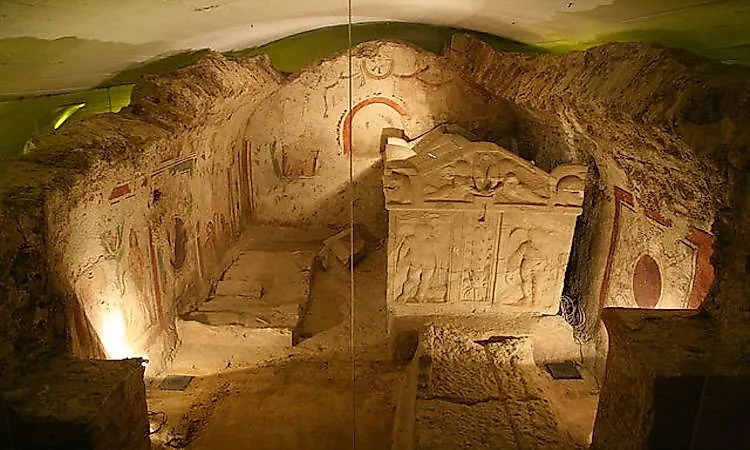
Sophianae was a thriving provincial capital of Pannonia when the first of these tombs were constructed in the 300s. Unlike many Roman sites where the dead were buried in simple plots, the wealthy citizens here commissioned elaborate two-story structures. The lower level was a burial chamber for the sarcophagi, while the upper floor functioned as a chapel for commemorative meals and prayers. Following the collapse of Roman rule, the necropolis was forgotten, buried by the accumulating layers of a medieval city. It was only by chance in the 18th century that builders stumbled upon the first painted walls, but the full extent of the site was not revealed until modern archaeological digs in the 1970s and 2000s. These excavations uncovered the Peter and Paul Tomb, where the faces of the apostles still gaze out with startling clarity, and the Wine-Pitcher Tomb, which hints at the celebratory nature of early Christian funerals.
Descending the metal walkways into the excavation site , a sharp drop in temperature and the faint, earthy smell of wet clay and ancient dust. The lighting is kept dim to protect the frescoes, creating an intimate atmosphere where the colors of the past seem to pulse in the gloom. The feel of the porous Roman bricks as you navigate the narrow passages between the chambers. In the Cella Septichora, the sheer scale of the seven-lobed ground plan leaves you feeling minuscule, proof of the architectural ambition of a dying empire. The muffled sounds of the city above, a distant reminder of the living world that seems miles away from this quiet sanctum. Visitors generally overlook the tiny details of the floral motifs on the ceilings, yet these delicate vines symbolize the eternal paradise that the inhabitants hoped to find. The moment you stand before the Chi-Rho monogram, the first symbol of a newly legal faith, you realize you are witnessing the dawn of a new era.
Trains from Budapest’s Keleti station reach
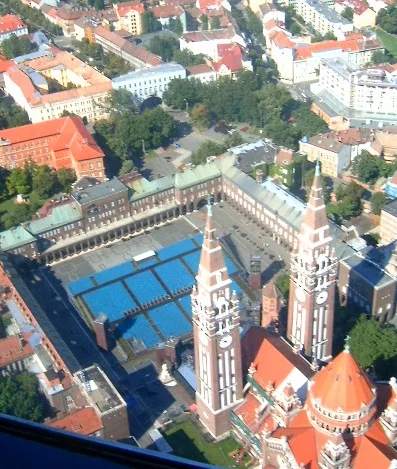
Trains from Budapest’s Keleti station reach Pécs in under three hours, offering a scenic transition from the flat plains to the rolling Mecsek Hills. Once in the city, the necropolis is easily found by walking toward the four spires of the Cathedral, as the visitor center is integrated into the square directly beside it. Walking from the main Széchenyi Square takes less than ten minutes, leading you through some of the most beautiful pedestrian zones in Southern Hungary. The site is fully accessible via elevators, allowing the journey into the fourth century to be taken at a slow, respectful pace.
Trains from Budapest’s Keleti station reach Pécs in under three hours, offering a scenic transition from the flat plains to the rolling Mecsek Hills.
The Experience
The air grows heavy and cool as you leave the bright Hungarian sunshine for the glass-encased descent. The silence is the first thing that hits you; the stone walls are thick enough to erase the noise of the nearby cafes. Something like a sense of profound continuity when you see the 'Jug Tomb,' where a simple painting of a glass of wine and a pitcher looks as fresh as if it were painted yesterday. The light is focused specifically on the Peter and Paul Tomb, where the dampness of the earth seems to lend a lifelike sheen to the frescoes. It is a strange sensation to look up and see the modern world through a glass ceiling while standing on a floor laid by Romans. The moment stays with you because of the intimacy; you aren't looking at ruins from a distance, but standing inside the very rooms where people once mourned and celebrated.
Why It Matters
Pécs holds the largest and best-preserved collection of early Christian burial chambers outside of Italy. It matters because it provides a visual map of how Christian art and architecture evolved during the exact moment the religion moved from the shadows into the mainstream. The site is a rare, tangible link to the Roman province of Pannonia, proving that even at the edge of the empire, culture and faith were deeply sophisticated.
Why Visit
This isn't just another pile of old stones; it is an atmospheric journey into the dark. While the catacombs of Rome are crowded and chaotic, the Pécs necropolis offers a quiet, high-tech, and incredibly clear view of antiquity. You visit for the rare chance to stand face-to-face with sixteen-hundred-year-old residents in an environment that feels like a cross between a tomb and a modern art gallery.
✦ Insider Tips
- 1
Look for the Wine-Pitcher Tomb first; its simple, domestic imagery offers a surprisingly human connection to the people buried here.
- 2
Visit during a weekday afternoon to have the long, echoing walkways of the Cella Septichora almost entirely to yourself.
- 3
Bring a light sweater regardless of the outdoor temperature, as the underground chambers remain a constant, chilly sixteen degrees year-round.
- 4
Use the interactive digital screens near the entrance to see 3D reconstructions of how the chapels originally looked above ground before they were buried.
- 5
Walk to the nearby Bishop's Palace afterwards to see how the Roman stonework was incorporated into the foundations of much later medieval structures.