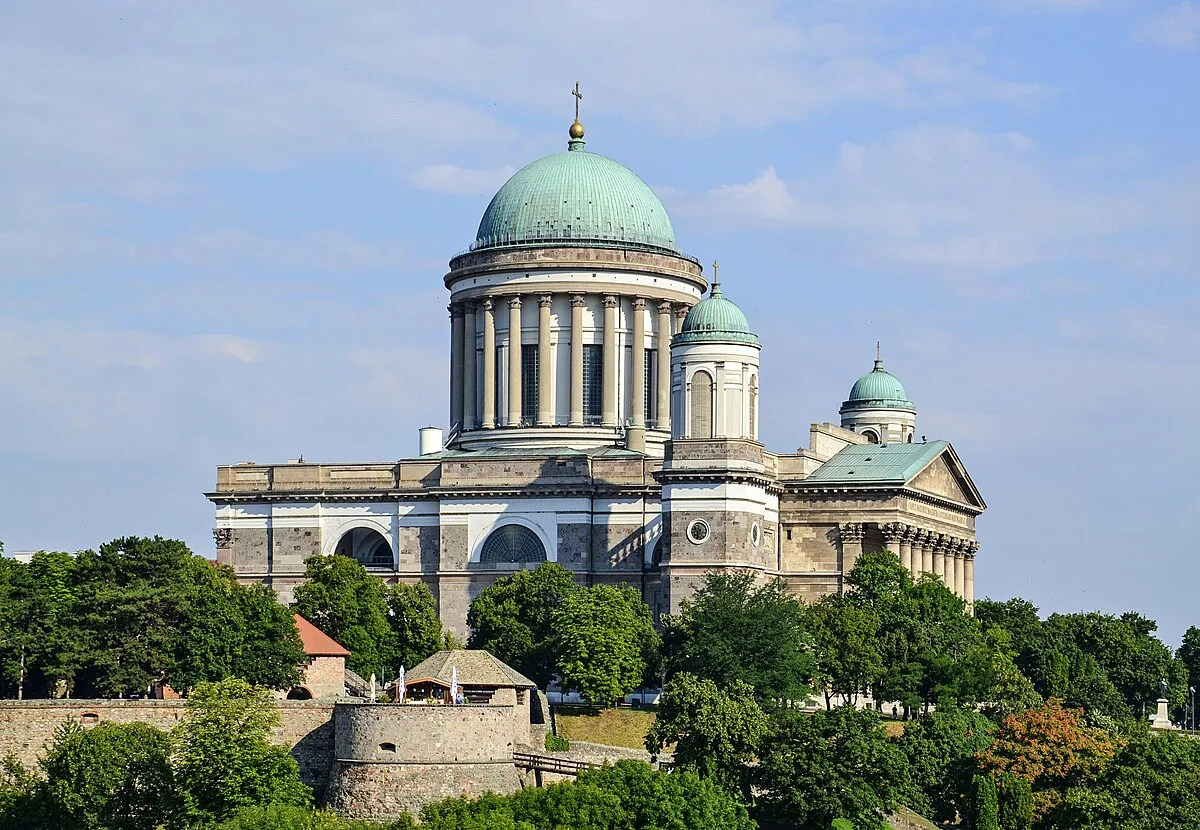
Inside this limestone giant, you will find a Renaissance chapel made of deep red marble that was chopped into sixteen hundred numbered pieces to hide it from an invading army.
About Esztergom Basilica
Saint Stephen, the founder of the Hungarian state, established the first archbishopric here at the dawn of the eleventh century, making Esztergom the spiritual center of the realm. The medieval cathedral was a jewel of the Romanesque era, but it met its end during the 150-year Ottoman rule, serving as a fortress until it was reduced to rubble. Modern construction finally ignited in 1822 under the direction of Pál Kühnel, who sought to create a monument that signaled the resurgence of the Catholic Church in Hungary. The project spanned several decades and the tenures of four different archbishops. It was a Herculean task of engineering; the dome alone stands seventy-one meters high, supported by walls seventeen meters thick. Despite the slow progress and the architect’s death, the building was finally consecrated in 1856, though the final decorative touches weren't completed until the 1860s, cementing its status as the largest church in the country.
High above a sharp bend in the Danube
High above a sharp bend in the Danube, the Mother Church of Hungary commands the horizon with a scale that humbles the river valley below. This massive Neoclassical sentinel marks the very spot where the kingdom’s first king was crowned over a millennium ago, though the current structure reflects the grander ambitions of the nineteenth century. Its copper dome, weathered to a pale malachite green, acts as a lighthouse for travelers crossing the Maria Valeria Bridge from Slovakia. The space around the hilltop is often brisk, smelling of fresh water and the faint, sweet smoke from wood stoves in the lower town. Inside the nave, the sheer volume of the space seems to swallow the sound of a hundred footsteps, replacing them with a heavy, resonant silence that only a building of this magnitude can produce.
The past
Royal history here began around the year 1000 when Stephen I transformed this rocky outcrop into the seat of the Hungarian Church. The medieval cathedral that originally occupied the site fell to ruin during the Ottoman occupation, used as a mosque and later destroyed during the siege to reclaim the city. Rebuilding didn't begin in earnest until 1822, when Archbishops Sándor Rudnay and later János Scitovszky envisioned a cathedral that could rival St. Peter’s in Rome. They commissioned architect Pál Kühnel and later József Hild to create a Neoclassical giant that took nearly half a century to complete. Franz Liszt even composed his Gran Mass specifically for the 1856 consecration, conducting the premiere within these reverberating walls while the dome was still a work in progress. One of the most remarkable survivals is the Bakócz Chapel, a red marble Renaissance masterpiece that was dismantled into 1,600 pieces and hidden to protect it from the Turks, only to be meticulously reassembled inside the new basilica.
Sunlight streams through the high windows of the dome, illuminating a massive altarpiece that holds the record for the world's largest painting on a single piece of canvas. Right away, the cool touch of the red marble walls as you descend into the crypt, where the air is noticeably still and the tombs of Hungarian primates lie in vaulted shadows. The climb up the winding, narrow stairs to the bell tower rewards you with a perspective of the Danube Bend that reveals the river's serpentine power. An echo of the vibration of the great bells if you time your ascent right, a deep bronze hum that resonates in your chest. In the treasury, the glint of gold filigree and heavy jewels on the coronation crosses tells a story of royal patronage that survived centuries of war. The most intimate moment occurs in the side chapels, where the smell of burning beeswax and the sight of local worshippers offer a reminder that this monument remains a living, breathing parish church. Trains depart frequently from Budapest’s Nyugati station, taking roughly an hour to reach the Esztergom terminal, followed by a pleasant walk through the residential streets to the base of Castle Hill. For a more cinematic arrival, the hydrofoil from Budapest allows you to see the basilica’s dome rising slowly above the treetops from the water. Driving from the capital takes you through the rolling Pilis Hills, where the road suddenly drops to reveal the cathedral’s massive portico standing against the sky like a Roman temple. Visitors often choose to walk across the Maria Valeria Bridge to Slovakia just to look back and see the entire architectural complex reflected in the Danube.
The Experience
It starts with the temperature drop as you pass through the massive bronze doors, leaving the bright Danube sun for the cool, incense-tinged air of the nave. Overhead, is dominated by the low murmur of visitors and the occasional thunderous swell of the organ being tuned for mass. A sense of small standing beneath the dome, where the golden mosaics seem to float in a hazy, celestial light. People generally miss the intricate detail of the organ pipes, but if you look up, you can see the sheer craftsmanship that went into Liszt’s favorite instrument. What usually sticks is the view from the cupola, where the wind whistles through the stone railings and you can see two different countries at a single glance, separated only by the blue ribbon of the river.
Why It Matters
Esztergom Basilica is the literal and figurative pinnacle of the Hungarian Catholic Church, serving as the seat of the Primate. It is a monument to national resilience, having been rebuilt on the ruins of a destroyed medieval past to assert a new, confident European identity in the 1800s. Its treasury houses the richest collection of ecclesiastical art in Central Europe, making it a vital archive of the continent’s shared Christian heritage.
Why Visit
The Bakócz Chapel alone, which is a rare piece of the Italian Renaissance that somehow survived in the middle of the Danube. While Budapest’s St. Stephen’s is grand, Esztergom possesses a solitary, windswept majesty that feels more like an ancient acropolis than a city cathedral. It offers a quietude and a panoramic view that the urban churches simply cannot match.
✦ Photo Gallery
Best Season
🌤 September is the finest time to visit, when the summer haze clears from the river valley and the late afternoon sun hits the red marble interior with a particularly warm, saturated glow.
Quick Facts
Best time to visit
September is the finest time to visit, when the summer haze clears from the river valley and the late afternoon sun hits the red marble interior with a particularly warm, saturated glow.
Getting there
In Esztergom, Hungary; reach Esztergom first, then continue to the site.
What's nearby
Hungarian Parliament Building, Dohány Street Synagogue and Hungarian National Museum are also in the area.
Location
Esztergom, Hungary
Type
attraction
Coordinates
47.7989°, 18.7364°
Insider Tips
- 1
Buy the 'all-in' ticket that includes the treasury and the dome to avoid standing in three separate lines inside.
- 2
Walk to the very end of the Maria Valeria Bridge to Slovakia at sunset for the most dramatic photograph of the dome's silhouette.
- 3
Search for the small entrance to the 'Bakócz Chapel' inside; it is the only part of the cathedral that predates the Ottoman invasion.
- 4
Listen for the 'Grand Bell' on Sundays at noon; it is one of the heaviest in Hungary and its vibration can be felt in the pavement of the square.
- 5
Visit the nearby Christian Museum in the Primate's Palace if you want to see the medieval paintings that were moved out of the old cathedral before its destruction.