Eighty thousand rare books survived the ravages of war because a Soviet officer agreed to build a brick wall in a hallway, hiding an entire wing of the palace from his own troops.
About Festetics Palace
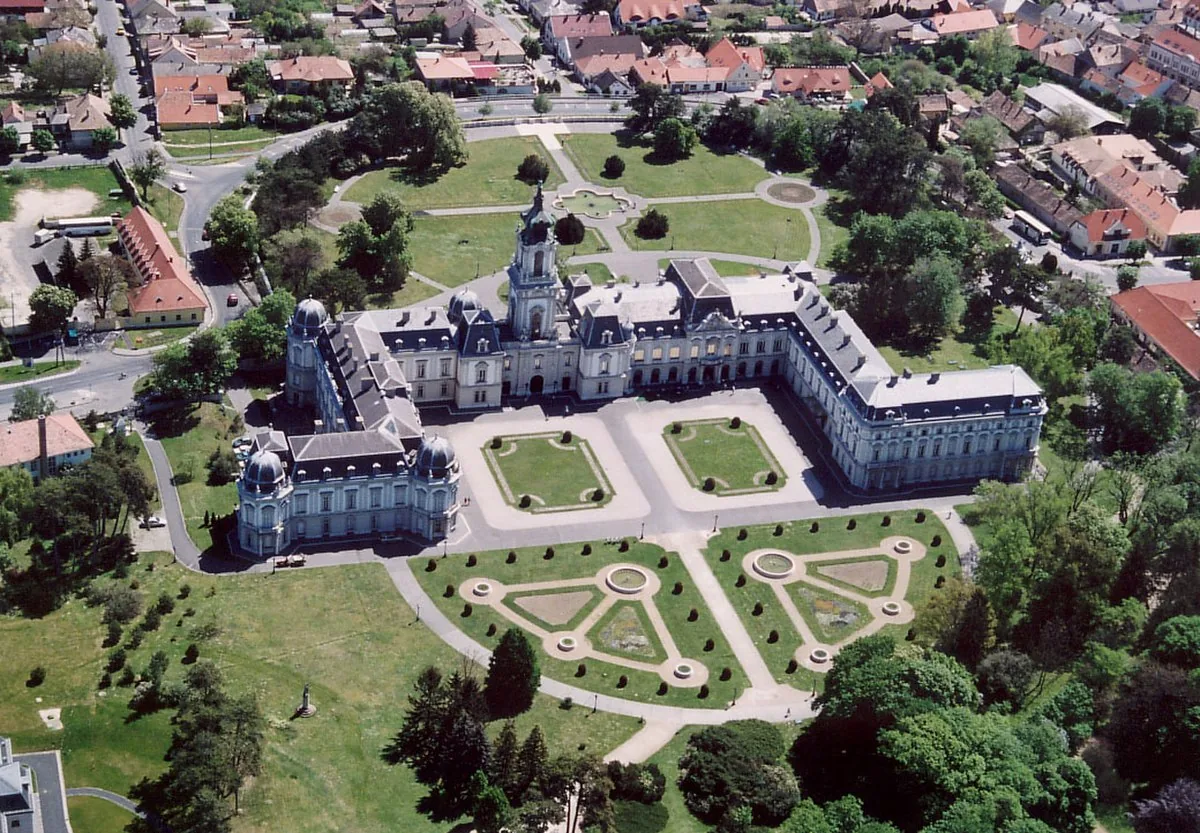
The Festetics family began their architectural legacy in 1745 on the foundations of a ruined castle, but the palace we see today is the result of three major waves of construction. Unlike their peers who focused on hunting and war, the Festetics counts were dedicated agronomists and bibliophiles. They founded Europe's first agricultural college, the Georgikon, and spent generations curating a library that became a signal of the Enlightenment in Central Europe. By the 1880s, the palace had doubled in size under Count Tasziló Festetics, who added the massive neo-Rococo tower and the opulent ballroom wing to accommodate his English wife, Lady Mary Hamilton. This transformation made the estate one of the three largest country houses in Hungary. While most aristocratic homes were stripped or burned during the mid-20th century, the Keszthely estate was spared the worst of the socialist era’s architectural purges, allowing it to transition into a public museum with its original furnishings and spirit remarkably well-preserved.
Festetics Palace in Hungary
Sunlight glints off the slate roof of the Helikon wing, casting long shadows across the manicured parterres of Keszthely. Festetics Palace functions as a defiant monument to aristocratic refined taste, anchored at the western tip of Lake Balaton where the water often takes on the color of a pale opal. The area here is a blend of lake moisture and the dry, sweet scent of old paper drifting from the library windows. Passing through the gate, you leave the noisy lakeside town behind for a spread of Baroque symmetry and sprawling English gardens. This U-shaped limestone giant feels less like a fortress and more like a scholarly retreat, its every balcony and balustrade designed to catch the breeze and the evening light.
Christopher Festetics began the work in 1745, but
Christopher Festetics began the work in 1745, but the palace’s current grandeur owes everything to a century and a half of obsessive expansion. The family was unique among the Hungarian nobility; they chose to invest their wealth in an agricultural university and a massive library rather than merely in military or political posturing. Count György Festetics transformed the estate into a cultural powerhouse during the early 1800s, hosting the Helikon festivals that gathered the greatest literary minds of the age. During the chaotic final days of World War II, the palace survived a potential looting by a stroke of luck and the quick thinking of a Soviet commander who agreed to wall up the library wing, preserving eighty thousand volumes from destruction. This act of preservation kept the Helikon Library as the only aristocratic collection in Hungary to remain entirely intact in its original setting.
Standing in the oak-paneled Helikon Library,
Standing in the oak-paneled Helikon Library, There is a profound stillness that seems to absorb the sound of your own heartbeat. The light pours through tall windows, illuminating rows of gold-tooled leather spines that reach toward a gallery carved with staggering precision. First, the scent of Slavonian oak and aging parchment, a sensory signature that has remained unchanged since the Napoleonic wars. Moving through the ballroom, the crystal chandeliers cast a thousand dancing prisms across the parquet floor, while the heavy silk wall coverings dampen the echo of your footsteps. Outside, the garden offers a different rhythm, where the splashing of the fountains and the crunch of gravel underfoot lead you toward the Palm House. A large share of visitors overlook the Carriage Museum, but wandering among the polished wood and brass of these nineteenth-century vehicles reveals the sheer logistical elegance of a vanished era. What lingers with you is looking out from the terrace at sunset, watching the palace turn the color of honey against the dark blue line of the lake.
Trains from Budapest’s Déli station reach
Trains from Budapest’s Déli station reach Keszthely in about three hours, winding through the vineyards and resorts of the southern Balaton shore. The palace is a short, pleasant walk from the station, taking you through the town’s historic pedestrian zone. Drivers can take the M7 motorway, enjoying a faster route that reveals the palace’s central tower rising above the trees long before the town gates appear. Boat services from other lakeside towns like Hévíz or Badacsony offer a more leisurely arrival, docking at the pier where a grand lime-tree alley leads directly to the palace grounds.
The Experience
The cool air as you enter the grand staircase hall, where the cool white limestone seems to radiate a quiet, stony dignity. On all sides, the is filtered through heavy velvet curtains, creating a soft, amber-toned world that feels entirely separate from the bright, windy shores of Lake Balaton nearby. The smoothness of the hand-carved cherry wood railings in the library, a tactile link to the craftsmen of the eighteenth century. Audible: the rhythmic ticking of a dozen antique clocks, each one adding a layer to the sense of frozen time that defines the state rooms. Visitors often miss the subtle floral scent in the Mirror Hall, a lingering ghost of the elaborate perfumes once worn by the Helikon festival guests. The moment of true connection usually happens in the private study, where the modest desk of the Count suggests that even in a palace this large, the most important work happened in a room no bigger than a library alcove.
Why It Matters
Festetics Palace is the cultural heart of Western Hungary and shaped by the enlightened nobility that once shaped the region’s intellectual life. It houses the Helikon Library, the most significant surviving aristocratic library in Central Europe, and provides an unbroken record of Hungarian interior design from the Baroque to the late nineteenth century. It is a bridge between the agricultural traditions of the Pannonian plain and the high-society glamour of the Austro-Hungarian Empire.
Why Visit
The Helikon Library alone, which is a cathedral of books that rivals the grandest monastic collections of Europe. While the castles of the Danube are often empty shells, Festetics is a fully furnished home that allows you to breathe the same air as the counts who built it. It is the only place where you can see a masterwork of European architecture perfectly reflected in the waters of Hungary’s great inland sea.
✦ Photo Gallery
Best Season
🌤 September is the most rewarding month, as the summer heat on Lake Balaton fades into a crisp clarity that perfectly illuminates the palace's limestone facade and turns the English garden into a sea of russet and gold.
Quick Facts
Best time to visit
September is the most rewarding month, as the summer heat on Lake Balaton fades into a crisp clarity that perfectly illuminates the palace's limestone facade and turns the English garden into a sea of russet and gold.
Getting there
In Keszthely, Hungary; reach Keszthely first, then continue to the site.
What's nearby
Lake Hévíz and Pannonhalma Archabbey are also in the area.
Location
Keszthely, Hungary
Type
attraction
Coordinates
46.7706°, 17.2417°
Insider Tips
- 1
Head straight to the library wing as soon as the doors open to experience the silence of the eighty thousand volumes before the tour groups arrive.
- 2
Look for the secret door disguised as a bookshelf in the library; it was used by the family to reach their private quarters without disturbing the scholars.
- 3
Walk to the far end of the garden to find the Carriage Museum, which houses the world's only surviving funeral coach of its kind.
- 4
Try the 'Helikon' brand chocolate or coffee at the palace cafe, which uses recipes found in the family's historical archives.
- 5
Visit on a Saturday evening during the summer months when the palace often hosts candlelight chamber music concerts in the Mirror Hall.