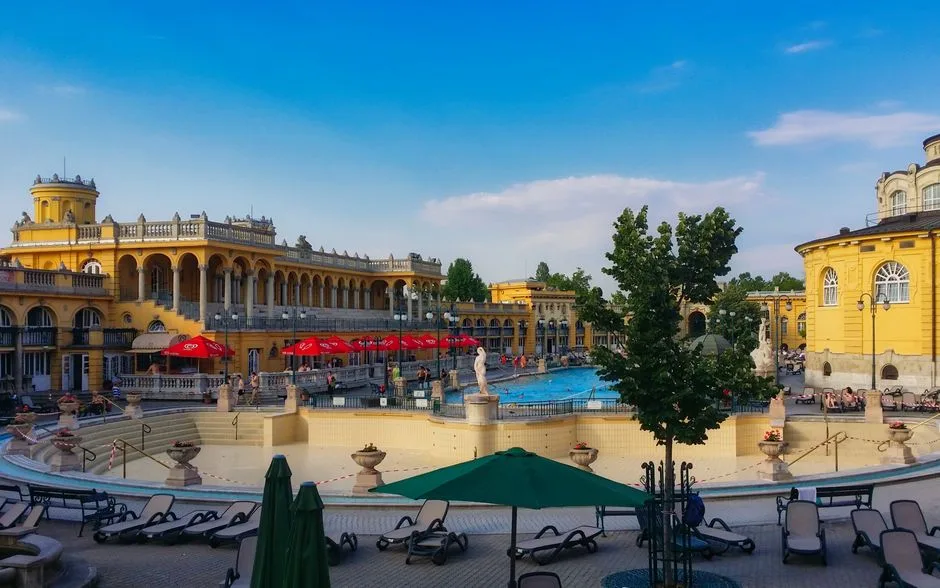
Old men with weathered skin and steel-trap minds sit chest-deep in 38-degree water, silently plotting checkmate on floating chessboards while the winter snow disappears the moment it touches the surface.
About Szechenyi Thermal Bath
The thermal story began with a deep bore-hole in the 1870s, reaching nearly a kilometer into the crust to tap a spring that had been trapped for millennia. Architect Gyozo Czigler envisioned a temple for the masses, completing the main structure in 1913 before the shadows of the Great War could halt his progress. Even as the city changed hands between empires and ideologies, the well remained constant. In 1927, the facility expanded to include the iconic outdoor pools, ensuring that the 'Szechenyi' became a permanent fixture of the Budapest skyline. It survived the bombings of 1945 with remarkably little damage, preserving its intricate mosaics and bronze sculptures for a century of bathers.
Deep beneath the manicured lawns of City Park
Deep beneath the manicured lawns of City Park, a geological furnace churns at seventy-seven degrees Celsius, fueling the grandest liquid cathedral in Europe. Visitors generally arrive expecting a simple swim but instead find themselves immersed in a Neo-Baroque palace where the currency is steam and the local pastime is aquatic chess. The sprawling yellow facade of Szechenyi rises like a Habsburg royal residence, its domes reflecting a sun that often struggles to pierce the thick ribbons of mineral-rich vapor rising from the outdoor basins. Here, the boundaries between a medical clinic and a social club dissolve in the sulfurous heat of eighteen different pools.
“Deep beneath the manicured lawns of City Park, a geological furnace churns at seventy-seven degrees Celsius, fueling the grandest liquid cathedral in Europe.”
Szechenyi Thermal Bath, Hungary
a thermal vein, 1878
Vilmos Zsigmondy, a mining engineer with a borderline obsession with subterranean heat, spent years drilling into the earth before finally striking a thermal vein in 1878. His persistence transformed a marshy outskirts of Budapest into a destination of high society. The current Neo-Baroque structure, designed by Gyozo Czigler, opened its doors in 1913, though it required further expansion in the 1920s to accommodate the sheer volume of citizens seeking the 'miracle waters.' Throughout the heavy decades of the twentieth century, these pools remained one of the few places where social hierarchies evaporated. Generals, poets, and plumbers stripped down to their swimsuits, finding a rare equality in the communal steam. The art and architecture were never secondary; every mosaic tile and water-spouting stone monster was intended to improve the act of bathing into a civic ritual.
Walking into the central hall, you immediately encounter the heavy, humid scent of minerals and the echo of water hitting marble. The outdoor pools provide the most cinematic theater, especially during the colder months when the air temperature drops and the water remains a constant, swaddling warmth. You might find yourself drifting past a group of elderly men chest-deep in the water, their brow furrowed over a floating chessboard, oblivious to the tourists nearby. Inside, the atmosphere shifts to something more intimate and somber. Dimly lit chambers house pools of varying temperatures, some bracingly cold and others as hot as a fever. The sound of rhythmic splashing against tile is the only soundtrack, occasionally joined by the muffled roar of the whirlpool jets outside. What you catch first is the way the light catches the steam, creating a soft-focus world where the baroque statues seem to ripple and breathe. Reaching the baths is half the charm if you take the M1 Millennium Underground, the second oldest subway line in the world. Its tiny, wooden-paneled cars rattle their way to the Szechenyi furdo station, depositing you just steps from the yellow entrance. If you prefer the surface, a walk through City Park past Vajdahunyad Castle provides a scenic buildup to the baths' grand scale. Taxis are plentiful, but the yellow tram-like feel of the M1 offers a historical continuity that matches the destination perfectly.
The Experience
Steam curls around the yellow balustrades, turning the grand courtyard into a hazy, soft-focus dream where time feels suspended. You come across a grit of the stone beneath your feet and the sudden, enveloping weight of the mineral water as you sink into the outdoor thermal basin. Somewhere nearby, a jet of water thunders into a pool, a rhythmic bass note to the hum of a dozen languages mingling in the mist. The most profound moment occurs at twilight, when the underwater lights turn the pools a glowing turquoise against the deepening blue of the Hungarian evening.
Why It Matters
Szechenyi represents the living heart of Hungarian 'spa culture,' a tradition that blends Roman, Turkish, and Northern European influences into a single, steamy identity. It is not a museum; it is a functioning piece of social infrastructure where medical treatments and morning gossip happen simultaneously. The water itself, rich in calcium, magnesium, and bicarbonate, serves as a literal bridge to the geological forces that shaped the Carpathian Basin.
Why Visit
Forget the sleek, modern spas of Western Europe; Szechenyi offers a grandiosity that feels like swimming inside an opera house. You come here for the contrast of the biting Hungarian wind against the searing heat of the springs. No other place allows you to soak in a century of history while the steam erases the modern world just a few inches from your face.
Insider Tips
- 1
Rent a 'cabin' rather than a locker to give yourself a private wooden dressing room that is a quiet sanctuary from the crowds.
- 2
Bring your own flip-flops and a towel to avoid the long, confusing queues at the rental desk.
- 3
Explore the labyrinth of indoor pools at the very back of the complex; most tourists stick to the three outdoor basins and miss the most beautiful mosaics.
- 4
Avoid Saturday afternoons if you want to see the chess players; they prefer the quieter weekday mornings.
- 5
Look up in the entrance hall to see the stunning circular mosaic of Helios, the Sun God, driving his chariot across the ceiling.