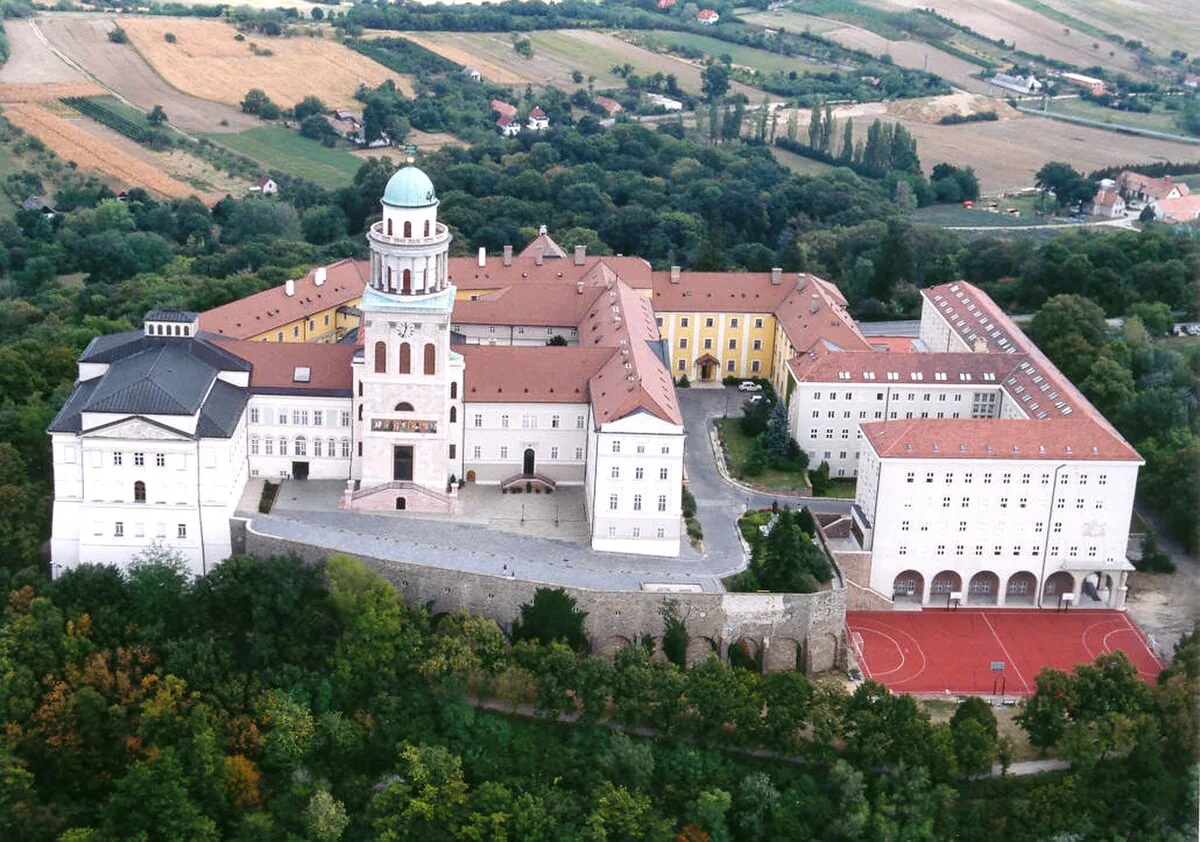
Monks have watched the sun rise over these plains for over a thousand years, guarding a library of four hundred thousand books and a secret recipe for herbal bitters.
About Pannonhalma Archabbey
The hill itself, once known as the Sacred Mount of Pannonia, became the cradle of Hungarian Christianity when the first monks arrived in 996. These early residents didn't just pray; they built a center of literacy that would eventually produce the nation's earliest written records. By the time the Gothic basilica was consecrated in 1224, Pannonhalma had become a critical cultural hub. When the Ottoman Empire swept across the plains in the 16th century, the monastery transformed into a defensive bastion, though the monks were eventually forced to flee. They returned in the 17th century to begin a massive Baroque expansion, only to face further closures under the enlightened absolutism of the 18th century and the secularization of the 20th. Through every upheaval, from the fires of the Middle Ages to the Iron Curtain, the community preserved its most precious assets: the archives, the botanical garden, and the spiritual continuity of the Benedictine order.
What Pannonhalma Archabbey actually is
High atop St. Martin’s Hill, A distinct sharpness, a blend of wild lavender and the cold, mineral scent of ancient limestone. This Benedictine stronghold has watched over the Pannonian plain since the first millennium, surviving as a living fortress of faith and scholarship. While the valley below moves to the frantic rhythm of modern Hungary, the Archabbey maintains a deliberate, monastic pace dictated by the Rule of Saint Benedict. Sunlight hits the neoclassic tower first in the morning, illuminating a complex where medieval cloisters meet a startlingly modern winery. It feels like a lighthouse of the intellect, anchored to the earth by deep cellars and reaching toward the heavens through the soaring arches of its basilica.
Origins
Prince Géza established the monastery in 996, inviting monks from Bohemia to settle on this strategic height and Christianize the Magyar tribes. These walls saw the birth of the Hungarian language; the abbey archives hold the 1055 Tihany Abbey foundation charter, the oldest surviving document containing Hungarian words. Throughout the centuries, the Archabbey acted as a spiritual shield against the Mongol invasion and later became a 'border fortress' during the Ottoman occupation. Fires and shifting political tides necessitated constant rebuilding, which resulted in a fascinating architectural dialogue between Romanesque foundations and Baroque flourishes. The Benedictines were briefly dissolved under Joseph II and later suppressed during the Communist era, yet they always returned to their hill, reclaiming their library and their vines with a quiet, stubborn persistence.
Stepping into the Library feels like entering a cathedral of wood and paper, where 400,000 volumes stand in silent formation under a pale blue ceiling. The smell of beeswax and old parchment, a scent that seems to absorb the sound of your footsteps on the polished floor. The basilica offers a different sensory journey, particularly the red marble crypt where the air remains heavy and still. In the cloisters, the play of light through the narrow windows creates a rhythmic pattern on the stone, urging a slower, more contemplative walk. A sudden transition when visiting the modern winery, where the glass and steel architecture reflects the surrounding hills, contrasting the ancient stone of the main complex. The hum of the abbey bells, deep and resonant, anchors the experience, reminding you that this is not a museum but a house of daily ritual.
Trains from Budapest to Győr depart
Trains from Budapest to Győr depart almost hourly, and from there, a local bus or a short taxi ride carries you through the rolling vineyards to the foot of the hill. Travelers arriving by car can take the M1 motorway, turning off at the Pannonhalma exit and winding through a landscape that increasingly resembles Tuscany. The final ascent to the abbey gates requires a short walk, providing ample time to watch the horizon expand until the entire Kisalföld plain opens up beneath you.
The Experience
The temperature drop significantly as you descend into the Romanesque crypt, where the silence is so profound it feels physical. The light in the Library has a peculiar, filtered quality, softened by the high windows and reflected off the gold-leaf detailing on the shelves. Most people overlook the Arboretum, but wandering through the 200-year-old trees provides a necessary palette cleanser for the senses. The rustle of the monks' robes during the midday prayers, a sound that bridges the gap between the modern visitors and the medieval spirit of the place. The experience concludes best at the herb garden, where the scent of drying sage and thyme reminds you of the monks' enduring role as healers.
Why It Matters
Pannonhalma serves as the spiritual compass of Hungary, a site where the nation's European integration began a millennium ago. It is a rare example of a monastery that has remained an active community despite centuries of war and religious suppression. Culturally, it acts as a bridge between the medieval monastic tradition and the contemporary world through its prestigious boarding school and internationally recognized winemaking.
Why Visit
Visit Pannonhalma to see how a thousand years of history can coexist with a vibrant, modern pulse. While Budapest offers the grandeur of an empire, this hill offers the intimacy of a soul. You come here to stand in a library that rivals the world’s most beautiful and to taste a wine born from a terroir that has been cultivated since the time of the Vikings.
✦ Photo Gallery
Best Season
🌤 September is the ideal month, as the lavender fields are being harvested and the vineyards turn a deep, rusted gold under the soft autumn sun.
Quick Facts
Best time to visit
September is the ideal month, as the lavender fields are being harvested and the vineyards turn a deep, rusted gold under the soft autumn sun.
Getting there
In Pannonhalma, Hungary; reach Pannonhalma first, then continue to the site.
What's nearby
Esztergom Basilica, Lake Hévíz and Festetics Palace are also in the area.
Location
Pannonhalma, Hungary
Type
attraction
Coordinates
47.5528°, 17.7611°
Insider Tips
- 1
Attend the organ concerts in the Basilica during the summer months to experience the acoustics the way they were intended.
- 2
Purchase a bottle of the abbey's own 'Officina' lavender oil; the flowers are grown and distilled directly on the hillside.
- 3
Look for the 'Porta Speciosa', the ornate red marble entrance to the church, which represents some of the finest Romanesque carving in Central Europe.
- 4
Eat at the Viator Restaurant at the base of the hill for a menu that uses herbs and produce grown in the abbey's own gardens.
- 5
Reserve a guided tour specifically for the Library if you want to see the rare codices that are usually kept away from the general flow of traffic.