“Two legendary leaders entered this marshy battlefield in 1566, but neither survived the month, turning a local siege into a historical stalemate that saved Western Europe from total conquest.”
About Szigetvár Fortress
The original fortress was a labyrinth of wood and earth built upon islands in the Almás stream, but the current brick structure reflects the desperate reinforcements made during the mid-sixteenth century. Miklós Zrínyi took command in 1561, aware that he was standing on a fault line of global power. When Suleiman the Magnificent arrived for his final campaign, the world watched as a small garrison of Hungarian and Croatian soldiers held the line against the pinnacle of Ottoman military might. The Sultan’s death from natural causes on September 6, 1566, was kept a secret by his viziers to prevent a mutiny during the final days of the battle. When Zrínyi fell during his final charge just two days later, the fortress was a smoldering ruin. The Ottoman occupation that followed lasted 122 years, during which the victors built a mosque and a madrasa within the walls. When the Habsburgs finally retook the site in 1689, they opted to keep the Turkish architecture intact, resulting in the rare cultural palimpsest that defines the fortress today.
About Szigetvár Fortress
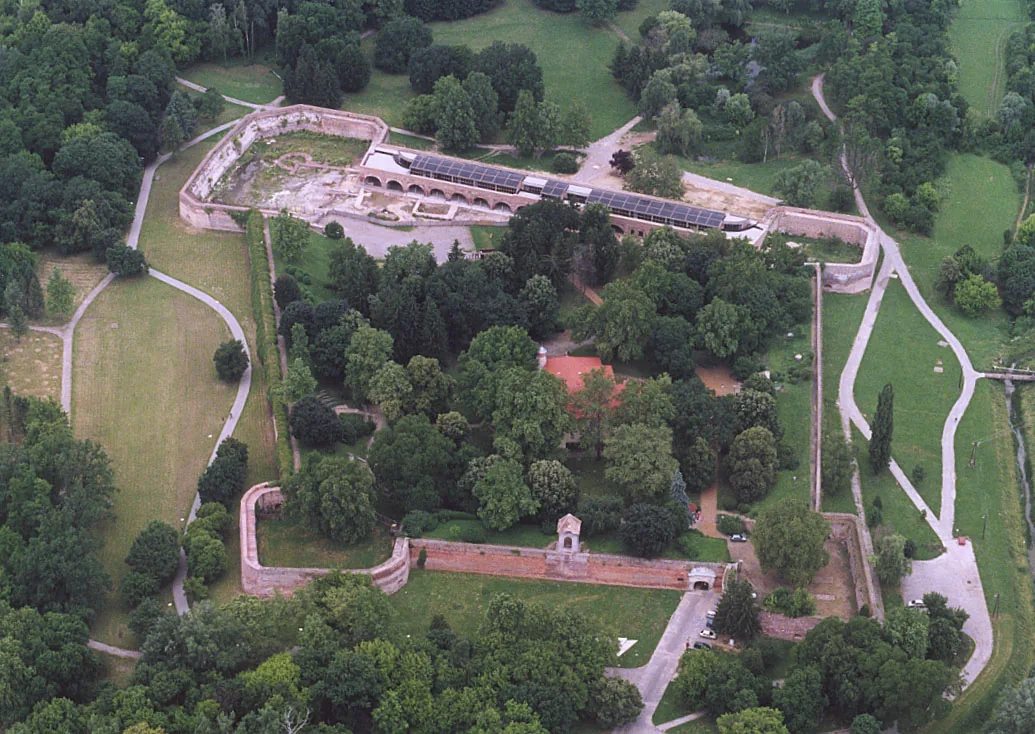
Rising from the marshy lowlands of Southern Hungary, the brick ramparts of Szigetvár Fortress carry a weight of history that few places on the continent can match. This island castle once stood as the final barrier between the Ottoman Empire and the heart of Europe, surviving a siege so fierce it claimed the lives of both the defending commander and the attacking Sultan. The space within the thick walls feels still and cool, scented with the musk of old earth and the sharp, metallic tang of the bronze statues that populate the grounds. Great grassy embankments now cover much of the original stone, but the geometric precision of the bastions remains clear. Down the high ridges, you overlook a landscape that was once a treacherous swamp, now transformed into a quiet park where the ghosts of the sixteenth century seem to linger in the shade of the walnut trees.
Rising from the marshy lowlands of Southern Hungary, the brick ramparts of Szigetvár Fortress carry a weight of history that few places on the continent can match.
Sultan Suleiman
The summer of 1566 defined Szigetvár when Sultan Suleiman the Magnificent arrived with an army of eighty thousand men to crush this stubborn obstacle on his path to Vienna. Miklós Zrínyi, the fortress commander, held out for thirty-three brutal days with only twenty-five hundred soldiers, refusing every offer of surrender. In a final, desperate act of defiance, Zrínyi led a suicidal charge out of the burning inner castle, an event that would be immortalized as the 'Hungarian Thermopylae.' Unbeknownst to the defenders, the aging Sultan had died in his tent just days before the final assault. The victory was so costly for the Ottomans that they abandoned their march on Vienna, essentially halting their expansion into Europe. Along the siege, the fortress was rebuilt by the Turks, who added the graceful minaret and the mosque of Sultan Suleiman, creating the unique architectural dialogue between East and West that survives today.
The change in light as you pass through the heavy arched gateway, moving from the bright southern sun into the dappled shadows of the inner courtyard. The sound of your footsteps on the gravel paths is often the only noise, occasionally joined by the distant tolling of the town's church bells. Inside the Mosque of Suleiman, the acoustic quality is haunting; every footfall on the stone floor resonates against the high, faded dome. The rough, uneven texture of the scorched bricks in the casemates, where the heat of the 1566 fires seems trapped in the very grain of the walls. Moving along the upper ramparts, the view stretches across the red-tiled roofs of the town toward the Mecsek Hills. The rustle of the leaves in the Park of Hungarian-Turkish Friendship, a place where the former enemies are now honored side-by-side in bronze. Just about everyone overlook the small, darkened room in the museum that houses the keys to the fortress, yet touching the cold iron of those replicas brings the gravity of the siege into sharp focus. What stays with you is standing at the spot of Zrínyi's final sortie, where the grass feels remarkably lush and the silence is absolute.
Regional trains from Pécs offer
Regional trains from Pécs offer a slow but scenic route through the sunflower fields of Baranya County, reaching Szigetvár in about forty minutes. If coming from Budapest, the drive takes roughly three hours along the M6 motorway and Route 6, crossing the Danube and heading deep into the sun-drenched south. The fortress sits just a short walk from the town’s main square, where the local thermal baths provide a relaxing counterpoint to the rugged military history of the castle. Many travelers arrive by bicycle, following the quiet backroads that trace the ancient border between empires, allowing the silhouette of the bastions to emerge slowly from the horizon.
Regional trains from Pécs offer a slow but scenic route through the sunflower fields of Baranya County, reaching Szigetvár in about forty minutes.
The Experience
At the front is the scent of wild thyme and sun-baked brick as you climb the grassy embankments that shield the inner bailey. The environment feels heavy with a sense of consequence, especially near the ruins of the castle tower where Zrínyi’s wife is said to have blown up the gunpowder stores rather than let them fall into enemy hands. The cool dampness of the stone inside the mosque, where the Arabic calligraphy on the walls remains a faint but defiant echo of the occupation. Almost all visitors miss the subtle markings on the bricks of the south bastion, which were signed by the individual masons who rebuilt the walls in the late seventeenth century. You hear the wind whistling through the hollow minaret, a lonely sound that emphasizes the solitude of the site. Near the 'Park of Hungarian-Turkish Friendship,' you notice the faces of Zrínyi and Suleiman carved into the same monument, a final, peaceful closing of a blood-soaked chapter.
Why It Matters
Szigetvár is more than a ruin; it is a continental monument to sacrifice and a turning point in the history of the Ottoman-Hungarian wars. It represents the precise geographical and chronological end of Suleiman’s expansionist dreams. Culturally, it is one of the few places in Central Europe where Ottoman religious architecture and European military engineering are preserved in such a direct and intimate embrace.
Why Visit
Visit Szigetvár to stand on the ground where the course of European history was literally decided by a few hundred meters of mud and brick. While Budapest’s monuments are polished and crowded, this fortress offers a raw, tactile connection to the past without the filters of tourism. You come for the epic story of Zrínyi, but you stay for the strange, quiet beauty of a mosque standing inside a Hungarian castle.
✦ Insider Tips
- 1
Look for the original sixteenth-century prayer niche (mihrab) inside the mosque, which is still perfectly aligned toward Mecca.
- 2
Walk to the very edge of the northwestern bastion at sunset to see the original moat system that once turned the fortress into an island.
- 3
Visit the nearby Turbék Church, built on the exact spot where Suleiman’s heart was allegedly buried in a golden casket before his body was taken to Istanbul.
- 4
Try the local Szigetvár wine at the small cellar near the entrance; the grapes are grown in the same volcanic soil that once formed the castle's defenses.
- 5
Enter the museum specifically to see the replica of Zrínyi’s sword, which helps convey the physical reality of the final charge.