“The royal crown of an entire nation was kept under lock and key on this windswept cliff for centuries, protected by walls designed to withstand the fury of the Mongol hordes.”
About Visegrád Citadel
Following the devastating Mongol raids of 1241, King Béla IV and his wife Queen Maria used their personal wealth to build a fortification system that could never be taken by horse-mounted archers. The Citadel was the centerpiece of this 'Great Wall' on the Danube. In the 1300s, the Anjou dynasty turned the fort into a diplomatic powerhouse, hosting the kings of Poland and Bohemia to settle trade disputes that had paralyzed the region for decades. For nearly two hundred years, the Holy Crown of Hungary was guarded within these walls, making Visegrád the symbolic center of the state. The fortress's decline began during the Turkish occupation, when it changed hands several times and was eventually blown up by the Habsburgs to prevent rebels from using it. It remained a forgotten pile of rocks until the 1870s, when local historians began the painstaking process of uncovering the gateways and towers from beneath centuries of forest overgrowth and landslides.
What Visegrád Citadel actually is
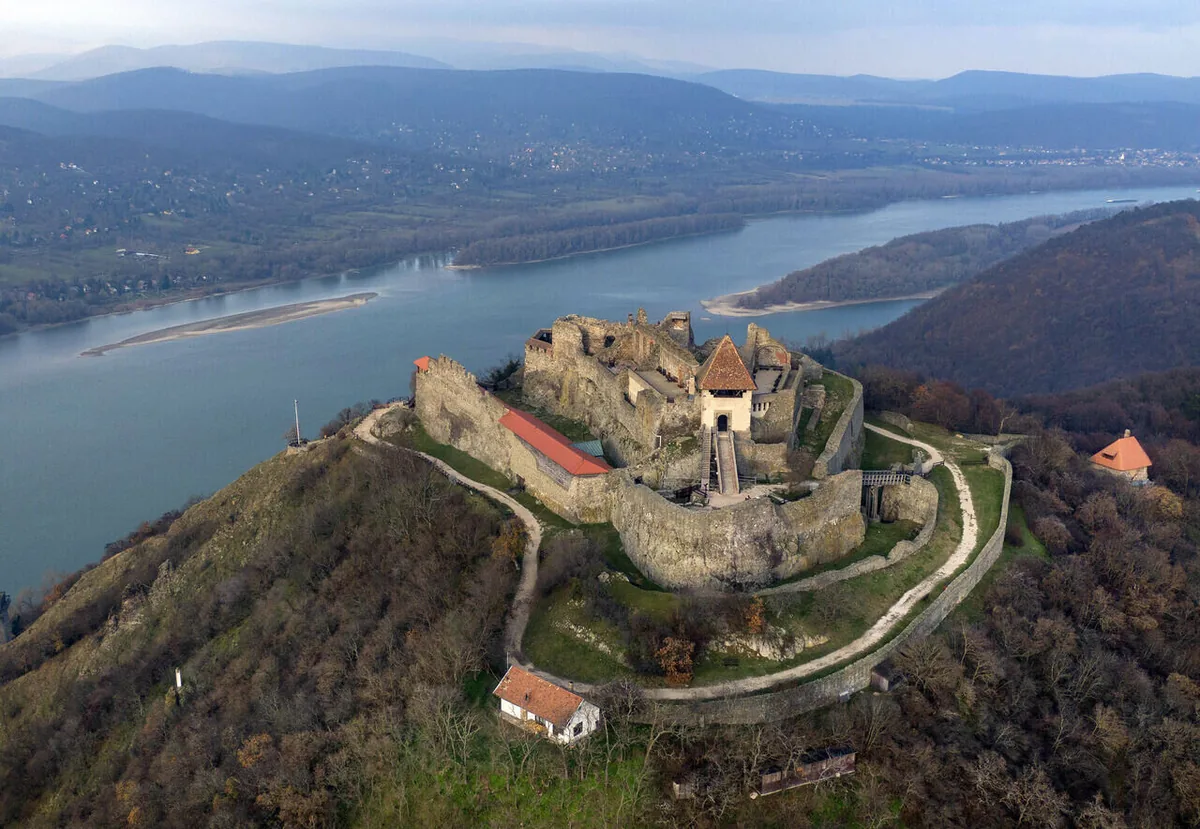
Perched on a jagged dolomite crag where the Danube makes its most dramatic and graceful turn, the Fellegvár or Citadel is a rugged crown over the Hungarian heartland. Around this altitude feels noticeably thinner and colder, carrying the sharp scent of pine and the damp limestone of the Börzsöny Mountains. Below the ramparts, the river bends in a massive U-shape, a geography so perfect it seems almost artificial. While the lower palace at the foot of the hill speaks of Renaissance luxury, the Citadel is a creature of raw defense, its thick walls built from the very rock upon which they sit. Sunlight catches the weathered grey stones in the late afternoon, turning the ruins into a golden silhouette that has was the silent sentry of the Danube Bend for nearly eight centuries.
Perched on a jagged dolomite crag where the Danube makes its most dramatic and graceful turn, the Fellegvár or Citadel is a rugged crown over the Hungarian heartland.
History
King Béla IV began the construction of this limestone fortress in the 1250s, a direct response to the scorched-earth terror of the Mongol invasion. He realized that the future of the Hungarian Kingdom depended on high-altitude retreats that could withstand prolonged sieges. By the 14th century, Visegrád became the royal seat under the Anjou kings, serving as the high-security vault for the Holy Crown of Hungary. In 1335, the Citadel hosted the famous Congress of Visegrád, a summit of Central European monarchs that laid the groundwork for regional alliances still echoed in modern politics. The fortress eventually succumbed to the Ottoman wars in the 1500s, falling into a state of atmospheric decay until archaeological interest revived the site in the late 19th century. Today, the restored bastions allow you to walk the same narrow parapets where medieval guards once watched for sails on the river.
Climbing the final stairs to the upper battlements, the wind whip across the exposed stone, a constant, restless sound that drowns out the quiet murmurs of other visitors. Opening with the rough, irregular texture of the ancient masonry, often held together by modern mortar that highlights the scars of past battles. Inside the wax museum chambers, the light is dim and yellowed, casting long shadows that make the historical tableaus feel strangely lifelike in the damp chill. Looking down from the western bastion, the view of the Danube Bend is so expansive it causes a momentary sense of vertigo; you can see the river shimmering like a silver ribbon toward the horizon. The distant, hollow clang of a blacksmith's demonstration in the lower courtyard, a sound that bridges the gap between the modern world and the medieval reality of the site. The experience culminates in the silence of the royal hall, where the absence of the Holy Crown is palpable, yet its history saturates the very air. Hydrofoils from Budapest offer the most evocative journey, arriving at the Visegrád pier after an hour of slicing through the river currents. From the dock, a local shuttle bus winds up the steep, serpentine road to the fortress gates, though adventurous travelers often choose the 'Spartacus path' for a grueling but rewarding hike through the forest. Driving from the capital takes about forty-five minutes via Route 11, providing a scenic transition from urban sprawl to the emerald hills of the Danube-Ipoly National Park. Arriving by bus from the Újpest-Városkapu station is equally efficient, dropping you at the base of the hill where the sheer scale of the Citadel becomes apparent from below.
The Experience
First, the way the light changes as you move from the sun-drenched ramparts into the deep, windowless corridors of the interior, where the smell of wet stone and old iron is inescapable. The wind is the primary inhabitant here, whistling through the arrow slits and tugging at your clothes as you stand on the edge of the vertigo-inducing drop. A remnant of the grit of the mountain beneath your boots, a reminder that this castle is an extension of the earth itself. Those who come focus solely on the panoramic view of the river, but if you look at the floor of the inner courtyard, you can still see the grooves worn into the stone by centuries of cart wheels and heavy boots. From somewhere comes the caw of crows circling the highest tower, their cries echoing off the grey walls in a way that feels perfectly suited to a ruin. The moment that stays with you is the realization of how small the surrounding villages look from this height, emphasizing the absolute power once held by the kings on the hill.
First, the way the light changes as you move from the sun-drenched ramparts into the deep, windowless corridors of the interior, where the smell of wet stone and old iron is inescapable.
Why It Matters
Visegrád Citadel is the quintessential symbol of Hungarian statehood and regional cooperation. As the historic home of the Holy Crown and the site of the 1335 summit, it represents the birth of Central European diplomacy. Culturally, it is a masterpiece of medieval military architecture, proving the ingenuity of 13th-century engineers who conquered the treacherous terrain to create a sanctuary for the crown.
Why Visit
Visit Visegrád for the single greatest view in Central Europe, the precise point where the Danube bends through the mountains. While Budapest’s Fisherman’s Bastion is a romanticized neo-Gothic fantasy, this is the real thing: a gritty, honest fortress that saw actual combat and guarded actual kings. You come here to feel the raw power of the river valley and to stand where the political map of the region was first drawn.
✦ Insider Tips
- 1
Arrive on the first shuttle bus of the morning to stand on the western bastion before the crowds arrive and the wind becomes too fierce.
- 2
Look for the display of the replica Holy Crown in the upper castle; the security measures around the original in Budapest make this version much easier to study in detail.
- 3
Walk down the hill instead of taking the bus back; the path leads you past the lower 'Solomon's Tower' and offers perspectives the road misses.
- 4
Check the weather for haze before visiting, as the view of the Danube Bend can be completely swallowed by fog even if Budapest is clear.
- 5
Visit the lower Royal Palace ruins first to understand the luxury the kings enjoyed before they had to retreat to the grim safety of the Citadel.