“A firebomb once crashed through the roof of this six-story wooden masterpiece and simply failed to explode, sparing the world's most beautiful fortress from certain ashes.”
About Himeji Castle
The foundations were laid in 1333, but the sprawling fortress seen today is the vision of Ikeda Terumasa, who completed the massive expansion in 1609. It served as a vital piece of the Tokugawa Shogunate's defensive chess board. While most Japanese castles were destroyed during the 19th-century transition to modernity or the 20th-century wars, Himeji remained occupied and maintained. A massive restoration project completed in 2015 stripped away decades of grey soot, returning the walls to the brilliant, blinding white that earned it the nickname Shirasagi-jo.
What Himeji Castle actually is
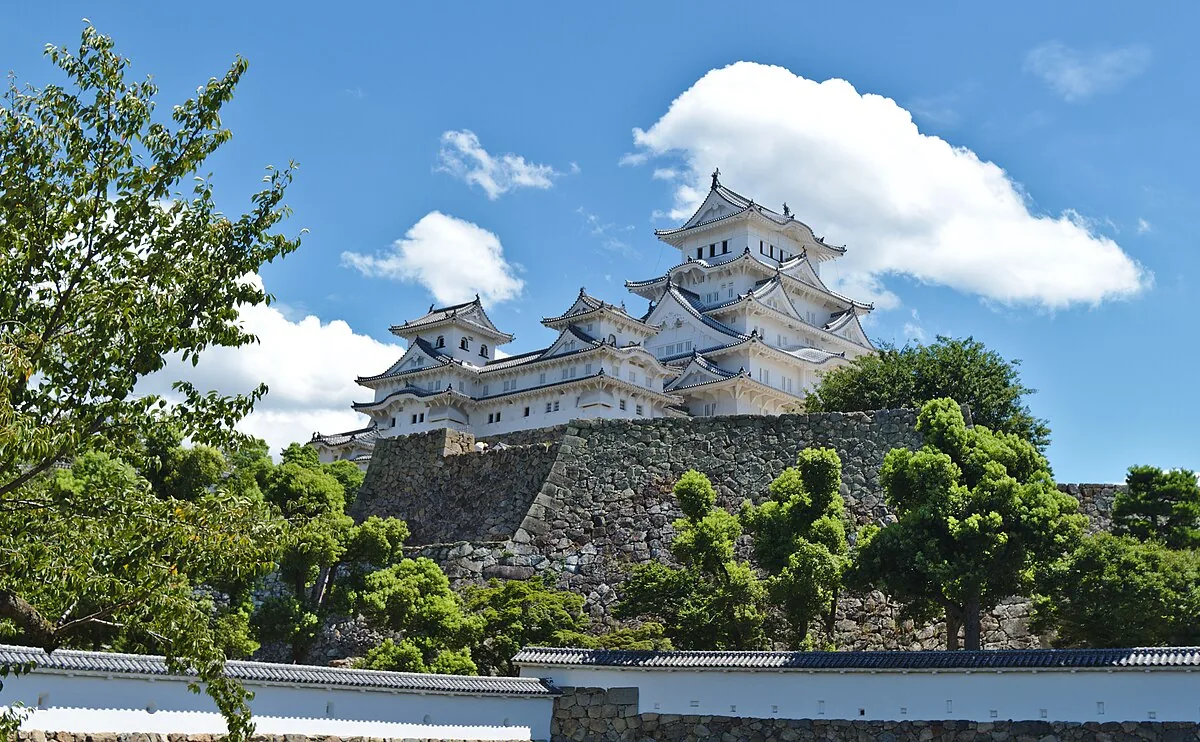
Six stories of gleaming white timber and plaster rise above the Hyogo skyline, resembling a great bird prepared to take flight from a sea of cherry blossoms. Himeji Castle remains the grandest survivor of Japan's feudal age, a fortress that managed to dodge fire raids, earthquakes, and the wrecking ball of modernization. Unlike the reconstructed concrete shells found in other Japanese cities, this complex is an intricate labyrinth of original 17th-century wood. The brilliant white exterior, coated in fireproof plaster, serves a dual purpose of aesthetic grace and grim military utility. Every gate, every winding path, and every slit in the wall was designed with a single, lethal intent: to trap and eliminate anyone attempting to reach the heart of the keep.
Six stories of gleaming white timber and plaster rise above the Hyogo skyline, resembling a great bird prepared to take flight from a sea of cherry blossoms.
Ikeda Terumasa received this strategic hill
Ikeda Terumasa received this strategic hill as a reward for his valor at the Battle of Sekigahara in 1600. Over the next nine years, he transformed a modest fort into a gargantuan defensive network comprising 83 buildings. The castle’s survival is nothing short of miraculous. During the Meiji Restoration, it was auctioned off for a pittance to a local man who wanted to demolish it for the land, but the cost of destruction proved too high. In the closing months of World War II, a firebomb struck the top floor of the main keep but failed to ignite. Through centuries of upheaval, the 'White Heron' has stood its ground, eventually becoming Japan’s first UNESCO World Heritage site in 1993.
Stepping onto the steep wooden stairs inside
Stepping onto the steep wooden stairs inside the keep, The temperature drop and the faint, sweet scent of aged cypress. The light grows dim, filtering through narrow apertures designed for archers and gunmen. There is a feeling of smooth, worn grain of the floorboards beneath your socks, polished by millions of feet over four centuries. The ascent is physically demanding, requiring you to navigate ladders that tilt at precarious angles. First, the sheer thickness of the massive pillars that support the entire structure without a single metal bolt. People often miss the 'suicide' gates and the hidden compartments where samurai would wait in silence for intruders. What remains with you is reaching the top floor and seeing the city spread out beneath the ornate fish-shaped roof ornaments, which were placed there to protect the castle from fire.
Himeji sits conveniently
Himeji sits conveniently on the Sanyo Shinkansen line, making it an easy day trip from Osaka or Kyoto. From the Himeji Station exit, the castle is impossible to miss, looming at the end of a long, wide boulevard. A fifteen-minute walk brings you to the Otemon Gate, the main entrance to the grounds. Many travelers prefer the loop bus that stops directly at the castle gates, but walking allows you to appreciate the scale of the outer moats and the defensive walls that once protected the town's elite.
Himeji sits conveniently on the Sanyo Shinkansen line, making it an easy day trip from Osaka or Kyoto.
The Experience
You notice the strategic genius of the 'Path of Ruin,' where the trail narrows so sharply that an invading army would be forced into single file. The wind whistles through the arrow slits, a lonely, high-pitched sound that evokes the ghost of a sentry. The cool touch of the plaster walls, which are thick enough to stop a musket ball. People tend to miss the drainage tiles shaped like crests of the various lords who held the castle. The view from the sixth floor offers a dizzying perspective of the defensive rings radiating outward like a stone spiderweb.
Why It Matters
Himeji Castle is the pinnacle of Japanese hilltop architecture. It represents the height of defensive technology before the introduction of Western artillery changed warfare forever. It is a rare, living document of the architectural techniques, social hierarchy, and aesthetic values of the Edo period, preserved in its original materials.
Why Visit
Visit Himeji because it is the only place where you can touch the actual timber of the 1600s rather than a concrete replica. While Kyoto offers temples, Himeji offers the raw, masculine energy of the samurai era. It provides a tactile connection to history that is increasingly rare in a country that often rebuilds the old with the new.
✦ Insider Tips
- 1
Wear thick socks; you must remove your shoes to enter the keep, and the ancient wooden floors are notoriously cold even in summer.
- 2
Arrive at the gate at least thirty minutes before opening to avoid the long queues that form for the limited-capacity main keep.
- 3
The Koko-en Garden next door is often skipped by tourists but contains nine different walled garden styles that are spectacular in autumn.
- 4
Look for the 'Witch's Well' in the courtyard, the subject of one of Japan's most famous and chilling ghost stories.
- 5
Use the free lockers at the station; the castle stairs are far too steep and narrow for backpacks or large bags.