Despite being an active volcano that last buried Tokyo in ash three centuries ago, more than 300,000 people rhythmically trudge up its scoria slopes every summer in search of a single sunrise.
About Mount Fuji
The mountain's geological youth belies its cultural age, having formed over the last 100,000 years through successive layers of basaltic lava. It became a site of 'Shugendo' asceticism in the 12th century, where monks blended Buddhist and Shinto beliefs through grueling physical trials on the slopes. The Fuji-ko cults of the 18th century eventually democratized the climb, organizing community-funded trips for ordinary citizens to reach the summit. This transition from a distant deity to a public challenge mirrored Japan's own journey toward modernity, eventually leading to its designation as a UNESCO World Heritage site under the category of 'Living Cultural Landscape' rather than a purely natural one.
What Mount Fuji actually is
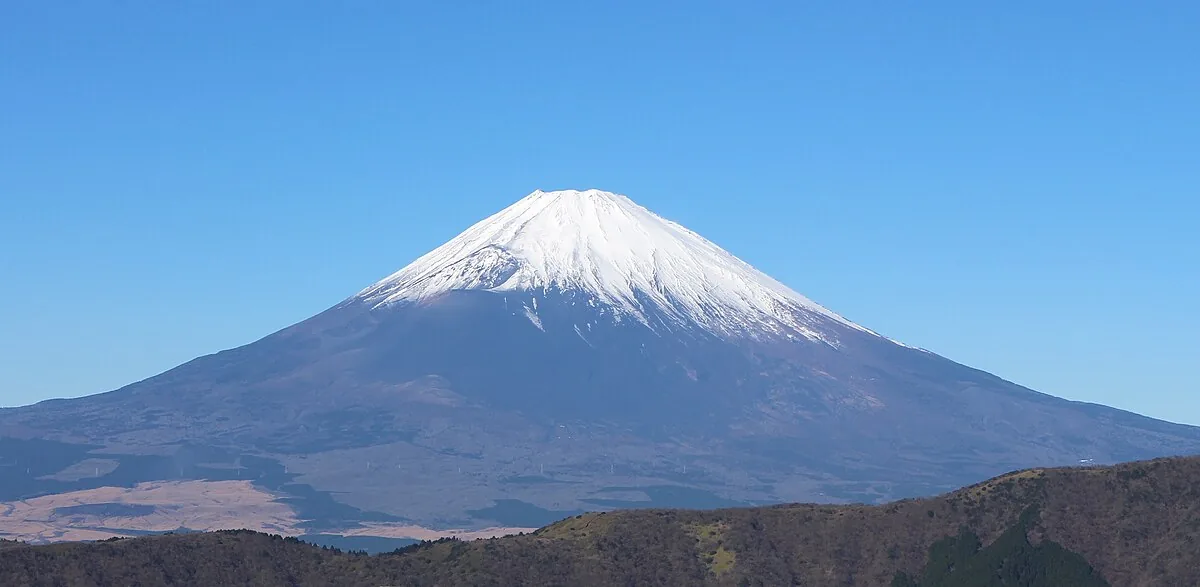
Visible from the skyscrapers of Tokyo on a crisp winter morning, this dormant stratovolcano is the ultimate anchor for the Japanese psyche. Fuji-san occupies a space between geology and divinity, its near-perfect conical silhouette rising 3,776 meters above the Suruga Bay. On all sides, the around the base is often smelling of damp cedar and the sulfurous whisper of volcanic history. There is a landscape of high-altitude lakes and ancient forests that have grown over frozen lava flows. The mountain does not just sit on the horizon; it dominates the light and weather of central Honshu, creating its own lens-shaped clouds that hover like guardian spirits above the snow-capped peak.
Its importance
Ancient Shinto traditions identify the mountain as the home of Princess Konohanasakuya, the goddess of flowering trees, whose presence is said to keep the volcano from erupting. Across centuries, Fuji was a forbidden sanctuary, with women officially barred from climbing until the Meiji Restoration in 1872. The first recorded ascent was by an anonymous monk in 663, beginning a millennium of religious pilgrimage where devotees clad in white robes sought spiritual purification. During the Edo period, the mountain became a global icon through the woodblock prints of Hokusai, who captured its changing moods across thirty-six different views. It remains an active volcano, though its last major eruption in 1707 rained ash upon the streets of distant Edo, shaping the topography of the Hoei crater still visible on its flank today.
Standing at the Fifth Station in the pre-dawn cold, the thin, biting air tighten your chest. The opening note is the crunch of volcanic scoria under your boots, a sound that echoes in the vast silence above the tree line. The path is a relentless zig-zag of rusted earth and grey stone, illuminated by a serpentine line of headlamps from fellow climbers. There is a wind gain a jagged edge passing the eighth station, where the smell of woodsmoke from the mountain huts offers a momentary comfort. The piece that stays with you is 'Goraiko', the arrival of light. As the sun breaks the horizon, the shadow of the mountain stretches for miles across the clouds below, a perfect blue triangle cast upon a sea of vapor. Most visitors depart from Shinjuku Station in Tokyo, taking the Fuji Excursion limited express train directly to Kawaguchiko. From there, local buses climb the winding roads to the Subaru Line 5th Station, the most popular starting point for the ascent. The climbing season is strictly limited to July and August when the trails are free of snow and the huts are operational. For those preferring the view to the climb, the northern shores of Lake Kawaguchi provide the most stable photographic angles. Arriving at the lakeside at 5:00 AM during the autumn months often rewards you with the 'Double Fuji', a flawless reflection in the mirror-still water before the morning breeze disturbs the surface.
The Experience
At the summit smells faintly of cold iron and old snow. Instantly, the deep red of the crater walls, a stark contrast to the brilliant white of the clouds swirling beneath your feet. There is a immense gravity of the silence once the wind drops, a stillness that makes the distant hum of the world below seem entirely irrelevant. Audibly, the of a brass bell at a summit shrine provides a sharp, metallic punctuation to your thoughts. Those who come focus on the upward struggle, but the real magic is the descent through the volcanic clouds, where the light turns a hazy, ethereal gold and the world slowly regains its color and warmth.
Why It Matters
Mount Fuji is the singular visual shorthand for Japan and a sacred site of outstanding importance. It represents the delicate balance between the destructive power of nature and the human desire for aesthetic perfection. Culturally, it has influenced everything from the poetry of the Manyoshu to modern photography, standing as a silent witness to the country’s entire recorded history.
Why Visit
Standing on the rim of the crater at dawn offers a perspective on Japan that no skyscraper can match. You come here to experience the 'borderland', the place where the earth meets the sky in a way that feels intentional. It is the only place on earth where a mountain feels less like a rock and more like a collective prayer.
✦ Photo Gallery
Best Season
🌤 Climb in late July for the best weather, but visit the Five Lakes in November when the maple leaves frame the snow-capped peak in brilliant vermilion.
Quick Facts
Entry
Free to view; climbing in season carries a trail conservation fee of around 2,000 yen.
Opening hours
Viewable year-round; the official climbing season runs roughly early July to early September.
Time needed
A viewpoint stop takes an hour or two; climbing is a 1 to 2 day undertaking.
Best time to visit
Climb in late July for the best weather, but visit the Five Lakes in November when the maple leaves frame the snow-capped peak in brilliant vermilion.
Getting there
Around the Fuji Five Lakes and Hakone, southwest of Tokyo; reached by bus or train from Tokyo in about 2 hours, with the 5th Station the usual climb start.
What's nearby
Shibuya Crossing, Tokyo National Museum and Matsumoto Castle are also in the area.
Location
Fujinomiya, Japan
Type
attraction
Coordinates
35.3608°, 138.7275°
Insider Tips
- 1
Bring a 100-yen coin for the summit toilets; they are the most expensive and well-maintained mountain facilities you will ever use.
- 2
Buy a wooden climbing stick at the base and have it branded with hot stamps at every station as a permanent, charred record of your progress.
- 3
The descent trail is different from the ascent and is composed of loose ash; gaiters are essential to keep rocks out of your boots.
- 4
Avoid the Obon holiday week in mid-August unless you enjoy standing in a human traffic jam at 3,000 meters.
- 5
Eat a bowl of 'Hoto' noodles in Kawaguchiko after your climb; the thick wheat ribbons and pumpkin broth were famously the fuel of samurai.