The bronze cast of this Buddha was so massive that it consumed nearly all of Japan's eighth-century copper supply, nearly toppling the national economy to save the national soul.
About Todai-ji
The temple served as the administrative head of a national network of provincial temples, making Nara the literal and figurative center of Japanese Buddhism. Its power grew so great that the capital was eventually moved to Kyoto just to escape the political influence of the Todai-ji monks. The Nandaimon Gate, rebuilt in 1199, showcases the 'Daibutsu-yo' architectural style, characterized by its exposed horizontal beams and lack of ceilings. In the 20th century, the temple became a symbol of cultural preservation, surviving the modernization of the Meiji era to become a pillar of the Nara UNESCO World Heritage site.
What Todai-ji actually is
Massive wooden pillars support the world's largest bronze Buddha within a hall that remains the largest timber building on the planet, despite being only two-thirds of its original size. Todai-ji is the spiritual anchor of Nara, a colossal born from the eighth-century ambition of an empire seeking divine protection. Inside, the space the Daibutsuden (Great Buddha Hall) is thick with the heavy, sweet scent of incense and the dry aroma of ancient cypress. The walk across cold stone floors, dwarfed by the sixteen-meter-tall Daibutsu, whose hand alone is the height of a grown man. Outside, the sound of the city is replaced by the clicking of wooden sandals and the persistent, gentle grunting of the sacred deer that roam the temple grounds.
“Massive wooden pillars support the world's largest bronze Buddha within a hall that remains the largest timber building on the planet, despite being only two-thirds of its original size.”
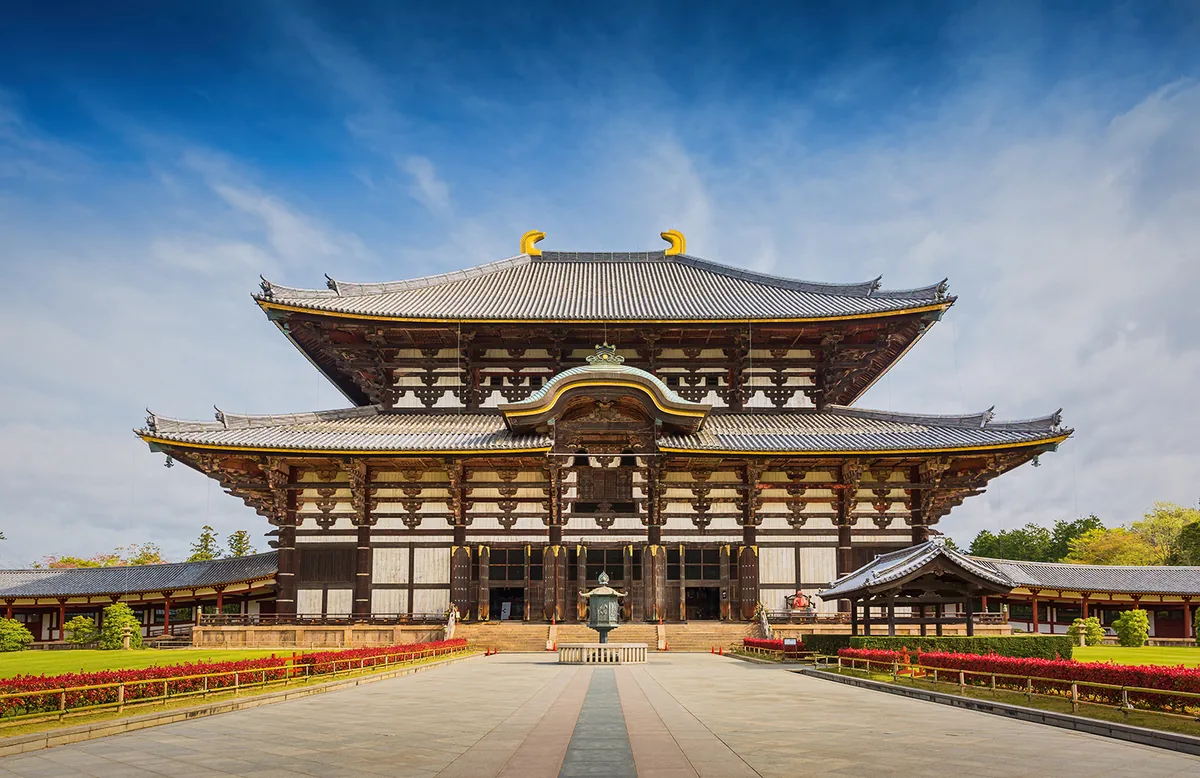
Todai-ji, Japan
Commissioned by Emperor Shomu
Emperor Shomu commissioned the temple in 728 during a time of smallpox outbreaks and political unrest, hoping that a massive display of Buddhist faith would stabilize the nation. The construction was a staggering collective effort that nearly bankrupted the young Japanese state, requiring eight years of work and over 400 tons of bronze. The original temple complex was even more immense, featuring twin seven-story pagodas that reached 100 meters into the sky. Fires, earthquakes, and civil wars took their toll over the centuries, with the current hall dating back to a 1709 reconstruction. The Daibutsu itself has had its head replaced twice due to seismic damage, yet it remains seated on a lotus throne of 56 petals, each engraved with scenes of the Buddhist cosmos.
Approaching the Nandaimon gate, the raw
Approaching the Nandaimon gate, The raw power of the two Nio guardian statues, their wooden muscles bulging in a permanent snarl. The first thing you register is the deer nudging your pockets for crackers, their damp noses a tactile reminder of the temple’s living history. Layered on top of this inside the hall is a cavernous echo of chanting and the metallic ring of coins falling into offering boxes. The sheer verticality of the space looking up into the intricate web of brackets and beams that hold the roof aloft. Starting with the 'healing pillar' near the back of the hall, where children and the adventurous squeeze through a hole the size of the Buddha's nostril, a ritual believed to grant enlightenment in the next life.
Todai-ji is a twenty-minute walk
Todai-ji is a twenty-minute walk from Kintetsu Nara Station or a slightly longer walk from the JR Nara Station. The path leads through Nara Park, where the resident deer act as a self-appointed welcoming committee. Arriving before 8:00 AM allows you to see the monks performing their morning duties before the heavy flow of school groups begins. To see the temple at its most dramatic, visit during the Omizutori ceremony in early March, when giant torches are carried along the balcony of the nearby Nigatsu-do hall, showering the crowds below in sparks of 'divine' fire.
“Todai-ji is a twenty-minute walk from Kintetsu Nara Station or a slightly longer walk from the JR Nara Station.”
The Experience
Arriving at Todai-ji is one of overwhelming scale that somehow manages to feel intimate. Beginning with the faint green patina on the Buddha’s bronze chest and the way the shadows congregate in the rafters. A trace of the vibration of the great bell, the largest in Japan, when it is struck during major ceremonies. The smell of the surrounding cedar groves mingles with the temple’s internal musk of old paper and wood. The most quiet moment is found at the Sangatsu-do hall further up the hill, where the dry-lacquer statues have stood in silent meditation for twelve hundred years. It is a place that forces you to acknowledge the endurance of faith through the medium of timber and bronze.
Why It Matters
Todai-ji is the headquarters of the Kegon school of Buddhism and a masterpiece of world architecture. It represents the height of the Tenpyo culture and the first great flourishing of international Buddhist art in Japan. Historically, it is the most important monument of the Nara period, preserving techniques of casting and carpentry that have been lost elsewhere.
Why Visit
Photographs fail to capture the physical pressure of this building. You need to stand under the shadow of the Buddha’s hand to understand the psychological weight of the eighth century. You come here for the giants, the statues, the gate, the hall, and the realization that humans once built things to last forever using nothing but joinery and devotion.
Insider Tips
- 1
The deer are considered sacred but they are also opportunistic; hide any paper maps or tickets or they will be eaten within seconds.
- 2
The hole in the pillar is exactly the size of the Great Buddha's nostril; if you can fit through it, legend says you are guaranteed a spot in paradise.
- 3
Look for the small museum near the entrance to see the original silver and gold artifacts found buried beneath the Buddha's throne.
- 4
Walk the path from the Nandaimon gate to the main hall slowly to appreciate the perspective shift as the building reveals its true size.