The buildings directly beneath the explosion survived because the blast was so vertical it simply pushed the stone walls into the earth rather than blowing them over.
About Hiroshima Peace Memorial
The site began as a packed hub for trade and exhibitions, located at the core of Hiroshima’s commercial district. Following the 1945 blast, the area was initially considered uninhabitable due to radiation, yet plants began to sprout through the ash just months later. The Peace Memorial Park was designed by the great Japanese architect Kenzo Tange, who envisioned a space that didn't just mourn the past but functioned as a laboratory for peace. In 1996, despite objections from some nations, the Genbaku Dome was added to the UNESCO World Heritage list as a 'negative' heritage site to ensure the tragedy is never repeated.
What Hiroshima Peace Memorial actually is
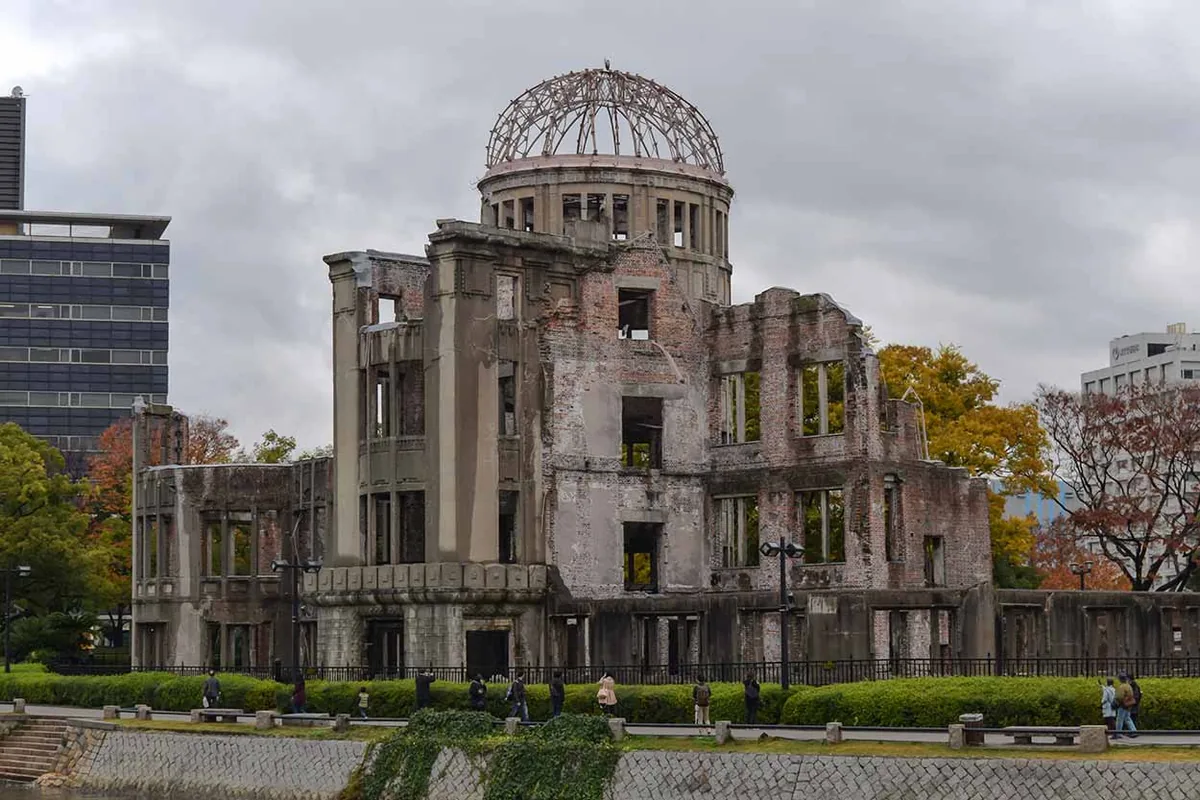
A skeletal dome of twisted iron and scorched brick stands at the confluence of two rivers, preserved exactly as it looked on the morning of August 6, 1945. The Hiroshima Peace Memorial, widely known as the Genbaku Dome, is a haunting skeletal remains of what was once the city’s Industrial Promotion Hall. While the modern city of Hiroshima has rebuilt itself with glass towers and noisy shopping arcades, this five-story ruins remains a silent, stationary witness to the first use of a nuclear weapon on a human population. It is a stark, physical reminder of the thin line between civilization and total annihilation, standing in a park that has been transformed from a charred wasteland into a verdant sanctuary of memory and hope.
Letzel and completed, 1915
Designed by Czech architect Jan Letzel and completed in 1915, the building was once a symbol of Hiroshima's growing economic prowess. At 8:15 AM on that fateful Monday, the atomic bomb exploded almost directly above the dome. Because the blast came from nearly vertical, the thick stone walls and the copper-covered dome managed to withstand the downward pressure that leveled every other building for kilometers. In the years following the war, there was a fierce debate among survivors over whether to demolish the ruin or preserve it. Ultimately, the city chose to keep the dome as a permanent memorial, reinforcing the structure with barely visible steel supports to ensure it remains proof for future generations.
Standing across the Motoyasu River,
Standing across the Motoyasu River, The absolute silence that often hangs around the ruin, even in the middle of a busy workday. Nearby, the river water lapping against the stone banks is the only constant. There is a profound sense of heavy stillness looking at the piles of rubble still lying exactly where they fell eighty years ago. The air around the nearby Children’s Peace Monument often smells faintly of paper and wax from the millions of colorful origami cranes sent by children from every corner of the globe. Frequently skipped is the 'shadow' steps of the nearby bank, where a human being’s outline was burned into stone by the heat of the blast. The element that stays with you is the sight of the Eternal Flame of Peace, which will only be extinguished when the last nuclear weapon on earth has been dismantled.
Hiroshima is easily accessible via
Hiroshima is easily accessible via the Sanyo Shinkansen, roughly ninety minutes from Osaka. From Hiroshima Station, the 'Green' or 'Orange' routes of the Hiroshima Sightseeing Loop Bus take you directly to the Peace Memorial Park. However, taking the local streetcar, the iconic 'Hiroden', is the more authentic way to arrive. These trams are a symbol of the city’s resilience, as some of the original carriages were back on the tracks just three days after the bombing. The walk from the tram stop across the Aioi Bridge offers the most dramatic first view of the Dome emerging from the trees.
The Experience
What registers is the way the light catches the rust on the iron girders, a dark orange that looks like dried blood against the blue sky. The grain of the site is defined by the contrast between the jagged, heat-warped bricks and the smooth, manicured lawns of the surrounding park. There is a feeling of collective weight of the thousands of names inscribed in the Cenotaph, each representing a life cut short in a fraction of a second. Most visitors miss the small stone markers scattered throughout the park that indicate where pre-war neighborhoods and hospitals once stood. What sticks with you is seeing a survivor, a 'hibakusha,' quietly tending to the flowers near the dome.
Why It Matters
The Hiroshima Peace Memorial is the ultimate monument to the nuclear age. It goes beyond national history to become a universal symbol of human fragility and the terrifying power of our own inventions. It serves as a physical plea for total disarmament and born from the resilience of the human spirit in the face of absolute destruction.
Why Visit
Visit Hiroshima because it is a place of profound moral clarity. While other landmarks celebrate victory or architectural beauty, this site demands that you confront the most difficult questions of the 20th century. It is an essential pilgrimage for anyone who wants to understand the true cost of war and the incredible capacity of a city to forgive and rebuild.
✦ Photo Gallery
Best Season
🌤 August 6th is the most moving time for the annual lantern floating ceremony, but early April offers a poignant contrast as the cherry blossoms bloom around the ruins of the dome.
Quick Facts
Best time to visit
August 6th is the most moving time for the annual lantern floating ceremony, but early April offers a poignant contrast as the cherry blossoms bloom around the ruins of the dome.
Getting there
In Hiroshima, Japan; reach Hiroshima first, then continue to the site.
Location
Hiroshima, Japan
Type
attraction
Coordinates
34.3956°, 132.4536°
Insider Tips
- 1
Enter the Peace Memorial Museum early in the morning to allow yourself time to process the intense emotional weight of the exhibits.
- 2
Look for the 'A-bombed trees' (Hibakujumoku) within the park; these are trees that survived the blast and still bear the scars of the heat on one side.
- 3
The mound of paper cranes is refreshed daily; you can fold and leave your own at the Children’s Peace Monument as a gesture of solidarity.
- 4
Visit the Rest House, one of the few other buildings that survived; the basement remains in its original, scorched condition and can be viewed by request.
- 5
Eat at one of the 'Okonomimura' stalls nearby afterward; the city’s signature soul food is a vital part of its post-war cultural recovery.