“This garden shouldn't technically exist, as it successfully combines six landscape qualities that ancient Chinese philosophers claimed were mutually exclusive.”
About Kenroku-en
The garden's development spanned the reign of several Maeda lords, beginning with a simple water channel in 1676 and culminating in the grand landscaping of the 19th century. It survived the abolition of the samurai class, opening to the public in 1874. Throughout its history, it served as the ultimate status symbol of the Kaga Domain, which was so wealthy it was often called 'the land of a million koku of rice.' The garden was designed not just for beauty, but as a sophisticated hydraulic achievement, using natural pressure to power fountains without any modern machinery.
What Kenroku-en actually is
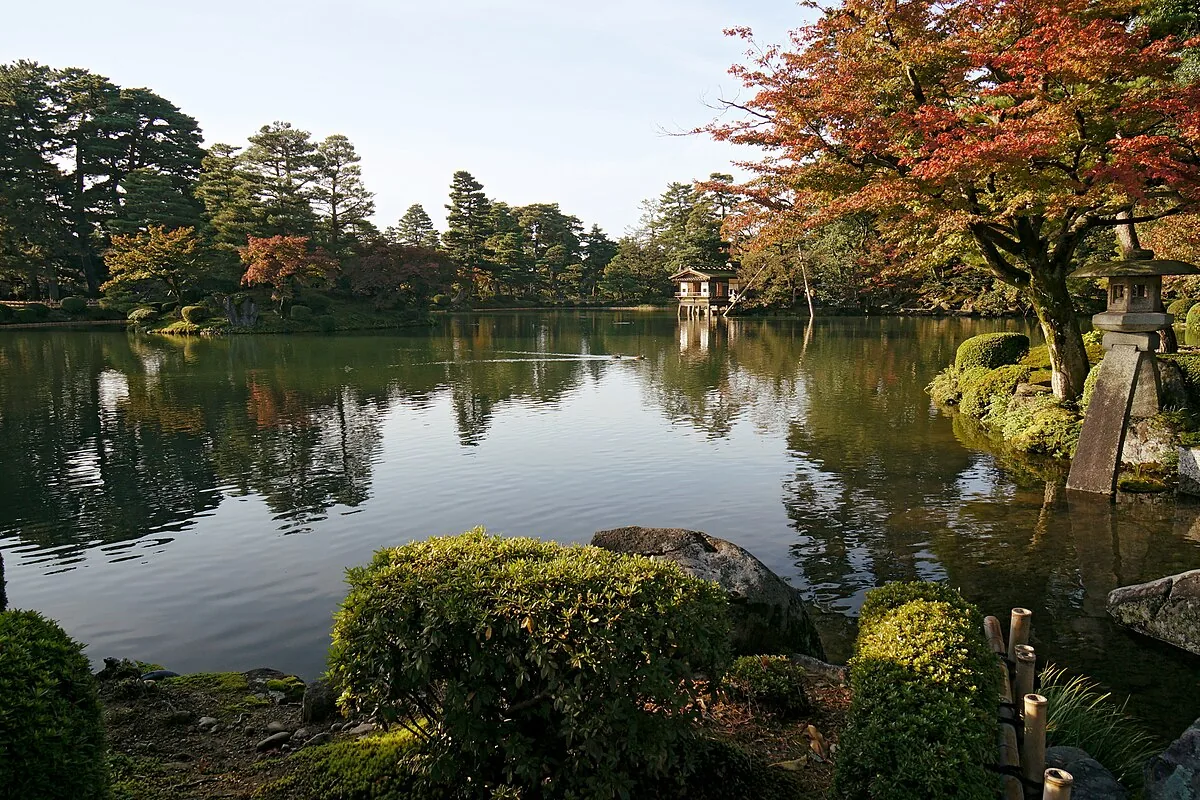
Water flows uphill, trees are supported by golden ropes, and every view is a meticulously composed painting in this sanctuary in Kanazawa. Kenroku-en is widely considered the finest example of the 'strolling garden' in Japan, designed over two centuries by the Maeda clan. Its name translates to the 'Garden of the Six Sublimities,' referring to a Chinese landscape theory that suggests no garden can possess all six essential qualities, spaciousness, seclusion, artifice, antiquity, waterways, and panoramas, because they contradict one another. Yet, Kenroku-en achieves this impossible balance. Here, the hum of the city disappears, replaced by the trickle of Japan’s oldest fountain and the soft rustle of ancient pines that have been groomed for generations to look like they grew that way by divine accident.
Water flows uphill, trees are supported by golden ropes, and every view is a meticulously composed painting in this sanctuary in Kanazawa.
The Maeda lords, the second most powerful family
The Maeda lords, the second most powerful family in feudal Japan, began work on this private retreat in the 1620s. It wasn't completed until the 1840s, reflecting the changing tastes and immense wealth of the Kanazawa region. The garden was almost destroyed in 1759 by a massive fire that swept through the city, but it was lovingly restored and expanded to its current eleven-hectare glory. During the winter, the garden’s most iconic feature becomes visible: the 'yukizuri.' These are umbrella-like structures of hemp rope that protect the limbs of the Karasaki Pine from being crushed by Kanazawa’s famously heavy, wet snow. This functional necessity has become an art form in itself, transforming the garden into a geometric wonderland of gold and green.
Visiting Kenroku-en
Walking across the Kotoji-toro stone lantern bridge, The two legs of the lantern are unevenly set, one in the water, one on land, a deliberate imperfection meant to catch the eye. Around you it is cool and moist, smelling of moss and the occasional whiff of matcha from the nearby teahouses. Audible: the water, which is cleverly channeled from a river miles away to create a series of ponds that stay clear and vibrant year-round. The crunch of fine gravel underfoot, a sound that highlights the profound stillness of the deeper groves. People often miss the 'Pagoda of the Seven Stars' on the island in the center of the pond, a silent monument to the garden's spiritual roots. The element that stays with you is standing on the Yamazaki Hill at sunset, watching the light catch the golden ropes of the yukizuri while the plum blossoms glow in the fading light.
Kanazawa is a major stop
Kanazawa is a major stop on the Hokuriku Shinkansen, roughly two and a half hours from Tokyo. From Kanazawa Station, the Kenrokuen Shuttle or the Kanazawa Loop Bus takes you directly to the garden gates in about fifteen minutes. The garden sits adjacent to Kanazawa Castle Park and the 21st Century Museum of Contemporary Art, making it the geographical and cultural heart of the city. The crossing of the nearby Higashi Chaya district before entering the garden provides the perfect historical context for the aristocratic beauty you are about to witness.
Kanazawa is a major stop on the Hokuriku Shinkansen, roughly two and a half hours from Tokyo.
The Experience
Notice the way the gardeners work in total silence, using hand tools to groom the moss as if it were a delicate carpet. You hear the waterfall near the tea house provides a constant, soothing white noise that blocks out the nearby road. There is a feeling of intentionality behind every curving path, designed to reveal a new 'framed' view every few steps. Most visitors miss the ancient cherry tree that has been grafted into a pine to create a hybrid of two seasons. The detail that stays with you is seeing the reflection of the ropes in the perfectly still water of Kasumiga-ike pond.
Why It Matters
Kenroku-en is the gold standard of the Japanese garden aesthetic. It represents the pinnacle of Edo-period horticulture and civil engineering. It serves as a living museum of botanical techniques, some of which are hundreds of years old and are practiced nowhere else in the world with such precision.
Why Visit
Visit Kenroku-en to see how the Japanese have mastered the art of controlling nature to make it look even more natural. While other gardens feel like small enclosures, this place feels like a sprawling, miniature universe. It is the only place where a piece of rope, the yukizuri, is as famous and beautiful as the tree it protects.
✦ Insider Tips
- 1
Visit the Shigure-tei tea house for a traditional bowl of matcha; the view from its tatami rooms is the same one the Maeda lords enjoyed.
- 2
The garden is free to enter for one hour before the official opening time, the 'early bird' entry is the only way to see it without crowds.
- 3
Look for the oldest fountain in Japan; it operates entirely on the natural water pressure from the higher ponds.
- 4
Wear shoes that are easy to slip on and off if you plan to visit the teahouses or the nearby castle buildings.
- 5
Check the 'evening illumination' schedule; during certain weeks in February and November, the garden is lit up, creating a hauntingly beautiful scene.