“While most Japanese castles are reconstructions of white plaster, this original 16th-century fortress is painted a deep, menacing black to symbolize its role as an impenetrable 'crow' in the mountains.”
About Matsumoto Castle
Matsumoto Castle was built on the remains of a previous fortification called Fukashi Castle. Its unique six-story keep actually hides a secret seventh floor, a tactical deception meant to confuse enemies about the number of soldiers within. Following the end of the samurai era in 1868, the new Meiji government planned to demolish the castle to sell the timber and iron. It was saved twice: once by a local leader named Ichikawa Ryozo who organized an exhibition to raise funds, and again in the 1910s when a high school principal led a second renovation campaign. It was designated a National Treasure in 1952, cementing its status as an irreplaceable link to Japan's feudal past.
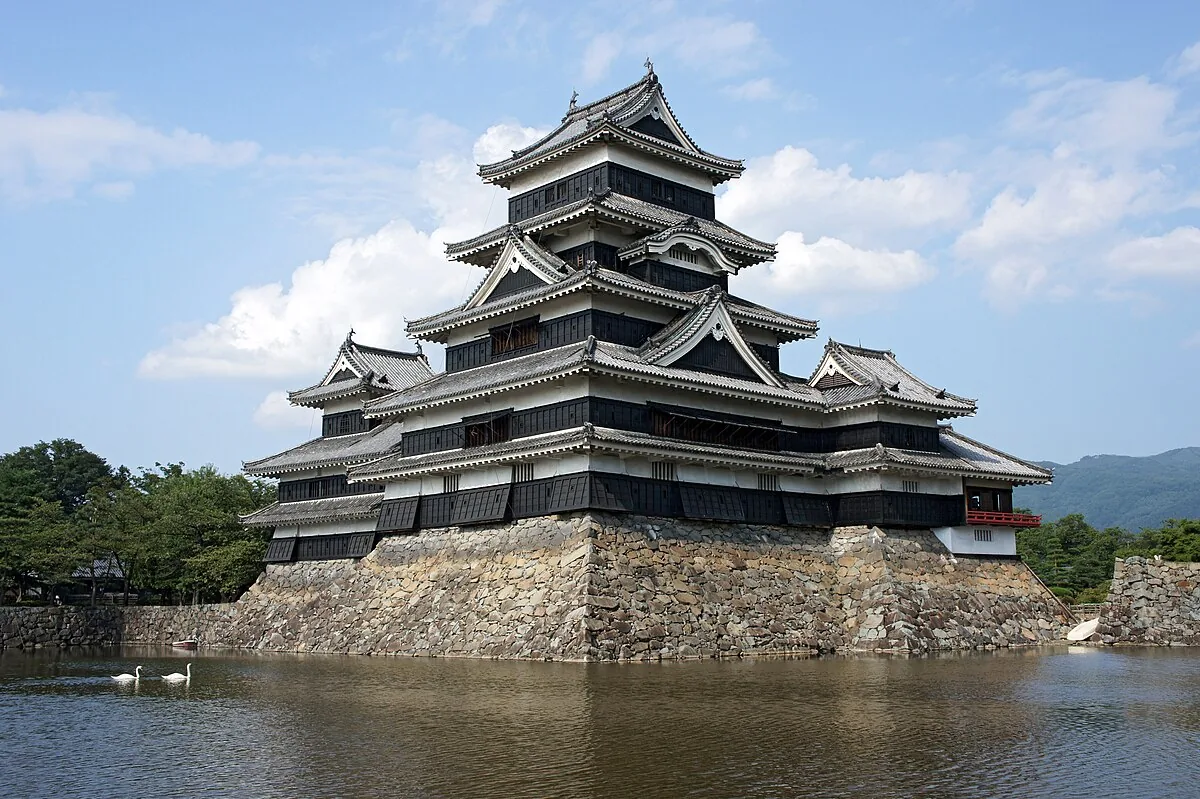
Matsumoto Castle
Black-lacquered wooden walls rise above a wide, swan-filled moat, their dark surfaces earning this fortress the nickname 'The Crow Castle.' Matsumoto Castle is one of Japan's premier historic sites, standing as one of the few original medieval strongholds that was not rebuilt from concrete in the 20th century. The area here is crisp with the altitude of the Japanese Alps, smelling of pine needles and the cold, still water of the moat. The walk across a bright red vermilion bridge that provides a startling contrast to the somber, monochromatic elegance of the keep. The sound is a quiet mix of the wind through the cherry trees and the rhythmic creaking of the original 16th-century floorboards climbing toward the moon-viewing pavilion.
' Matsumoto Castle is one of Japan's premier historic sites, standing as one of the few original medieval strongholds that was not rebuilt from concrete in the 20th century.
Construction began in 1592 during the Sengoku, or
Construction began in 1592 during the Sengoku, or Warring States period, under the orders of the Ishikawa clan. Unlike many Japanese castles built on high hills, Matsumoto is a 'hirajiro' or flatland castle, relying on its complex system of moats and gatehouses for defense. It was designed for a long siege, featuring hidden floors where samurai could wait in ambush and specialized windows for dropping stones on invaders. Paradoxically, the castle also features a 'Tsukimi-yagura' or Moon Viewing Room, added in 1633 during a time of peace, representing a transition from military necessity to aesthetic leisure. It survived the Meiji-era demolition craze only because local residents pooled their money to buy the structure and preserve it for the future.
Climbing the interior stairs, the sheer
Climbing the interior stairs, The sheer verticality of the design, with steps so steep they require the use of handrails to navigate. You register the way the light filters through the narrow 'arrow slits,' illuminating the dust motes in the air and the heavy, hand-hewn cedar beams. The sound is a series of deep, resonant echoes that make every footstep feel significant. You get a texture of the original plaster and the cold iron of the hinges on the massive doors. Instantly, the collection of matchlock firearms on the second floor, a trace of the castle's violent origins. The most evocative moment is reaching the top floor and looking out over the tiled roofs toward the snow-capped peaks of the Hida Mountains, realizing the castle was the literal and figurative center of its world.
Matsumoto is easily reached from Tokyo
Matsumoto is easily reached from Tokyo by the Limited Express Azusa train from Shinjuku Station, a journey of about two and a half hours. The castle is a fifteen-minute walk or a short bus ride from Matsumoto Station. Because the interior is original wood, you must remove your shoes and carry them in a plastic bag; thick socks are recommended as the floors are cold in any season. Arriving at the castle park at sunset provides the best photographic conditions, as the black walls absorb the orange light and the reflection in the moat becomes a perfect, dark mirror.
Matsumoto is easily reached from Tokyo by the Limited Express Azusa train from Shinjuku Station, a journey of about two and a half hours.
The Experience
The atmosphere inside the castle is one of focused, functional beauty. The standout is the smell of the old wood, dry, slightly spicy, and heavy with the weight of four hundred years. A trace of the transition from the dark, defensive lower levels to the airy, open upper floors where the lord would have received guests. The sound of the wind rattling the wooden shutters is a haunting reminder of the castle's isolation during the long Nagano winters. The most striking detail is the lack of any decoration; the beauty comes entirely from the geometry of the joinery and the raw strength of the materials. It is a place that feels built by people who valued survival above all else.
Why It Matters
Matsumoto Castle is one of only five castles in Japan designated as a National Treasure and the oldest five-tiered, six-story castle keep remaining in the country. It represents the peak of military architecture before the long peace of the Edo period. Culturally, it is a symbol of civic pride, having been saved by its own citizens twice in the face of modernization.
Why Visit
The reason to visit: you want to see a castle that is 'real' rather than a museum. Matsumoto is a tactile experience of the 16th century, where you can touch the same wood that samurai leaned against while waiting for battle. You come here for the black-on-white elegance and the view of the Alps, but you stay for the thrill of climbing those impossibly steep stairs.
✦ Insider Tips
- 1
Wear thick, thermal socks; the original wooden floors are beautiful but will freeze your feet within ten minutes during the winter and spring.
- 2
Don't try to climb the stairs with a heavy backpack; use the lockers at the entrance, as the staircases are narrow and very steep.
- 3
Look for the 'moishi' or stone-dropping windows near the base, designed to crush invaders attempting to scale the walls.
- 4
The castle is illuminated every night until 10:00 PM; a night walk around the moat is free and arguably more atmospheric than the daytime visit.
- 5
Visit the 'Nawate-dori' or Frog Street nearby after your visit for traditional snacks and a look at Matsumoto’s eccentric shopping history.