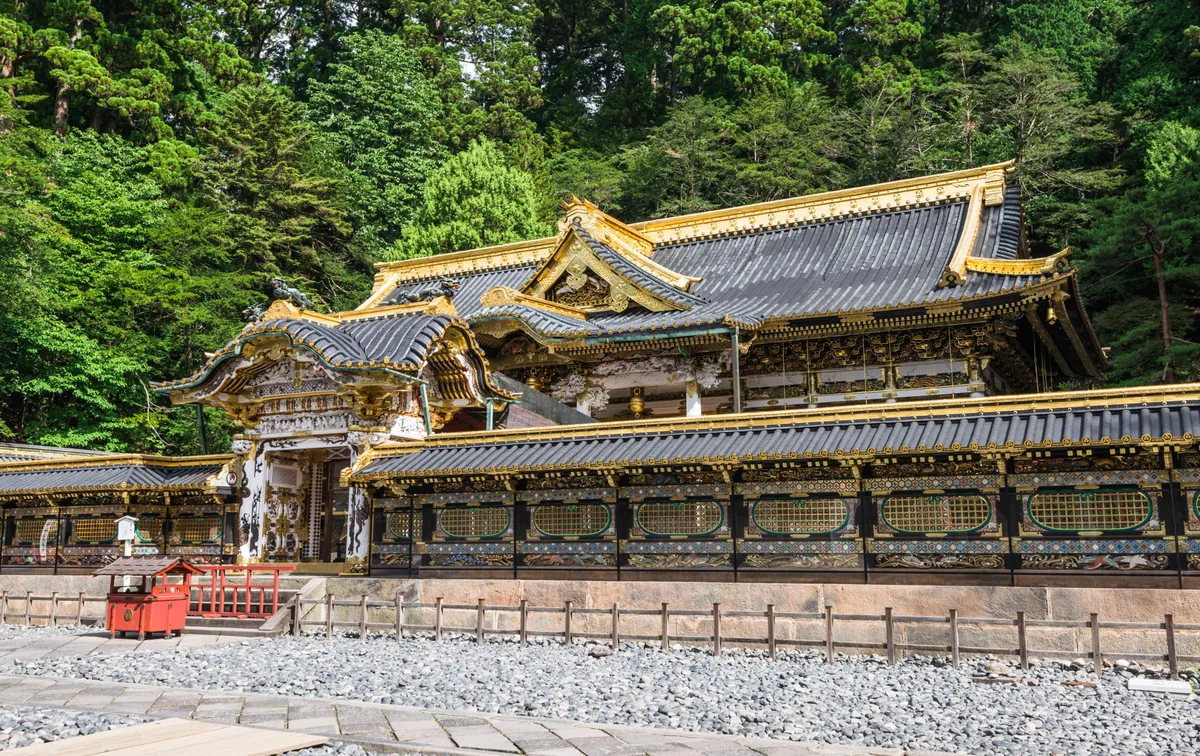
Fifteen thousand craftsmen spent two years and used five hundred kilograms of gold to ensure one man would never be forgotten by the gods or the living.
About Nikko Toshogu
Following the death of Tokugawa Ieyasu in 1616, his remains were moved to this mountain slope to guard the shogunate from the north. His grandson, Tokugawa Iemitsu, commissioned the current structure in 1636, intending it to be an architectural manifestation of the Tokugawa clan's absolute authority. Unlike the minimalist aesthetic typically associated with Zen Buddhism, Toshogu drew from the ornate style of the Azuchi-Momoyama period. It survived the Meiji Restoration’s purge of Shinto-Buddhist syncretism primarily because of its undeniable artistic value, eventually becoming a pillar of Japan’s national heritage.
What Nikko Toshogu is
Deep within a forest of towering, ancient cedars, the Nikko Toshogu Shrine erupts in a chaotic combination of gold leaf, polychrome carvings, and intricate woodwork. While most Japanese sacred spaces embrace the understated elegance of weathered wood and moss, this final resting place of Tokugawa Ieyasu, the founder of the Tokugawa Shogunate, screams with visual opulence. Over 500 kilograms of gold were used to gild its surfaces, creating a shimmering contrast against the deep emerald canopy of the surrounding mountains. Every inch of the Yomeimon Gate, often called the Twilight Gate because one could look at it until sunset without tiring of its details, tells a story of power, piety, and the sheer artistic ambition of the early 17th century.
Tokugawa Ieyasu died, 1616
Tokugawa Ieyasu died in 1616, leaving behind a legacy of national unification and a specific request to be deified as the 'Great Deity of the East Shining Light.' Originally a modest mausoleum, the complex was transformed into its current baroque brilliance twenty years later by his grandson, Iemitsu. Using a force of 15,000 master artisans and three centuries’ worth of accumulated wealth, the shogunate aimed to create a monument that made their divine right to rule indisputable. The project was so vast that it nearly bankrupted several provincial lords, but it successfully established Nikko as the spiritual heart of the Edo period, a place where the line between shogun and god became permanently blurred.
Passing through the Ishidorii stone gate
Passing through the Ishidorii stone gate, The air grows cooler and carries the heavy, sweet scent of damp cedar and incense. Audible: mountain streams trickling through stone channels provides a constant rhythmic backdrop to the chatter of visitors. There is a feeling of physical weight of the history climbing the stone steps toward the main keep, each riser worn smooth by centuries of pilgrims. The light here is fractured, filtered through the massive trees to strike the golden carvings in sudden, blinding flashes. What most skip is the 'Sleeping Cat' carving, tucked away above a corridor, which supposedly ensures the shrine remains free of pests. The moment that stays with you is standing before the Great Pagoda as a mountain mist rolls in, blurring the sharp edges of the crimson lacquer until the building looks like a ghost ship floating in a green sea.
Reaching this mountain sanctuary involves
Reaching this mountain sanctuary involves a two-hour train journey from Tokyo, typically via the Tobu-Nikko line from Asakusa. Once you arrive at the station, the shrine is a pleasant thirty-minute uphill walk through the town of Nikko, crossing the iconic Vermilion Shinkyo Bridge. Alternatively, the 'World Heritage' loop bus shuttles visitors directly to the forest entrance every few minutes. The walk is highly recommended if only to witness the transition from the modern gift shops to the sudden, cathedral-like silence of the cedar groves.
The Experience
The way the gold leaf reflects the forest floor, casting a warm, honeyed glow on the faces of everyone standing beneath the eaves. The feel of the place is a mix of rough, ancient bark and the glass-smooth finish of black lacquer. An impression of spiritual gravity of the inner sanctum, where the air seems to vibrate with the low resonance of a struck bronze bell. Most visitors miss the inverted pillar on the Yomeimon Gate, left upside down by design because the builders feared that a perfect structure would invite the jealousy of the gods.
Why It Matters
Nikko Toshogu represents a departure from traditional Japanese restraint, showcasing the pinnacle of Edo-period craftsmanship. It serves as a visual record of a time when art was used as a tool of political intimidation and religious devotion. It is where the warrior culture of the samurai met the refined aesthetic of the imperial court.
Why Visit
Visit Nikko Toshogu to see the side of Japan that isn't subtle. While Kyoto is a whisper, this is a roar. It offers an sensory overload that proves the samurai were as obsessed with beauty and detail as they were with battle and discipline.
✦ Photo Gallery
Best Season
🌤 October and November are spectacular, as the surrounding maples turn a fiery red that rivals the crimson lacquer of the shrine buildings under the clear autumn sky.
Quick Facts
Best time to visit
October and November are spectacular, as the surrounding maples turn a fiery red that rivals the crimson lacquer of the shrine buildings under the clear autumn sky.
Getting there
In Nikko, Japan; reach Nikko first, then continue to the site.
Location
Nikko, Japan
Type
attraction
Insider Tips
- 1
Look for the 'Three Wise Monkeys' on the Sacred Stable; the carving is part of an eight-panel series depicting the entire cycle of a human life.
- 2
Bring a small coin for the offering box at the inner shrine, but ensure you bow twice and clap twice as per Shinto tradition.
- 3
The stairs to the inner sanctum are steep and numerous; pace yourself as the altitude makes the climb more taxing than it looks.
- 4
Visit the nearby Tamozawa Imperial Villa afterward to see the stark contrast between the Shogun’s flashiness and the Emperor’s quiet elegance.
- 5
Check the belly of the 'Crying Dragon' painting in the Honjido Hall; the monks strike wooden blocks beneath it to demonstrate a unique acoustic resonance.