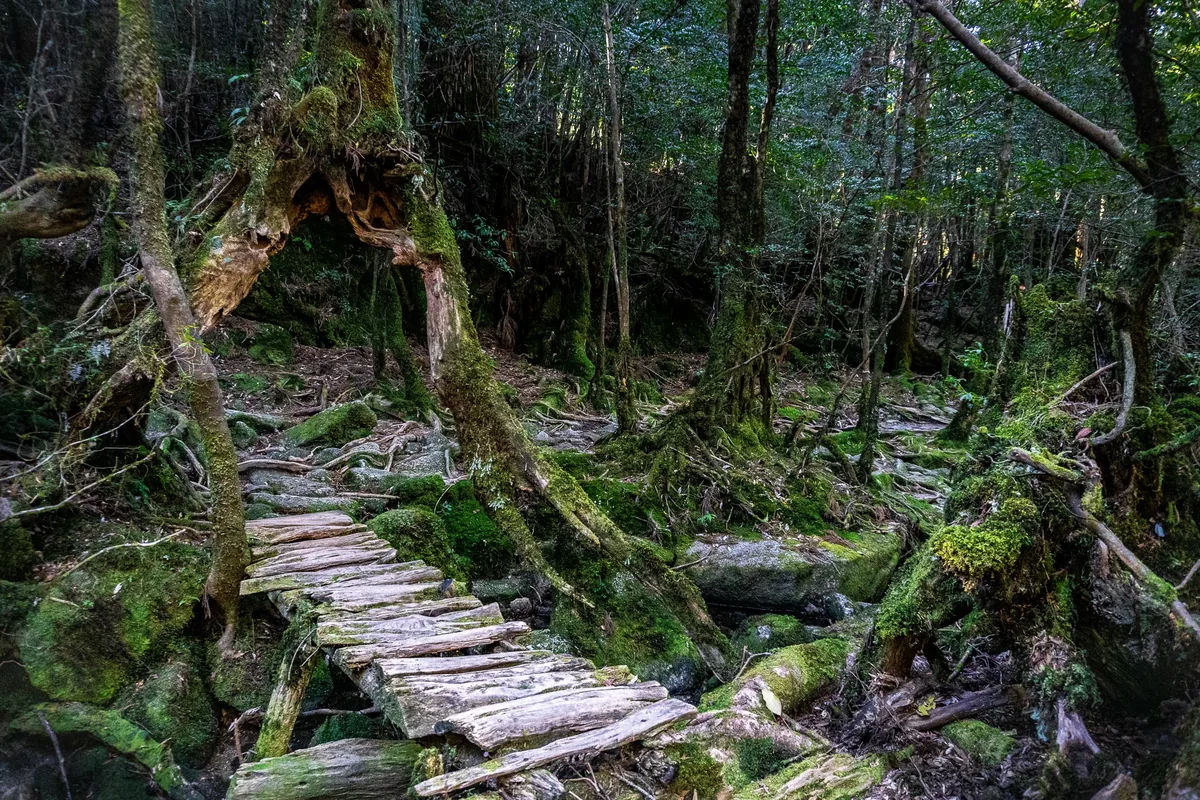
On an island where it is said to rain thirty-five days a month, this ravine has developed a layer of moss so thick it has swallowed the forest floor and the history of time.
About Shiratani Unsuikyo
The cedars of Yakushima, known as Yakusugi, are technically the same species as those on the mainland, but the island’s nutrient-poor granite soil and high rainfall slow their growth to a crawl. This results in incredibly dense, resin-heavy wood that can resist rot for thousands of years. During the Edo period, the island was a major source of shingles for the shogunate, but the rugged terrain of Shiratani Unsuikyo protected its oldest residents. Today, the forest is a living laboratory for biologists studying how ancient ecosystems adapt to extreme humidity. It remains one of the few places in Japan where you can stand in a landscape that looks exactly as it did five thousand years ago.
Shiratani Unsuikyo in Japan
Moss carpets every visible surface of this primeval ravine on the island of Yakushima, where prehistoric cedars twist into shapes that defy the laws of gravity. Shiratani Unsuikyo is a temperate rainforest that feels less like a park and more like a sunken, emerald world from another geological epoch. The air air here is incredibly saturated, smelling of rotting wood, fresh rain, and the sharp, medicinal scent of cedar resin. The walk along trails that alternate between wooden boardwalks and the gnarled, slippery roots of trees that have lived for two thousand years. The noise is a constant, percussive dripping of water from a hundred different heights and the rushing of clear, cold streams over granite boulders.
“Moss carpets every visible surface of this primeval ravine on the island of Yakushima, where prehistoric cedars twist into shapes that defy the laws of gravity.”
Shiratani Unsuikyo, Japan
Yakushima was the first site in Japan
Yakushima was the first site in Japan to be designated a UNESCO World Heritage site for its natural beauty, and Shiratani Unsuikyo is its most famous corner. The island’s unique climate, where it famously rains 'thirty-five days a month', allows for an extraordinary density of mosses, with over six hundred species covering the ravine. These forests was the visual inspiration for Hayao Miyazaki’s animated masterpiece, Princess Mononoke, and the 'Mononoke-no-mori' section of the trail is where the fictional world meets the real one. Over the centuries, these mountains were the domain of loggers seeking the high-resin wood of the Yakusugi cedars, but the most inaccessible parts of the ravine remained untouched, preserving a genetic line of trees that dates back to the Jomon period.
Yakushima is reached by a high-speed ferry or
Yakushima is reached by a high-speed ferry or a short flight from Kagoshima. From the port of Miyanoura, a thirty-minute bus ride climbs the steep mountain road to the entrance of Shiratani Unsuikyo. The park offers several hiking loops ranging from one to five hours; the 'Mononoke' trail is the most popular, while the trek to Taiko-iwa provides a rare panoramic view of the island's interior peaks. Because of the extreme rainfall, waterproof gear is not an option but a necessity. Arriving at the trailhead at 8:00 AM ensures you have enough light to navigate the trickier root sections before the afternoon mists roll in from the sea.
What the visit is like
Climbing the moss-covered steps toward the 'Taiko-iwa' rock, the humidity cling to your skin like a second garment. You catch the way the light is filtered through multiple layers of canopy, turning into a strange, underwater green that seems to have no source. Audible here is an immersive layer of bird calls and the muffled silence of the moss absorbing every footfall. A mark of the spongy texture of the ground and the cold, damp bark of the 'Kuguri-sugi', a cedar so large you can walk through its hollowed trunk. The tiny, white flowers that bloom directly on the mossy rocks and the deer that wander the forest with a complete lack of fear, looking like spirits moving through the fog.
The Experience
The mood of the ravine is one of profound, ancient dampness. The opening note is the smell of the earth, a deep, loamy fragrance that feels like it’s being inhaled directly from the lungs of the world. A trace of the shift in the air as you climb higher, the mist cooling your face and blurring the edges of the trees. In your ears of a hidden waterfall is often the only way to navigate when the fog becomes thick. The most magical moment is finding a patch of 'Yaku-shika' deer grazing in the Mononoke forest; their fur is damp and they move with a ghostly, silent grace. It is a place that makes you feel like an uninvited, but tolerated, guest in a very old house.
Why It Matters
Shiratani Unsuikyo is a premier example of a temperate ancient-growth forest and a pillar of Japan’s natural heritage. It represents the successful transition from an extractive logging economy to one based on deep ecological preservation. Culturally, it is the spiritual home of Japanese environmental animation and a site of pilgrimage for those seeking a connection to the prehistoric wild.
Why Visit
The point is that you need to see a world that has no straight lines. In Shiratani Unsuikyo, every tree and rock is a complex, curving sculpture of green. You come here to see the real-life inspiration for the spirits of the forest and to breathe air that is cleaner than anything you will find on the mainland. It is the closest thing to time travel that nature provides.
Insider Tips
- 1
Rent high-quality rain boots and a professional poncho in Miyanoura before you head up; your 'waterproof' city jacket will not survive an hour here.
- 2
The hike to Taiko-iwa rock is steep but the view of the island's 'granite heart' is the best reward in the park.
- 3
Don't just look at the big trees; use a macro lens or a magnifying glass to look at the moss, which contains entire miniature worlds of life.
- 4
The bus back to Miyanoura is infrequent, so photograph the timetable at the entrance to avoid a very long wait in the rain.
- 5
Bring a portable, waterproof seating pad; there is nowhere dry to sit for lunch in the entire ravine.