“Digital crows fly between rooms and flowers bloom only when you stand perfectly still in this museum where not a single piece of art is ever the same twice.”
About TeamLab Borderless
The concept of 'Borderless' was born from the teamLab collective's desire to liberate art from the physical constraints of frames and canvases. Founded by Toshiyuki Inoko, the group spent two decades refining the technology required to make different artworks recognize and interact with each other. When the first museum opened in 2018, it shattered global attendance records, proving a massive public appetite for immersive, interactive technology. The 2024 move to Azabudai Hills allowed the team to integrate even more advanced sensors, making the relationship between the human body and the digital light more seamless and responsive than ever before.
TeamLab Borderless in Japan
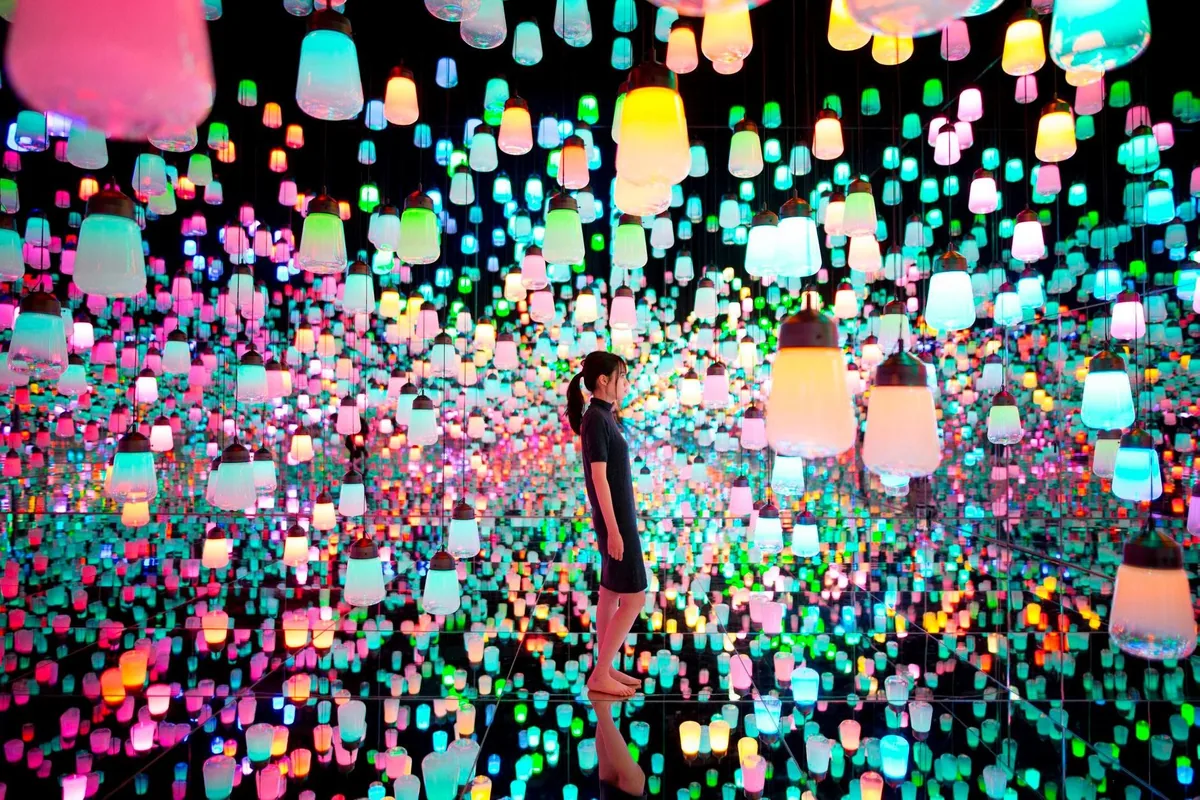
Digital waterfalls tumble over physical ledges and flowers bloom across the skin of passersby in a museum that lacks a single map or static boundary. TeamLab Borderless, recently reborn in the basement of Tokyo's Azabudai Hills, represents a radical departure from the traditional gallery experience. Sunlight never reaches these halls; instead, the environment is fueled by hundreds of computers and projectors creating a living, breathing ecosystem of light. Moving through a series of dark, interconnected rooms where the art literally walks out of one space and into the next. Butterflies might flutter from a forest of LEDs into a room filled with crystal rain, reacting to your presence and the movements of other visitors in real time.
Digital waterfalls tumble over physical ledges and flowers bloom across the skin of passersby in a museum that lacks a single map or static boundary.
The collective known as teamLab formed in 2001
The collective known as teamLab formed in 2001, comprising artists, programmers, engineers, and animators who sought to blur the line between the viewer and the work. Their original Borderless installation in Odaiba became the most visited single-artist museum in the world before closing its doors in 2022. This new iteration at Azabudai Hills is a more sophisticated evolution, utilizing complex algorithms that ensure no two moments are ever identical. The software creates a generative world that is not a pre-recorded loop but a constant calculation. Every flower that wilts and every bird that flies is a unique event occurring only once in the history of the museum.
Stepping through the heavy black curtains
Stepping through the heavy black curtains of the entrance, The immediate loss of your internal compass. What you catch first is the air smells faintly of ozone and expensive floral scents pumped through the ventilation to match the visual themes. The audio element is a binaural wash of orchestral swells and organic chirps that shift moving from the 'Forest of Lamps' to the 'Infinite Crystal Universe.' The soft, carpeted floors beneath your feet and the cold glass of the mirrors that line almost every wall to create an illusion of endless space. Right away you see how the light clings to your clothing, turning you into a canvas for the digital paint. The most profound moment occurs when you stop moving; the art begins to gravitate toward you, as if the museum itself is curious about your presence. The museum sits within the Azabudai Hills complex, accessible via the Kamiyacho Station on the Hibiya Line or Roppongi-itchome Station on the Namboku Line. Tickets must be purchased weeks in advance through the official website, as walk-ins are virtually nonexistent. Because the layout is intentionally confusing, you should allow at least three hours to ensure you stumble upon the smaller, more secluded rooms. Arriving for the final entry slot of the evening often provides a slightly more intimate experience, as the energy of the crowds thins and the generative art seems to settle into a more melancholic, nocturnal rhythm.
The Experience
The place feels one of sensory overload that eventually settles into a meditative trance. The way the light reflects in the pupils of people around you, making them look like part of the simulation. A strange urge to reach out and touch the digital waves, only to find the cool, flat surface of a wall. Audibly, the of thousands of tiny bell-like chimes in the lamp room creates a feeling of floating in a deep, electric ocean. What stays with you is wandering into a quiet corner and realizing a trail of digital flowers has followed you there. It is a place where you lose the distinction between what is programmed and what is felt.
The place feels one of sensory overload that eventually settles into a meditative trance.
Why It Matters
TeamLab Borderless is a global benchmark for the intersection of technology and fine art. It challenges the traditional role of the spectator, turning every visitor into a co-creator of the visual landscape. Humanly, it offers a rare space where we can experience a digital world that feels as fragile and ephemeral as the natural one.
Why Visit
See this because is the only place on earth where you can physically walk through the inside of a shifting mix. While other 'immersive' exhibits are just projections on walls, Borderless is a reactive world that needs you to exist. You come here to lose yourself in the literal sense, finding wonder in the dark corners of a computer's imagination.
✦ Insider Tips
- 1
Wear white or light-colored clothing so the digital projections can show up clearly on your body for photos.
- 2
Avoid wearing skirts or dresses, as many rooms have mirrored floors that will reflect everything upwards.
- 3
Visit the En Tea House inside the museum; the digital flowers bloom inside your actual cup of matcha as long as there is liquid in it.
- 4
There is no set path, so if a room looks crowded, walk away and return later; the art will likely have changed completely.
- 5
Bring a portable phone charger, as the constant photography and the museum's own app will drain your battery within an hour.