“Only a single gatehouse remains of a fortress that once guarded the world's richest trade route, saved from total destruction at the last second by a curious British officer.”
About A Famosa Porta de Santiago
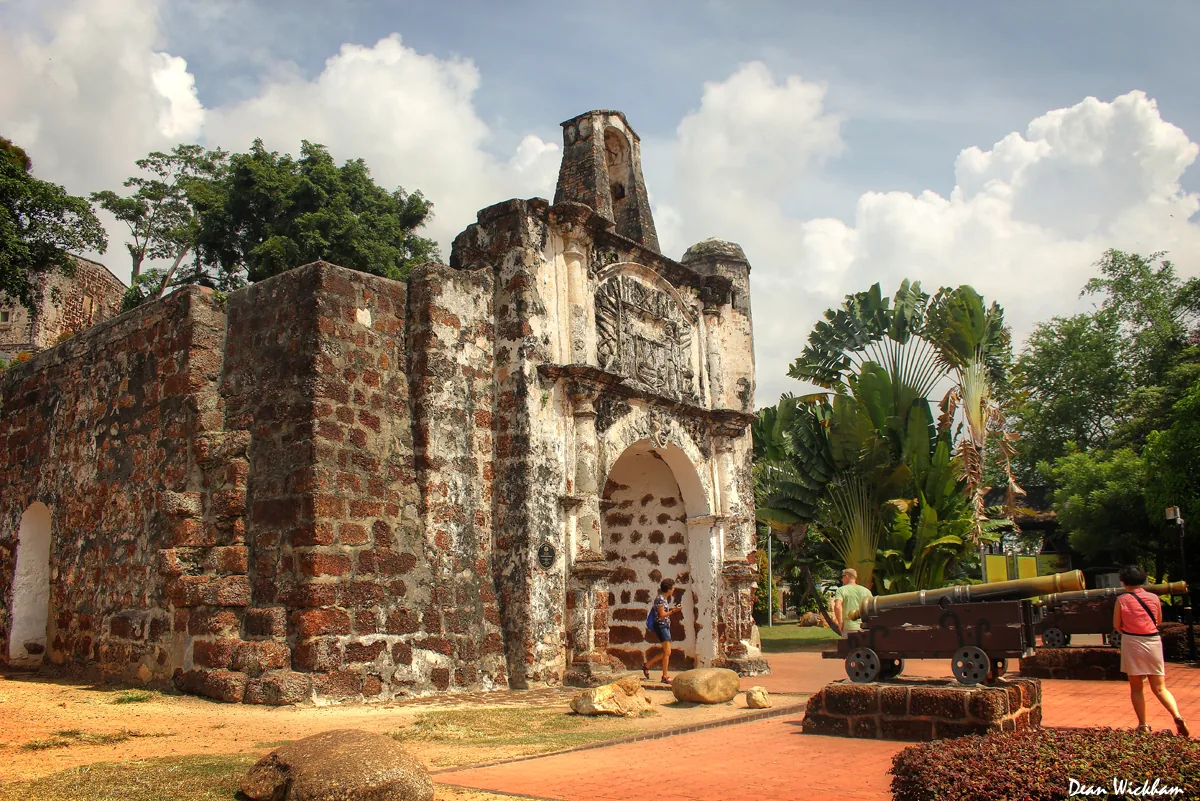
Porta de Santiago was the southern gateway of the Portuguese fortress, situated near the mouth of the Melaka River. For 130 years, it was the symbol of Portuguese maritime power in the East. After the Dutch victory in 1641, the gate was renovated and became a central part of their administrative hub. The British plan to level the city in 1807 was nearly successful; the massive walls and most of the towers were reduced to rubble before Raffles persuaded the authorities that the gatehouse had historical value. It was one of the first acts of heritage conservation in Southeast Asia, turning a military ruin into a monument to the city’s complex, multi-layered past.
The short version
A lonely stone gatehouse stands at the foot of St. Paul’s Hill, the only surviving remnant of a massive fortress that once dominated the Melaka Strait. Porta de Santiago is a scarred, weathered archway that is the physical memory of five centuries of colonial struggle. Built by the Portuguese and later held by the Dutch and the British, this small gate was once the entrance to a walled city that was the most important trading post in Asia. The white plaster has long since crumbled away, revealing the dark, porous laterite stone that gives the structure its brooding, ancient character. It remains a silent witness to the era when Melaka was the hinge upon which the global spice trade turned.
Paul’s Hill, the only surviving remnant of a massive fortress that once dominated the Melaka Strait.
conquest of Melaka, 1511
Alfonso de Albuquerque led the Portuguese conquest of Melaka in 1511, immediately ordering the construction of a fortress to protect the new colony from the deposed Sultan’s forces. They used slave labor and stone from destroyed mosques and royal tombs to build 'A Famosa' (The Famous One). The fortress featured four-meter-thick walls and a massive keep. In 1641, the Dutch captured the city after a brutal siege, repairing the gatehouse and adding the Dutch East India Company (VOC) coat of arms that is still visible above the arch today. When the British took control during the Napoleonic Wars, they decided to demolish the fortress to prevent it from falling back into French or Dutch hands. Only the intervention of Sir Stamford Raffles, who arrived in 1808 just as the explosions were starting, saved this single gatehouse from being blown into the sea.
Visiting A Famosa Porta de Santiago
Standing under the archway, The surprising coolness of the thick stone walls, which provide a brief sanctuary from the intense Melaka sun. On all sides, the air is often full of local buskers playing traditional Malay songs or the tinkling bells of brightly decorated trishaws. The first thing you register is the rough, pockmarked surface of the laterite blocks, which look more like volcanic rock than traditional masonry. What you catch first is the VOC crest above the door, a sharp reminder of the corporate power that once governed this coast. The history of the ground beneath you, knowing that millions of sailors and merchants from Lisbon to Nagasaki once walked this same path. The smell of the nearby Melaka River, a mix of brackish water and street food, drifts through the archway. What hits is how the modern city has grown up around this ruin, with shopping malls and traffic just a few meters away, making the gate feel like a misplaced fragment of a lost world. The gate is located in the centre of Melaka’s UNESCO World Heritage zone, an easy walk from the famous Jonker Walk or the Red Square (Stadthuys). Melaka is two hours south of Kuala Lumpur by bus or car. People generally explore the area on foot, climbing the stairs of St. Paul’s Hill behind the gate to see the ruins of the old church before descending to the Porta de Santiago.
The Experience
The late afternoon light hits the red stone of the gate, making it glow like a dying ember against the green grass of the hill. What hits is the small alcoves where guards once stood, now often used by tourists for shade. Something like a sense of irony seeing children play on the very spot where empires were won and lost with cannon fire. Opening with the contrast between the European coat of arms and the tropical heat, a visual collision of two different worlds. What sticks with you is looking through the arch toward the sea and realizing that the coastline has moved; what was once the water's edge is now a active city of reclaimed land.
The late afternoon light hits the red stone of the gate, making it glow like a dying ember against the green grass of the hill.
Why It Matters
A Famosa is the oldest surviving European architectural remains in Southeast Asia. It represents the violent and transformative arrival of the West in the region and the subsequent blending of cultures that created the unique Peranakan identity of Melaka. It is a monument to the fragility of power and the endurance of stone.
Why Visit
See this gate to stand at the exact point where world history shifted. It is a small structure, but it holds the weight of three colonial eras. It is the perfect starting point for a walk through Melaka, providing the historical context for the mosques, temples, and townhouses that make the city a world heritage treasure.
✦ Insider Tips
- 1
Visit early in the morning before 8:30 AM to photograph the gate without the massive crowds of tour groups that arrive by mid-day.
- 2
Look closely at the stone above the arch to find the date 1670, marking the Dutch reconstruction of the Portuguese gateway.
- 3
Combine your visit with the Melaka Sultanate Palace Museum next door, which provides a wooden contrast to the stone colonial ruins.
- 4
The gate is best viewed from the front, but be sure to walk through it and look back to see the internal support structures added during the restoration.