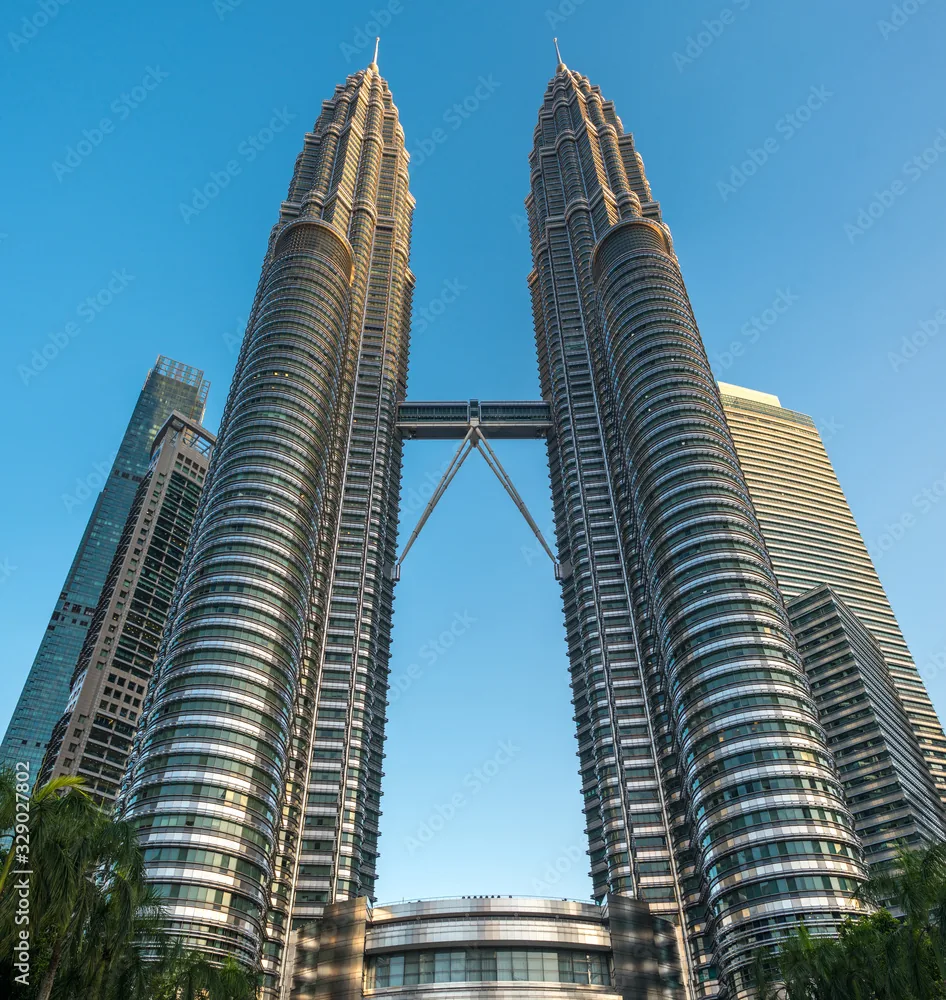
Thirty-three thousand stainless steel panels wrap these towers in a metallic skin that reflects the tropical sky, proving that a skyscraper can be a prayer in geometric form.
About Petronas Twin Towers
Prime Minister Mahathir Mohamad envisioned the towers as a physical manifestation of his 'Vision 2020' plan to modernize Malaysia. The site was originally a colonial-era racecourse, chosen for its central location and the symbolic shift from British leisure to Malaysian industry. Because of the soft soil, the project required the world's largest continuous concrete pour, lasting 54 hours for each tower. Pelli’s design intentionally avoided the boxy Western style of the era, opting for a tiered structure that recalls the minarets of the great mosques of the world. The towers served as the headquarters for the state oil company, Petronas, but quickly became a public symbol of national pride.
What Petronas Twin Towers actually is
Silver spires pierce the humid haze of Kuala Lumpur, reflecting a geometric complexity that mimics Islamic arabesque patterns. These eighty-eight-story giants held the title of the world's tallest buildings for six years, but their enduring appeal lies in how they anchored Malaysia's transition from a rubber-and-tin economy to a high-tech powerhouse. The stainless steel facades glint like fine silk under the tropical sun, while the double-decker Skybridge connects the two towers like a futuristic handshake. At night, the structures transform into glowing beacons of white light, visible from the jungle-clad hills that ring the Klang Valley. They represent a rare moment where corporate ambition met cultural heritage to create a silhouette that defined an entire nation’s skyline.
Commissioned by Architect César
Architect César Pelli did not want to build just another glass box when he won the commission in the early 1990s. He drew inspiration from the Rub el Hizb, an Islamic symbol consisting of two overlapping squares that create an eight-pointed star. By adding semicircular arcs to the inner corners, he increased the office space while creating a soft, scalloped profile. Construction was a logistical high-wire act; two separate consortia from Japan and South Korea raced to finish their respective towers first. They utilized high-strength concrete rather than steel to minimize vibrations, pouring foundations that go deeper than 120 meters into the earth. When the towers officially opened in 1999, they signaled to the world that Southeast Asia had arrived on the global stage.
Standing at the base in KLCC Park, you
Standing at the base in KLCC Park, The sheer verticality of the brushed metal panels, which hum with the distant vibration of thousands of air conditioning units. Nearby, the near the fountains is cool and misted, a brief relief from the city’s sweltering 32-degree heat. The intricate play of light on the sun-shading fins that wrap around the exterior, creating a texture that feels more like jewelry than engineering. As you ascend to the 41st floor, the elevator movement is so smooth you only notice the height when your ears pop. On the Skybridge, the subtle swaying designed to accommodate the wind, and the sprawling city below looks like a circuit board of neon and green canopy. The view from the 86th-floor observation deck reveals the jagged mountains of the Titiwangsa Range in the distance, often framed by a dramatic afternoon thunderstorm that sends bolts of lightning dancing around the spires. Most people ignore the lobby ceilings, which are masterclasses in traditional Malay woodcarving and songket weaving patterns translated into stone. Kuala Lumpur City Centre is the heart of the capital’s rail network. The LRT Kelana Jaya line stops directly underneath the towers at the KLCC station. Taxis and ride-shares are plentiful, but the covered elevated walkway from Bukit Bintang offers a scenic, air-conditioned ten-minute stroll that avoids the notorious city traffic.
The Experience
The metallic tang of the city air fades as you enter the marble-cool lobby, where the silence feels expensive and heavy. The first thing you register is the rhythmic blinking of aircraft warning lights on the opposite tower, a constant reminder of your height above the streets. A momentary shiver when looking through the glass floor sections of the Skybridge, seeing the tiny yellow taxis crawling hundreds of feet below. From the start, the way the light catches the stainless steel at sunset, turning the silver into a liquid copper. The most quiet moment is in the observation deck, watching the clouds drift through the gap between the two spires, making the buildings feel as though they are moving.
Why It Matters
The Petronas Twin Towers are the definitive icons of modern Malaysia. Beyond their architectural merit, they represent the country’s successful effort to blend Islamic identity with global modernization. They remain the tallest twin towers in the world, serving as a benchmark for high-rise engineering in tropical climates.
Why Visit
Visit these towers to witness the scale of human ambition when it is rooted in local tradition. While many tall buildings feel anonymous, the Petronas towers could only exist in Kuala Lumpur. They offer a masterclass in how architecture can give a city its soul and a people their face.
✦ Photo Gallery
Best Season
🌤 June and July offer the clearest skies and least rainfall, providing the sharpest views of the distant mountains and the city's complex topography.
Quick Facts
Entry
Around 80 RM for an adult to the Skybridge and observation deck.
Opening hours
Open Tuesday to Sunday, roughly 9am to 9pm; closed Mondays.
Time needed
About 1 to 1.5 hours for the towers.
Best time to visit
June and July offer the clearest skies and least rainfall, providing the sharpest views of the distant mountains and the city's complex topography.
Getting there
In central Kuala Lumpur (KLCC); the Kelana Jaya LRT line stops at KLCC, beneath the adjoining mall.
Location
Kuala Lumpur, Malaysia
Type
attraction
Insider Tips
- 1
Purchase tickets online at least two weeks in advance, as the strictly limited daily slots for the Skybridge often sell out by 9:00 AM.
- 2
Visit the towers at twilight to see them transition from silver monuments to glowing lanterns as the exterior floodlights ignite.
- 3
Explore the bridge in the park behind the towers for the best 'hero shot' without the distortion of looking straight up from the sidewalk.
- 4
The towers are closed to visitors on Mondays and during Friday prayer times, so plan your itinerary around these cultural and maintenance breaks.
- 5
Check the basement level of the attached Suria KLCC mall for some of the city's best high-end food courts after your descent.