Six hundred meters of vertical coral wall drop into an oceanic abyss here, where barracuda form silver tornadoes so dense they can blot out the afternoon sun.
About Sipadan Marine Reserve
Before it was a world-class diving destination, Sipadan was a turtle egg collection site and a point of refuge for local Bajau Laut nomads. The 2004 relocation of the resorts was a landmark moment in Southeast Asian conservation, prioritizing the long-term health of the reef over short-term tourism profits. Since then, the island has seen a remarkable increase in biodiversity, with grey reef sharks and hammerheads becoming more frequent visitors to the deeper sections of the wall. The permit system was recently digitalized to prevent over-tourism, ensuring that Sipadan remains a high-value, low-impact destination for the global diving community.
A volcanic spire rises from the depths
A volcanic spire rises from the depths of the Celebes Sea, culminating in a tiny island fringed by a vertical wall that drops six hundred meters into the abyss. Sipadan Marine Reserve is widely considered the pinnacle of tropical diving, a place where the nutrient-rich currents of the deep ocean collide with a vibrant coral reef. The island is a mere twelve hectares of dense jungle surrounded by white sand, but its true scale is found beneath the waves. Here, thousands of barracuda and big-eye trevally form living tornadoes that blot out the sun, while green and hawksbill turtles graze on the sponges in numbers found nowhere else on earth. It is a strictly protected sanctuary where the land has been returned to the birds and turtles, leaving the surrounding waters as a pristine laboratory of marine life.
Jacques Cousteau famously declared in the late 1980s
Jacques Cousteau famously declared in the late 1980s that he had found 'an untouched piece of art' at Sipadan, launching the island into the global spotlight. Geologically, it is the only oceanic island in Malaysia, formed by living corals growing on top of an extinct volcanic cone over thousands of years. For a time, the island was a site of contention between Malaysia and Indonesia, a dispute finally settled by the International Court of Justice in 2002. In a bold and controversial move in 2004, the Malaysian government ordered all resorts on the island to be dismantled and moved to the nearby islands of Mabul and Kapalai. This decision, aimed at protecting the delicate ecosystem from sewage and human impact, turned Sipadan into a day-trip-only reserve, allowing the reef to recover and the turtle nesting sites to remain undisturbed.
Falling backward off the side of a dive boat into the turquoise water, the immediate, silencing embrace of the ocean. The air is replaced by the rhythmic hiss of your regulator and the distant, metallic clicking of parrotfish grazing on the reef. First, the 'Drop Off,' where the reef suddenly ends and the water turns from a bright aquamarine to a terrifying, bottomless indigo. The sheer density of life; you are not just watching the fish, you are swimming through them, feeling the pressure wave of a thousand barracuda as they spiral around you. A mark of the cool thermoclines, layers of cold water from the deep, that bring the sharks up from the shadows. What comes through is the massive green turtles resting on every ledge, their shells scarred and ancient, seemingly indifferent to your presence. The light at thirty meters is a soft, filtered blue that makes the neon colors of the soft corals pop with electric intensity. Most divers focus on the big pelagics, but you should notice the 'Macro' life, the tiny flamboyant cuttlefish and ornate ghost pipefish that hide in the crevices. The smell of the salt spray and the hot sun on the boat deck during the surface interval provides a sharp contrast to the silent, cool world below. The white-tip reef sharks patrolling the edges of the wall, their movements effortless and predatory in the deep current.
Sipadan is accessible only by boat
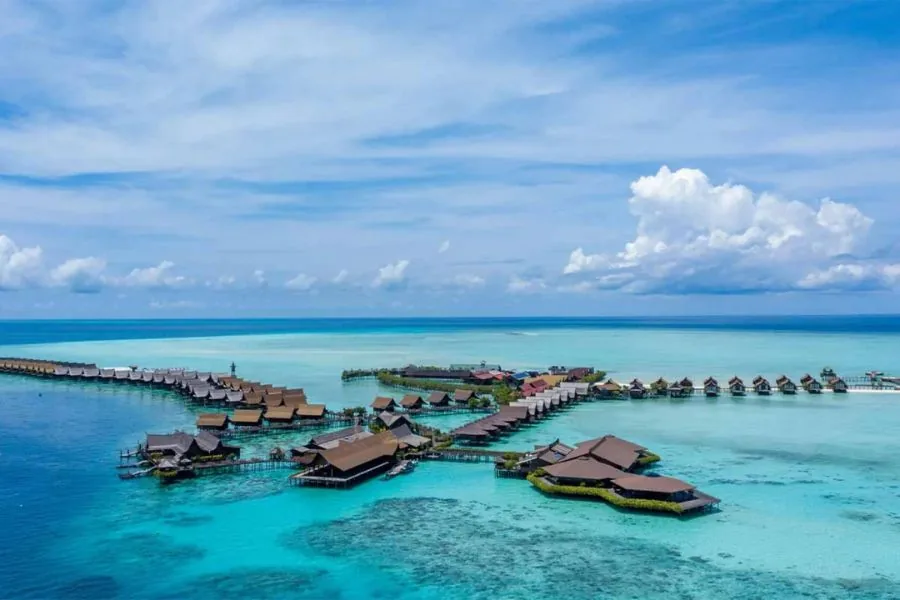
Sipadan is accessible only by boat from the gateway town of Semporna or the nearby resort islands of Mabul and Kapalai. Entry is strictly regulated via a permit system, with only 176 permits issued per day. Most divers stay on Mabul or Kapalai and take a twenty-minute speedboat ride to the reserve. Permits must be secured months in advance through licensed dive operators.
The Experience
The moment you cross the reef crest and look down into the six-hundred-meter void, you feel a profound sense of vertigo and wonder. The first thing you register is the way your bubbles expand as they rise toward the shimmering surface, like liquid diamonds against the blue. The current pulling at your fins at Barracuda Point, a trace of the massive forces that move through this part of the sea. First, the 'Turtle Tomb,' an underwater cave where the skeletons of turtles who lost their way remain perfectly preserved in the silt. The piece that stays with you is being completely surrounded by a school of bumphead parrotfish, their prehistoric-looking faces and grinding teeth creating a surreal, underwater parade.
Why It Matters
Sipadan is a biological powerhouse, serving as a nursery for marine species that populate the wider Coral Triangle. Its vertical wall provides a unique cross-section of marine life, from shallow-water reef dwellers to deep-sea predators. Culturally and politically, it represents Malaysia’s commitment to bold environmental stewardship in a region where marine resources are often over-exploited.
Why Visit
Visit Sipadan to see what the ocean looks like when it is truly protected. It is not just a dive; it is a pilgrimage to one of the last great wildernesses on the planet. It offers a scale and density of marine life that is simply unavailable at any other accessible reef in the world.
✦ Photo Gallery
Best Season
🌤 April to June offers the best visibility, up to 40 meters, and the calmest sea conditions, though diving is spectacular year-round due to the island's location outside the typhoon belt.
Quick Facts
Best time to visit
April to June offers the best visibility, up to 40 meters, and the calmest sea conditions, though diving is spectacular year-round due to the island's location outside the typhoon belt.
Getting there
In Sipadan Island, Malaysia; reach Sipadan Island first, then continue to the site.
Location
Sipadan Island, Malaysia
Type
attraction
Insider Tips
- 1
Book your permits at least six months in advance, especially if you are traveling during the peak months of July and August.
- 2
Check the permit allocation of your chosen dive shop; larger resorts usually have more guaranteed slots per day than smaller operators.
- 3
Bring a high-quality underwater camera or GoPro; the sheer scale of the schools of fish makes it impossible to capture the experience with words alone.
- 4
Stay on Mabul Island to experience the Bajau Laut culture during your surface intervals, adding a human layer to the marine adventure.
- 5
The 'Turtle Tomb' requires a specialized cave diving certification to enter; do not attempt to follow a guide inside without the proper training.