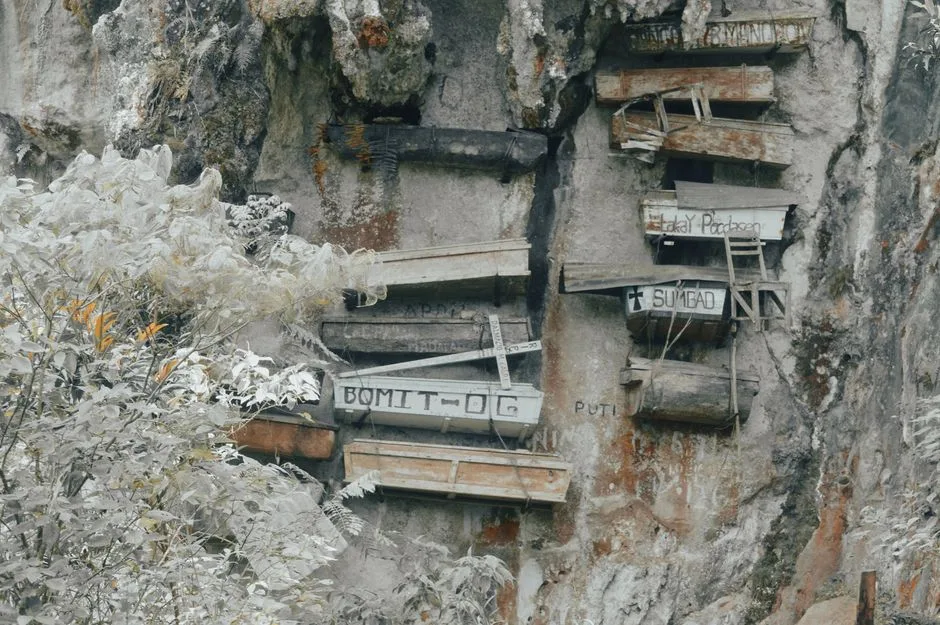
Wooden coffins nailed to cliff faces by the Igorot people, a burial tradition that predates Christianity by centuries and hasn't stopped. Some of the coffins in Echo Valley are recent.
About Hanging Coffins
Cliff burial has been practiced in Sagada for centuries. The Igorot tradition requires the elderly to carve their own coffin before death. The body is placed in the fetal position and carried up the cliff by family.
What Hanging Coffins is
Wooden coffins nailed to the limestone cliff faces of Echo Valley in Sagada, Mountain Province. The Igorot people have practiced this form of burial for centuries, the belief is that elevating the dead brings them closer to ancestral spirits and protects the bodies from floods and animals. Some of the coffins are recent. The practice continues.
“Wooden coffins nailed to the limestone cliff faces of Echo Valley in Sagada, Mountain Province.”
Cliff burial is found in several cultures across Southeast Asia and China, but the Sagada version is one of the most accessible and best-preserved. The tradition requires the elderly to carve their own coffin before death. When they die, their body is placed in the fetal position inside the coffin and carried up the cliff by family members. The coffins are arranged in clusters along the rock face, and new ones appear every few years. The practice has declined but hasn't stopped, it is a living burial tradition, not a museum exhibit.
A local guide is required for the hike into Echo Valley, about 500 pesos. The trail descends through pine forest and opens to a limestone cliff face where dozens of coffins are attached at various heights. Some are weathered and breaking apart, some are relatively new. The guide explains the tradition and the significance of the coffin placement. The walk takes about an hour round trip and isn't physically demanding. Sagada itself is a small mountain town at about 1,500 metres elevation, cool, quiet, surrounded by rice terraces and pine forests.
Sagada is in Mountain Province, about 11-12 hours by bus from Manila via Baguio. The road is winding and mountainous. From Banaue, jeepneys run to Sagada in about 3-4 hours. There are no ATMs in Sagada, bring cash.
“Sagada is in Mountain Province, about 11-12 hours by bus from Manila via Baguio.”
The Experience
Hike into Echo Valley with a required local guide to see dozens of coffins attached to the limestone cliff face at various heights, some centuries old, some from recent years.
Why It Matters
One of the most accessible and best-preserved cliff burial traditions in Southeast Asia, a living practice, not a historical artifact.
Why Visit
This is a genuine living cultural tradition that you can witness respectfully. The cool mountain town of Sagada, at 1,500 metres, is worth the journey on its own.
Insider Tips
- 1
A local guide is required and costs about 500 pesos.
- 2
There are no ATMs in Sagada. Bring enough cash from Baguio or Bontoc.
- 3
The hike is about an hour round trip and not physically demanding.
- 4
Try Sagada's coffee, the Cordillera region grows some of the best in the Philippines.