“The birds rarely sing near the ruins of the gas chambers, where the silence of a million voices remains etched into the cold, gray Polish soil.”
About Auschwitz-Birkenau
The camp was built in an area of former Polish army barracks, chosen for its proximity to a major railway junction. Rudolf Höss, the longest-serving commandant, oversaw the expansion of the site into a complex of nearly 50 subcamps. The infrastructure was designed by civilian firms to maximize efficiency in murder, utilizing Zyklon B gas. Following liberation, the site became a focal point for international justice during the Frankfurt Auschwitz trials, and in 1979, it was added to the UNESCO World Heritage list as a unique site representing the dark side of humanity.
What Auschwitz-Birkenau actually is
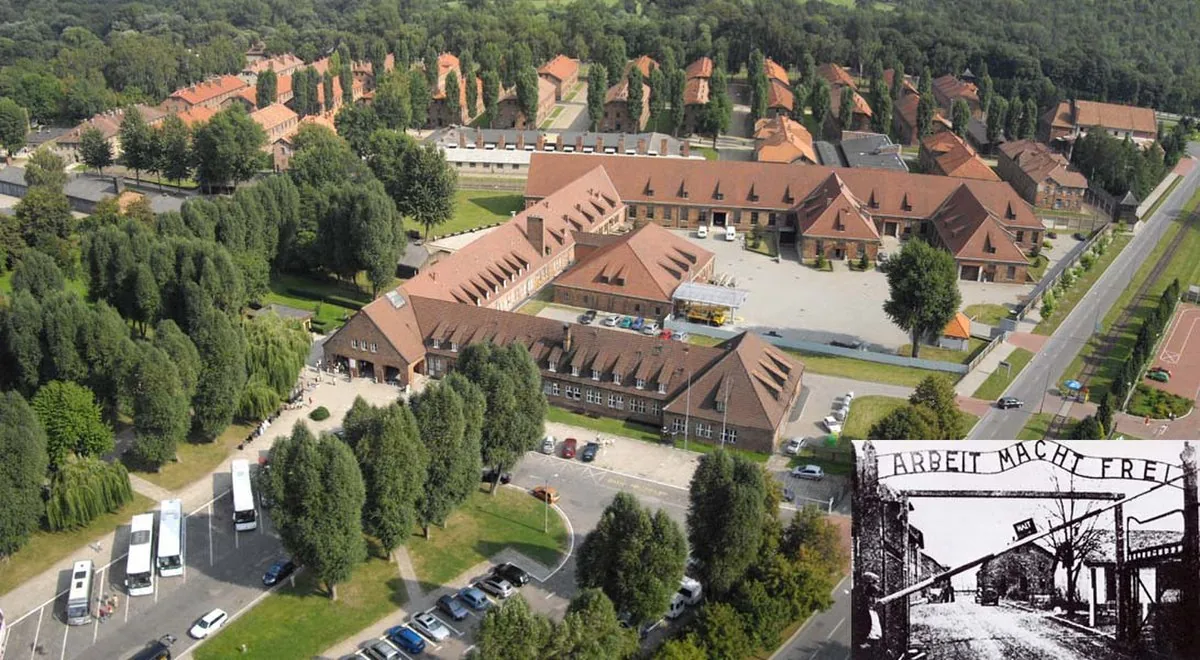
Auschwitz-Birkenau is a site that demands a different kind of attention than any other landmark in Poland. It is a vast, somber landscape of memory, situated sixty kilometers west of Kraków. The site comprises two distinct areas: the brick barracks of Auschwitz I and the sprawling, haunting expanse of Auschwitz II-Birkenau. To walk here is to navigate the physical remains of the largest site of mass murder in human history. On all sides, the air is often still and the silence is heavy, broken only by the crunch of gravel underfoot. This is not a place for sightseeing, but for witnessing the industrial scale of the Holocaust and the individual lives that were systematically erased within these wire fences.
Auschwitz-Birkenau is a site that demands a different kind of attention than any other landmark in Poland.
by Nazi Germany, 1940
Established by Nazi Germany in 1940 in the suburbs of the town of Oświęcim, the camp originally held Polish political prisoners. By 1942, it evolved into the epicenter of the 'Final Solution,' the genocide of the European Jews. Birkenau was constructed specifically for mass extermination, featuring four large crematoria and gas chambers. Between 1940 and 1945, at least 1.1 million people were murdered here. As the Soviet Army approached in January 1945, the SS attempted to destroy the evidence of their crimes by blowing up the gas chambers and forcing prisoners on 'death marches.' The museum was established in 1947 at the request of former prisoners to ensure the world would never forget the scale of the atrocity.
Visiting Auschwitz-Birkenau
In Auschwitz I, through the gate under the cynical inscription 'Arbeit Macht Frei.' The brick blocks now house exhibitions containing the personal effects of the victims, mountains of shoes, suitcases marked with names of those who never returned, and shorn hair. The grain of the place is cold and hard. In contrast, Birkenau is defined by its terrifying scale. You stand on the 'Judenrampe,' where the trains arrived, and look down a rail line that seems to stretch into infinity. The wind across the open fields of Birkenau is biting, even in summer. The standout is the ruins of the crematoria, twisted rebar and broken concrete left exactly as they were found, serving as a silent accusation against the sky.
Location and access
The museum is located in the town of Oświęcim. Most people arrive from Kraków via a direct bus from the main station or a regional train. The journey takes about 90 minutes. A shuttle bus runs regularly between Auschwitz I and the much larger Birkenau site, which is about three kilometers away. It is highly recommended to book a guided tour months in advance, as visitor numbers are strictly controlled to maintain the dignity of the site. Independent visits are possible but usually restricted to specific late-afternoon time slots.
Most people arrive from Kraków via a direct bus from the main station or a regional train.
The Experience
You feel a hollow weight in your chest as you pass the glass cases filled with prosthetic limbs and spectacles, each one representing a life cut short. The space in the underground punishment cells of Block 11 feels thick and stagnant, a sharp contrast to the vast, windy emptiness of the Birkenau fields. The detail that hits is how nature has begun to reclaim the site, with grass growing through the ruins of the wooden barracks, yet the sense of trauma remains visceral. The hum of dozens of different languages being whispered by tour groups creates a strange, international murmur of mourning. What stays with you is standing at the end of the rail tracks, where the path to the gas chambers ends in a field of wild flowers.
Why It Matters
Auschwitz-Birkenau matters as the ultimate warning of what happens when hatred is industrialized. It is the primary memorial for the millions of Jews, Poles, Romani, and others murdered by the Nazi regime. It serves as an educational center and a cemetery without graves, forcing every visitor to confront the absolute fragility of civilization.
Why Visit
This is a pilgrimage of conscience. You visit because the scale of the Holocaust is impossible to grasp through books alone. Seeing the physical proximity of the barracks to the crematoria and the sheer size of the Birkenau complex provides a necessary, painful clarity that no museum gallery can replicate. It is a difficult but essential responsibility for any curious traveler.
✦ Insider Tips
- 1
Visit the national exhibitions in the various blocks of Auschwitz I, especially the heart-wrenching Jewish Pavilion in Block 27.
- 2
Wear layers and sturdy footwear; you will be walking for several hours across rough gravel and exposed fields.
- 3
Take the time to walk to the very back of Birkenau to see the International Monument, away from the more crowded entrance areas.
- 4
Carry a small bottle of water but note that food and large bags are strictly prohibited inside the memorial grounds.
- 5
The site requires silence and respectful behavior; avoid taking photos in the rooms containing hair or the basements of Block 11.