Sixty-five meters of unsupported concrete span over your head in a feat of engineering so brazen that its 1913 contemporaries were certain it would collapse upon its own creators.
About Centennial Hall
The hall emerged from the ambitious 'Exhibition Grounds' project in a German Breslau that was rapidly industrializing. Max Berg utilized the pioneering 'System Hennebique' for reinforced concrete, a material then reserved for bridges and factories rather than civic monuments. Its opening was marked by a massive theatrical production directed by Max Reinhardt, cementing its status as a premier venue for the masses. After the borders shifted in 1945 and the city became Polish Wrocław, the hall was renamed the People's Hall. It hosted the World Congress of Intellectuals in 1948, bringing figures like Pablo Picasso and Bertolt Brecht within its ribbed walls to discuss the future of a fractured Europe.
What Centennial Hall in Poland is
Wrocław’s skyline is defined by many spires, but its most radical silhouette is a massive, ribbed concrete dome that looks like a spacecraft docked in a formal park. Centennial Hall represents the exact moment when the architectural world realized that reinforced concrete could be beautiful. Completed in 1913, it was a middle finger to the ornate, heavy styles of the Victorian era. The structure feels lightweight despite its staggering mass, sitting amidst the Pergola and the Japanese Garden like a silent, grey giant. It is a temple to the possibilities of the modern age, stripped of ornament and relying entirely on the raw honesty of its engineering.
“Wrocław’s skyline is defined by many spires, but its most radical silhouette is a massive, ribbed concrete dome that looks like a spacecraft docked in a formal park.”
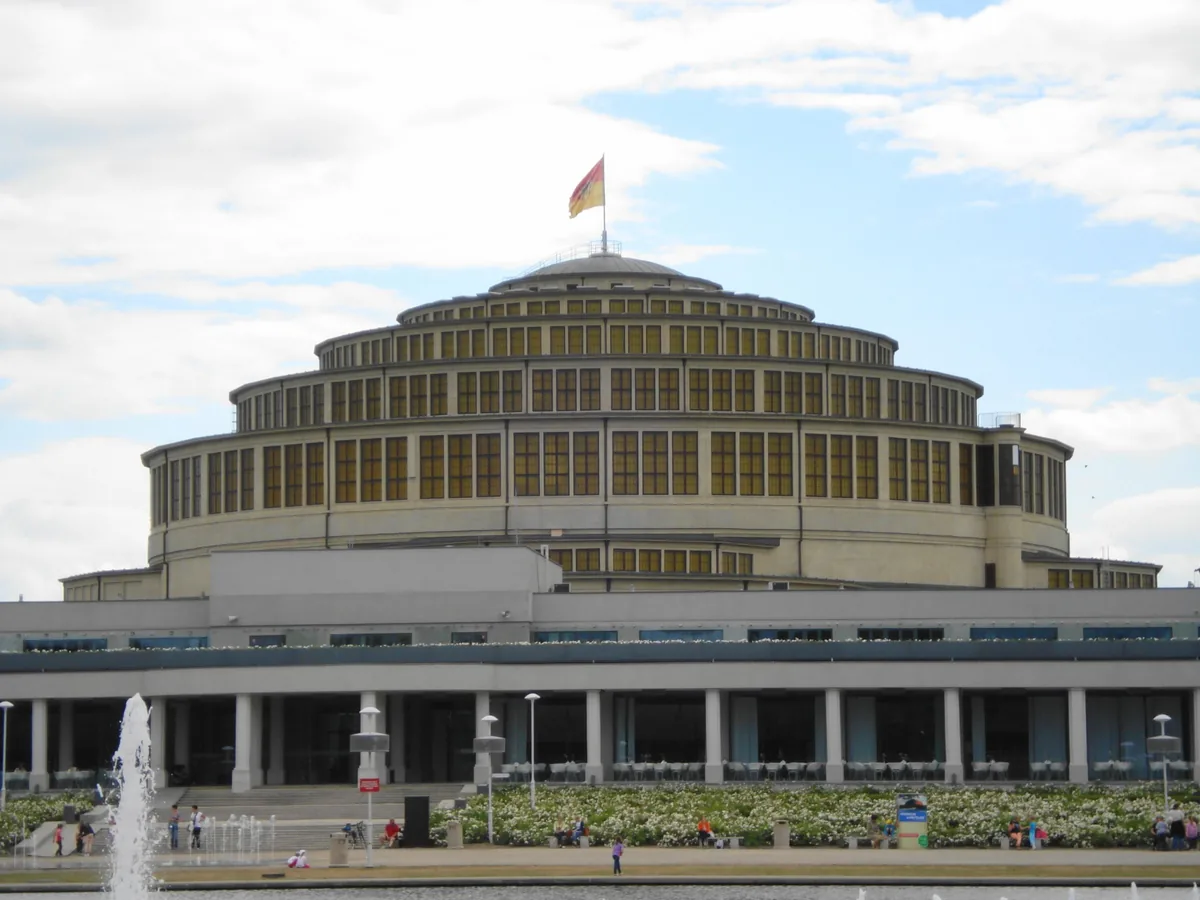
Centennial Hall, Poland
Max Berg, the city's municipal architect, took
Max Berg, the city's municipal architect, took a massive gamble when he proposed a dome with a span of 65 meters, wider than the Pantheon in Rome. Critics at the time were convinced the entire thing would collapse the moment the wooden supports were removed. Berg was so confident that he reportedly offered to pay for the first hour of labor during the most dangerous phase of construction out of his own pocket. The hall was built to commemorate the 100th anniversary of the defeat of Napoleon, intended as a multipurpose space for the citizens of what was then Breslau. It survived the fierce Siege of Breslau in 1945 with remarkably little damage, standing today as a rare survivor of the early Modernist movement.
Stepping into the central chamber causes an immediate , involuntary tilting of the head. The sheer volume of the air inside is dizzying. Light streams through four tiers of windows, casting long, geometric shadows across the floor that move with the precision of a sundial. The environment smells of old stone and polished wood. During the day, the concrete has a velvet-like texture, absorbing sound in a way that makes even a large crowd feel strangely distant. Outside, the Pergola's semicircular walkway offers a different perspective, where the ivy-covered columns frame the dome against the sky. If you visit during the evening, the nearby multimedia fountain erupts in a display of water and light, but the hall remains the steady, glowing anchor of the park.
Tram lines 1, 2, 4
Tram lines 1, 2, 4, and 10 run frequently from the main railway station and the city center toward Biskupin, dropping you right at the Hala Stulecia stop. The journey takes about fifteen minutes. Walking from the zoo across the street is the most common approach, allowing the dome to slowly reveal itself behind the trees of Szczytnicki Park. The area is wide and flat, making it ideal for a slow afternoon of exploration on foot.
“Tram lines 1, 2, 4, and 10 run frequently from the main railway station and the city center toward Biskupin, dropping you right at the Hala Stulecia stop.”
The Experience
The scale is the first thing that hits you, followed by the surprising warmth of the light. A sense of small, but not diminished, as the concentric rings of the ceiling draw your eyes toward the central lantern. The acoustics are legendary; even a whisper carries a strange, metallic clarity across the vast floor. What registers is the ribbed texture of the concrete, which still bears the grain of the wooden planks used for the molds over a century ago. On a quiet afternoon, the space feels like a secular cathedral, cool and still, providing a refuge from the summer heat of the surrounding gardens.
Why It Matters
Centennial Hall is the undisputed ancestor of every modern stadium and concert hall on the planet. It proved that industrial materials could achieve a monumental, spiritual quality without relying on historical styles like Gothic or Baroque. As a UNESCO World Heritage site, it is evidence of to the era when architecture first dared to look strictly toward the future.
Why Visit
Go because you want to see the exact point where the 20th century began. While the Old Town of Wrocław is charming, Centennial Hall is commanding in a way that resets your internal scale. It is one of the few places on earth where you can stand inside a structural miracle and feel the audacity of the human spirit.
Insider Tips
- 1
Check the schedule for the 'Discovery Centre' inside, which uses interactive projections to show the daring construction process.
- 2
The multimedia fountain shows occur every hour on the dot, but the night shows with music and lights are the only ones worth a special trip.
- 3
Walk the entire circumference of the exterior to see how the light changes the color of the concrete from beige to deep charcoal.
- 4
If you want the best photos, head to the far side of the Pergola pond to capture the reflection of the dome in the water.