For six centuries, the scarred face of a single wooden icon has was the unofficial commander-in-chief of the Polish people, outlasting empires, invaders, and ideologies alike.
About Jasna Góra Monastery
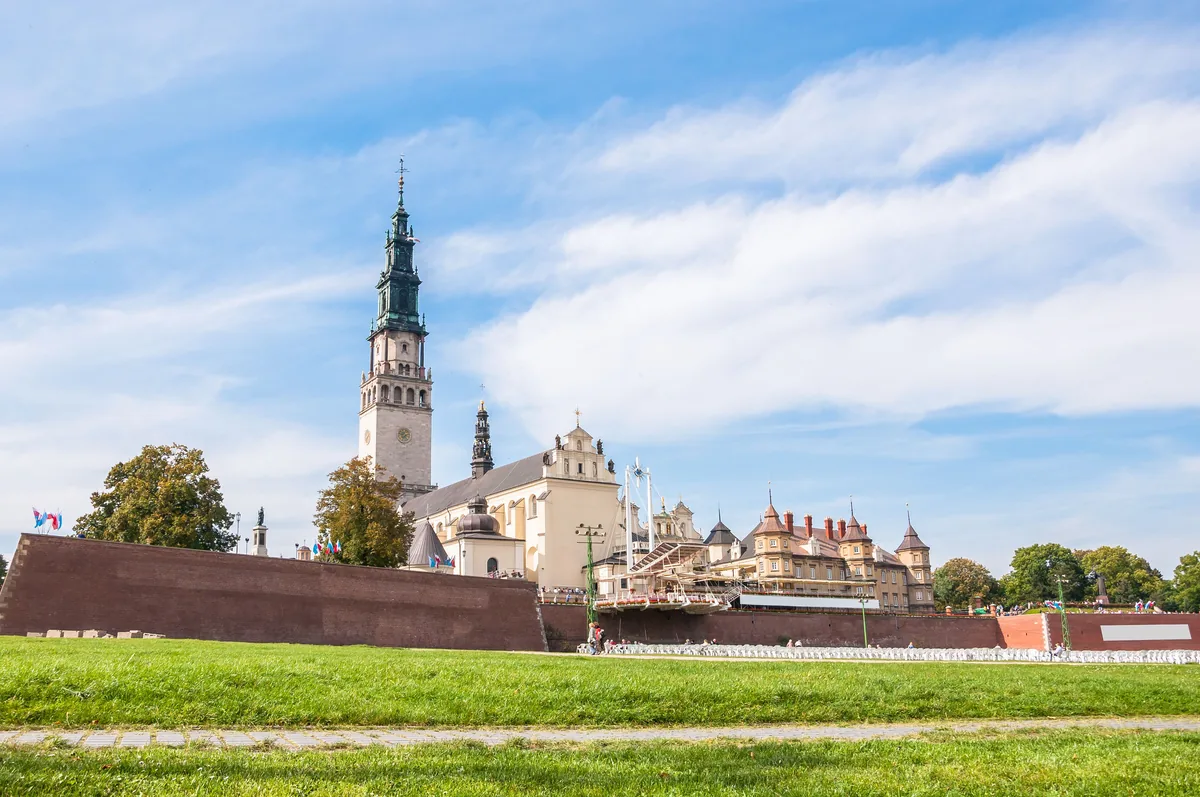
The Pauline monks who established this site were invited from Hungary, bringing a rigorous tradition of prayer and hospitality. The monastery’s architecture evolved from a simple Gothic church into a massive, star-shaped fortress designed to withstand the artillery of the 17th century. It became the site of royal coronations and national vows, most notably when King John Casimir declared Mary the Queen of Poland. During the Cold War, Jasna Góra was a bastion of resistance against the communist regime, serving as a gathering point for the Solidarity movement and a site of massive, peaceful protests that eventually helped topple the Iron Curtain.
What Jasna Góra Monastery actually is
To understand Poland, you must eventually find yourself on the limestone hill of Jasna Góra in Częstochowa. This is not merely a monastery; it is the spiritual battery of a nation. Behind its formidable fortress walls lies a complex of Baroque churches and silent cloisters, all centered around a single, small icon: the Black Madonna. The room here is thick, not just smelling of millions of burning beeswax candles, but with a palpable, vibrating intensity of faith. It is a place of perpetual motion, where thousands of pilgrims arrive on foot from hundreds of miles away, their singing echoing off the stone ramparts long before they reach the gates.
What it represents
Founded by Pauline monks in 1382, the monastery became a symbol of national survival in 1655. During the Swedish invasion, a small band of monks and locals held off a massive Swedish army for forty days, a victory attributed to the protection of the Virgin Mary. This event turned the monastery into a fortress of the soul as much as of the state. The Black Madonna herself is a mystery; tradition claims she was painted by St. Luke on a cedar tabletop from the Holy Family’s house. The two distinct scars on her cheek are the result of a 15th-century looter’s sword, scars that, despite multiple restoration attempts over the centuries, refused to be covered by paint, as if the icon itself insisted on wearing its wounds.
The walk up the long, tree-lined avenue toward the monastery tower feels like a slow-motion immersion into another era. As you enter the Chapel of Our Lady, the atmosphere becomes electric. The area is dark, glittering with thousands of silver 'ex-votos', tiny silver hearts, legs, and arms pinned to the walls by those seeking or celebrating a miracle. When the silver screen covering the icon is raised to the sound of trumpets, the collective intake of breath from the crowd is audible. The opening note is the deep, soulful eyes of the Madonna, which seem to follow you across the room. Outside, the ramparts offer a release from the intensity, providing views over the city and a chance to walk the Stations of the Cross, where monumental bronze sculptures depict the Passion with a raw, modern emotionality.
Częstochowa is a major rail hub
Częstochowa is a major rail hub, easily reached from Warsaw or Krakow in about two hours. From the train station, a straight, mile-long boulevard leads directly to the monastery hill. The walk is part of the experience, as you join the flow of people heading toward the spire. For those with limited mobility, taxis can drive close to the upper gates, but the true spirit of the place is found in the slow, communal approach on foot.
The Experience
The soundscape of Jasna Góra is a constant, rhythmic layering of chanted Latin, the shuffling of knees on stone, and the low murmur of confessions. You discover a cool, heavy air of the treasury, where the walls are lined with gold monstrances and the jewelry of queens. The light in the main basilica is a golden, hazy wash that makes the elaborate Baroque carvings seem to ripple. Beginning with the way people lean into the walls, as if trying to absorb some of the ancient strength stored in the stone. The most quiet, reflective moments are found in the cloisters at dawn, before the first wave of tour buses arrives.
Why It Matters
Jasna Góra is the cultural and emotional North Star for millions. It goes beyond pure religion to represent the concept of 'Polonia', the enduring identity of a people who have frequently seen their borders erased from the map. It is a living repository of Polish history, where every century has left a gift, a scar, or a prayer within the fortress walls.
Why Visit
Visit Jasna Góra to witness a level of devotion that has largely disappeared from the Western world. For those who are a believer or a skeptic, the sheer weight of the history and the raw emotional energy of the pilgrims is undeniably powerful. It is the best place to witness the intersection of Polish politics, history, and the human spirit in one spectacular setting.
✦ Photo Gallery
Best Season
🌤 August is the most intense time due to the massive walking pilgrimages, but for a more contemplative visit, October offers beautiful autumn light and a calmer atmosphere.
Quick Facts
Best time to visit
August is the most intense time due to the massive walking pilgrimages, but for a more contemplative visit, October offers beautiful autumn light and a calmer atmosphere.
Getting there
In Częstochowa, Poland; reach Częstochowa first, then continue to the site.
What's nearby
Auschwitz-Birkenau and Wieliczka Salt Mine are also in the area.
Location
Częstochowa, Poland
Type
attraction
Coordinates
50.8125°, 19.0972°
Insider Tips
- 1
The 'reveal' of the icon happens at specific times; check the daily schedule so you don't find yourself staring at a silver cover.
- 2
Visit the Monastery Library; it is one of the most beautiful rooms in Poland but is often overlooked by those rushing to the chapel.
- 3
The walls are lined with 'votive offerings' including crutches and wedding rings; take the time to read the small inscriptions to understand the personal stories behind them.
- 4
If you want to avoid the crowds, the monastery opens very early in the morning for the first mass, which is the most atmospheric time.
- 5
Walk the perimeter of the fortifications; the 17th-century engineering is as impressive as the religious art inside.