Moving Dunes — modern landmark in Poland
🏙️ ModernPoland ·

Moving Dunes

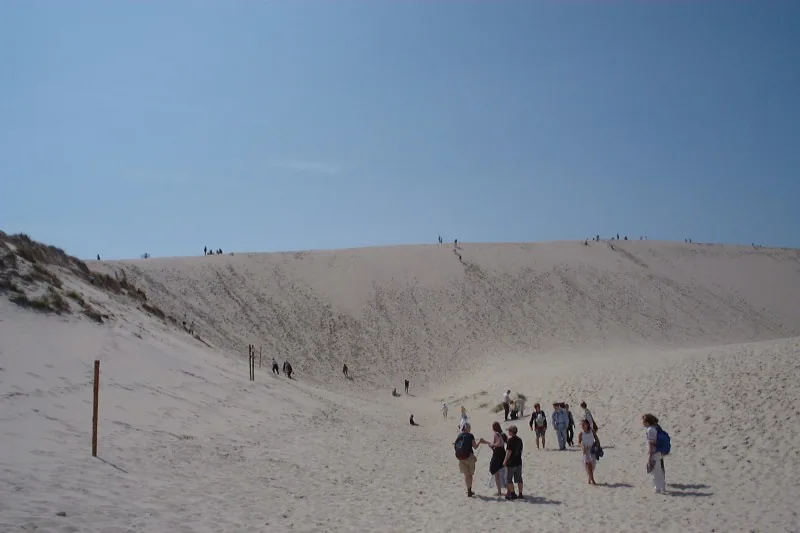
A coastal landscape of 42-metre high shifting sand dunes that migrate up to ten metres per year; burying the surrounding pine forest in white quartz sand; the UNESCO biosphere reserve sits between the Baltic Sea and Lake Łebsko; hike the ridge at sunset; the wind-sifted sand creates a low; humming sound while the laterite-red sun disappears into the grey Atlantic horizon.

Forty-meter peaks of shimmering white sand are slowly marching across the Polish coast, burying entire forests and uncovering the bleached skeletons of the past.

About Moving Dunes

Słowiński National Park is named after the Slovincian people, a Baltic Slavic group that once lived in the fishing villages along these shores. Their culture was largely erased by the shifting borders of the 20th century, but the park preserves the landscape they called home. The dunes themselves are part of a larger complex of coastal lakes and forests that form a vital stopover for migratory birds. Scientists have used these moving sands to study the long-term effects of wind erosion and climate change on coastal stability. Despite attempts in the past to plant grasses and trees to stop the sand’s progress, the dunes have proven unstoppable, a reminder that on this stretch of the Baltic, nature refuses to be anchored.

Wind-driven mountains of white sand migrate across the Pomeranian coast, slowly swallowing pine forests and uncovering ghost-like skeletal remains of trees buried decades ago. The Moving Dunes of Słowiński National Park represent a restless, Saharan landscape perched on the edge of the Baltic Sea. The air here is a sharp, exhilarating mix of salty sea spray and the dry, heat-radiating scent of fine quartz sand. You climb the crest of the Łącka Dune, noticing how the wind erases your footprints within minutes, leaving behind a perfectly rippled surface that looks like a frozen sea. The soundscape is dominated by the constant, rhythmic hiss of sand grains skittering across the dunes and the distant, muffled roar of the Baltic surf. It feels like a land in a state of permanent transition, where the boundary between the earth and the sky is blurred by the blowing white dust.

The dunes began their march thousands of years ago as the retreating glaciers of the last Ice Age left behind vast quantities of sand, which the prevailing westerly winds began to push inland. This is not a static landmark; the dunes move at a rate of three to ten meters per year, driven by the relentless power of the Baltic storms. Historically, this movement has forced entire villages to relocate, leaving behind only legends of houses buried deep beneath the sand. During the 20th century, the area served as a testing ground for German Afrika Korps equipment due to its desert-like conditions, but today it is a strictly protected biosphere reserve. The park was established in 1967 to preserve this unique coastal ecosystem, where the dunes, salt marshes, and peat bogs provide a sanctuary for rare birds and resilient flora that can survive being buried alive.

Standing atop the highest dune, you feel the physical force of the wind as it sandblasts your legs and shapes the horizon into ever-changing peaks and valleys. You notice the way the light reflects off the quartz grains, creating a brilliant, blinding white that makes the blue of the Baltic Sea appear unnaturally deep. The smell is clean and mineral, occasionally punctuated by the scent of pine needles from the doomed forest that stands in the dunes' path. You feel the fine sand find its way into every pocket and crease of your clothing, a tactile souvenir of the landscape’s persistence. You notice the 'dead forest'—the silvered, leafless trunks of trees that the dunes have finished with and moved past, leaving them like bleached bones in the sand. The most evocative moment is watching the sun set over the dunes, when the white sand turns a deep, bruised purple and the shadows stretch out like long, dark fingers across the desert.

The gateway to the dunes is the coastal town of Łeba, located about two hours northwest of Gdańsk. Most travelers park their cars in Rąbka and choose to either walk the five-kilometer forest path, rent a bicycle, or take one of the electric 'melex' carts that run regularly to the base of the dunes. Arriving in the early morning is highly recommended to avoid the summer heat and the crowds that flock to the area in July and August. A hike along the beach on the way back provides a different perspective of the dunes meeting the sea, but be prepared for a long day of walking on shifting surfaces. Because the dunes are a protected area, you must stay within the marked poles to prevent erosion and protect the rare grasses that help stabilize the sand.

The Experience

The atmosphere at the Moving Dunes is one of wild, restless energy. You notice the sound of the wind is constant—a low, melodic hum that vibrates through the sand under your feet. You feel the temperature change rapidly as you move from the sheltered pine forest onto the open, sun-baked expanse of the dunes. The light is incredibly intense, reflecting off the white sand with a brilliance that requires dark sunglasses even on overcast days. You notice the patterns in the sand, perfect geometric ripples that look like they were carved by a master artist. The most striking detail is the contrast between the lush green of the forest and the sterile, blinding white of the sand as it prepares to consume the next line of trees.

Why It Matters

The Moving Dunes are the most unique geological feature of the Baltic coast and a rare example of an active desert ecosystem in Central Europe. They represent the incredible power of wind and water to reshape the earth on a human timescale. Culturally, the park serves as a monument to the vanished Slovincian culture and a sanctuary for biodiversity in an increasingly developed coastline.

Why Visit

Visit because you didn't know Poland had a desert. While the rest of the country is famous for its mountains and old towns, Słowiński offers a landscape that feels like it belongs in the Sahara. You come here to feel the wind reshape the world in real-time and to walk through a forest of ghosts. It is the only place where the ground you stand on won't be there next year.

✦ Photo Gallery

Best Season

🌤 June and September offer the best balance of manageable temperatures and clear Baltic light, with significantly fewer crowds than the peak summer months.

Quick Facts

Location

Poland

Type

attraction

Insider Tips

  • 1

    Walk the five kilometers from Rąbka along the beach rather than the forest path to see the dunes gradually rising from the sea.

  • 2

    Bring a light scarf to cover your face if the wind picks up; the blowing sand is fine and can be very abrasive.

  • 3

    Check the weather for 'Łeba' before you go; if the wind is too strong, the electric carts may stop running and the sand can make visibility difficult.

  • 4

    Look for the small, hardy sea holly plants that manage to bloom in the sand—they are a protected species and a symbol of the park.

  • 5

    Bring plenty of water and a hat, as there is absolutely no shade once you leave the forest and step onto the dunes.

All of Poland
Free Travel Tools
Games & Discover

Featured

Conquer the World

195 nations. One dart. Build your empire.

New Game

FateLand

Three darts. The world decides your fortune, heartbreak & legacy.

FateLand
Fortune. Heartbreak. Legacy. Throw & find out.
Show on Map