“One thousand years of vibrant cultural evolution are often eclipsed by twelve years of tragedy, but this glass sanctuary in Warsaw demands that you witness the centuries of life first.”
About POLIN Museum of the History of Polish Jews
The narrative begins in the early Middle Ages, when Jewish merchants first followed trade routes into the Piast kingdom. King Casimir the Great solidified this relationship in the 14th century, granting protections that turned Poland into the 'Paradisus Judaeorum.' For centuries, this land served as the intellectual and spiritual heart of the Jewish world, birthing Hasidism and revolutionary political movements alike. This long trajectory was violently severed by the German occupation in 1939, transforming the very site where the museum now stands into a prison for nearly half a million people. Following the war, the area remained a scarred wasteland until the museum's opening in 2013 finally reconnected the city to its amputated memory.
Overview
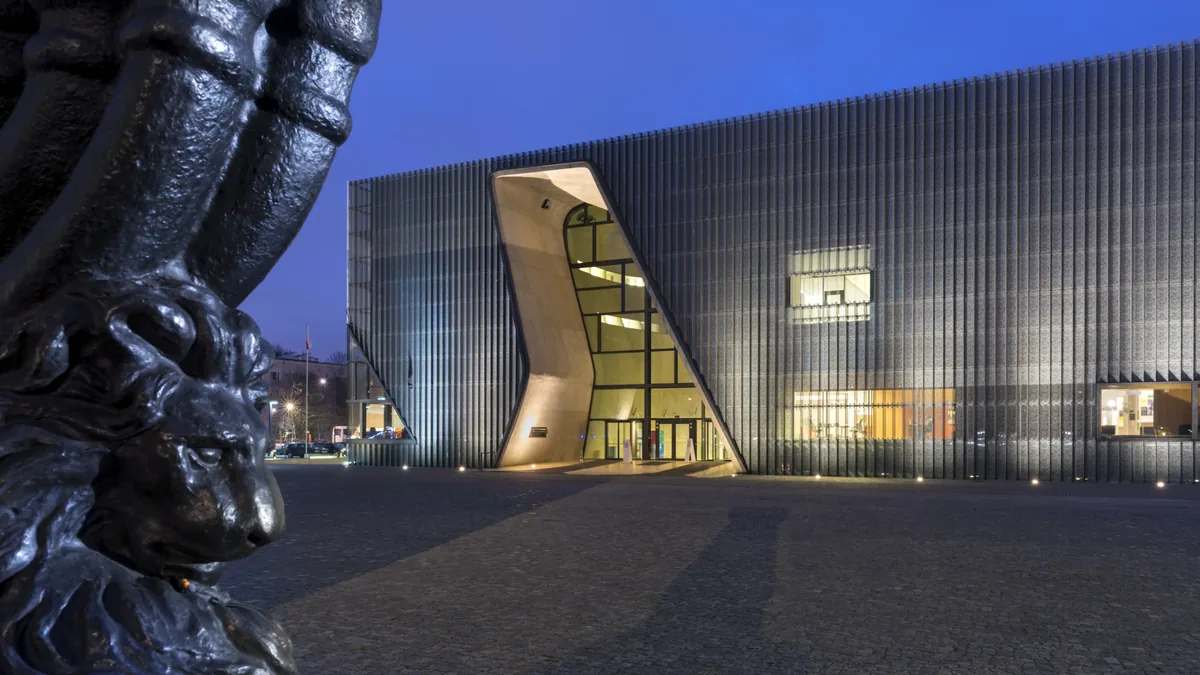
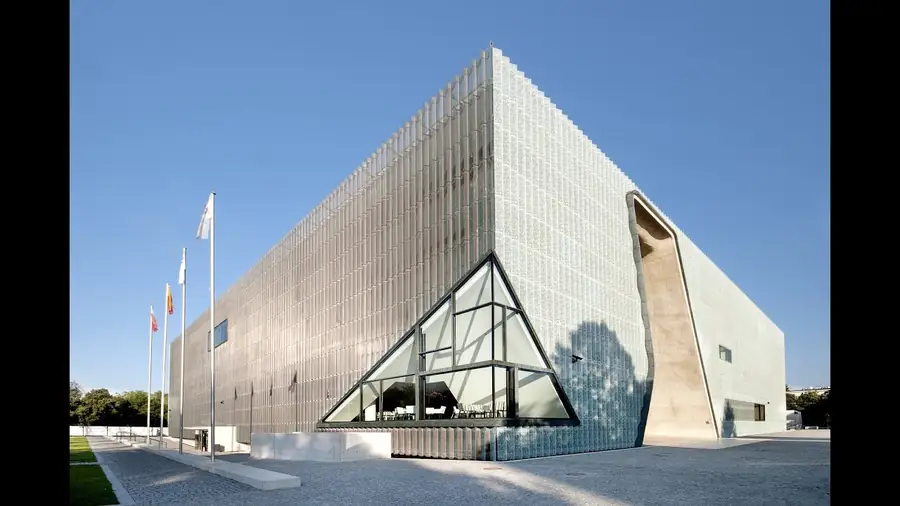
Standing upon the fractured ground of the former Warsaw Ghetto, the POLIN Museum does not attempt to mimic the brick and mortar of the past. Instead, its glass fins and soft copper hues create a shimmering mirage that seems to shift as the sun moves across the Muranów district. While many visitors arrive expecting a somber eulogy for the Holocaust, they find something far more expansive. This is a house of life, documenting a thousand-year odyssey of a people who helped weave the very fabric of Polish identity. The architecture itself speaks of a rupture, a massive, jagged canyon cutting through the center of the building, yet the light that pours through that gap suggests a bridge rather than a void.
Standing upon the fractured ground of the former Warsaw Ghetto, the POLIN Museum does not attempt to mimic the brick and mortar of the past.
leveled this neighborhood, 1943
Rainwater used to pool in the empty lots here for decades, a silent reminder of the destruction that leveled this neighborhood in 1943. The museum’s conception was a feat of collective will, taking over twenty years to move from a bold idea to a finished masterpiece of Finnish design. Architects Rainer Mahlamäki and Ilmari Lahdelma envisioned a structure that functioned as a giant sculpture. They chose to name it POLIN, referencing the Hebrew word for Poland which translates to 'here thou shalt rest.' Legends say the first Jewish travelers in the medieval era heard birds chirping this word as they entered the forests, signaling a sanctuary that would last for ten centuries before the darkness of the mid-twentieth century nearly extinguished it.
Walking into the main hall feels like stepping inside a massive, petrified sand dune. The undulating walls are rough to the touch, curving upward into a cavernous ceiling that hums with the soft echoes of hushed conversations. Once inside the core exhibition, the atmosphere shifts from the ethereal to the visceral. You move through a forest of painted trees into the vibrant, chaotic streets of Jewish Krakow and Vilna. The centerpiece, a meticulously reconstructed roof of the 17th-century Gwoździec synagogue, glows with celestial blues and zodiac symbols, smelling faintly of treated timber and paint. It is a sensory overload of hand-lettered signs, the clatter of industrial looms, and the melodies of Yiddish theater. In the final galleries, the space tightens and the colors drain away, forcing a confrontation with the Shoah that feels deeply personal because you have spent the last hour learning the names and dreams of those who were lost.
Reaching the museum requires a short
Reaching the museum requires a short tram ride or a brisk walk north from Warsaw’s Old Town. The building sits set in a quiet residential square, surrounded by the grey blocks of the post-war reconstruction. Trams 15, 18, and 35 stop at Muranów, putting you within a two-minute walk of the entrance. Approaching on foot allows you to pass the Monument to the Ghetto Heroes, which stands in direct dialogue with the museum’s glass facade, creating a powerful tension between the heavy stone of remembrance and the light-filled temple of history.
Reaching the museum requires a short tram ride or a brisk walk north from Warsaw’s Old Town.
The Experience
Soft, diffused light filters through the pleated glass walls, creating an atmosphere that feels oddly peaceful despite the weight of the subject matter. You find yourself looking up at the towering, organic curves of the entrance hall, which mimic the parting of the Red Sea. The transition from the bright, modern lobby into the dark, wooden textures of the medieval forest gallery creates a physical sensation of traveling through time. Visitors often linger longest under the synagogue ceiling, where the vibrant folk art provides a shocking contrast to the stark, modern exterior. Beginning with the silence of the crowd, not out of gloom, but out of a shared, intense focus on the intricate details of a vanished world.
Why It Matters
POLIN serves as a vital corrective to a singular historical narrative, restoring the agency and complexity of a community that was almost erased. It functions as a cultural laboratory where modern Poles and the global diaspora can confront a shared, often painful heritage. By focusing on how people lived rather than just how they died, it ensures that the Jewish contribution to European civilization is recognized as an ongoing story rather than a closed chapter.
Why Visit
Ignore the misconception that this is purely a Holocaust memorial. You should visit because it is one of the most immersive storytelling triumphs in the world. The synagogue reconstruction alone is a masterpiece of experimental archaeology that will change your perspective on religious art. It offers a depth of context that makes the rest of Poland’s history finally click into place.
✦ Insider Tips
- 1
Purchase your tickets online at least three days in advance to avoid the morning queues that snake around the plaza.
- 2
The museum restaurant, Warsze, serves authentic Jewish-Polish fusion that is legitimately some of the best food in the district.
- 3
Allocate at least four hours; trying to rush through the thousand-year timeline in ninety minutes will leave you exhausted and overwhelmed.
- 4
Look for the small, tactile replicas of artifacts designed for the visually impaired; they provide a unique sensory way to engage with the textures of history.
- 5
Visit the nearby 'Miła 18' bunker site after the museum to see the raw, unpolished reality of the ghetto resistance.