Four kilometers of unapologetic industrial ambition prove that a city doesn't need a medieval market square to possess a soul that vibrates with raw, creative energy.
About Ulica Piotrkowska
The transformation of a rural trail into a world-class boulevard began in earnest during the 1820s industrial land rush. Surveyors laid out the long, straight axis that would define the city's growth, inviting German weavers and Jewish merchants to build a new life on the banks of the Łódka River. By the late 1800s, the street was a riot of architectural competition, featuring the first electric lights in the region and opulent palaces designed to mask the grit of the surrounding factories. While the world wars brought hardship, the physical fabric of the street remained largely intact, surviving as a rare, complete archive of European industrial-era urbanism.
What Ulica Piotrkowska actually is
Four kilometers of weathered brick and exuberant stucco stretch through the heart of Łódź, creating one of the longest commercial thoroughfares in Europe. Unlike the medieval squares of Krakow or the rebuilt facades of Warsaw, Ulica Piotrkowska feels entirely authentic to its industrial roots. This street was the spine of a 19th-century boomtown, once referred to as the Polish Manchester. It is a grand laboratory of eclectic architecture where Neo-Renaissance palaces sit shoulder-to-shoulder with Art Nouveau tenements. The streetscape is famously punctuated by the rickshaws that zip past bronze statues of the city’s industrial titans, creating a rhythm that is uniquely fast-paced yet deeply rooted in the past.
“Four kilometers of weathered brick and exuberant stucco stretch through the heart of Łódź, creating one of the longest commercial thoroughfares in Europe.”
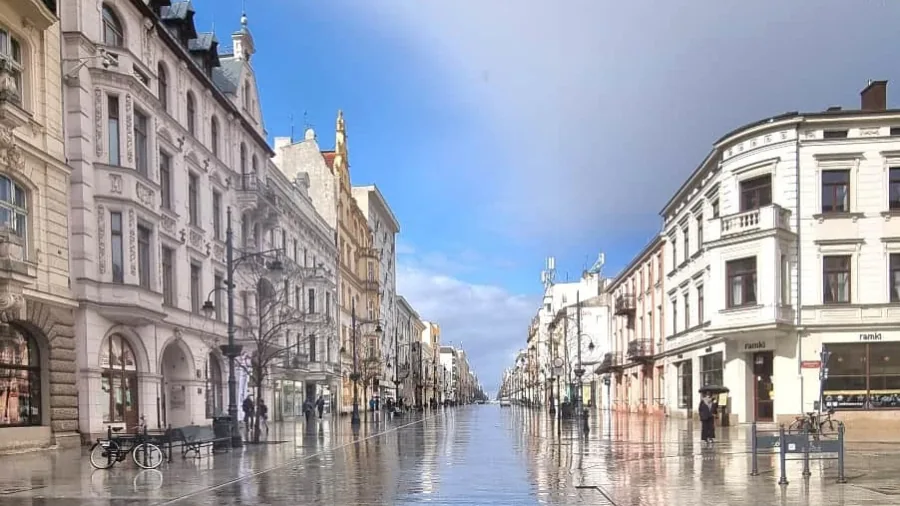
Ulica Piotrkowska, Poland
Rain washed the dust
Rain washed the dust of a small settlement into the gutters here until 1823, when the decree to transform Łódź into a textile hub changed everything. The street began as a simple route connecting Zgierz to Piotrków Trybunalski, but it quickly became the trophy room for the city’s 'Cotton Kings.' Immigrants from across Europe flocked here, turning a muddy path into a paved canyon of wealth and ambition. Families like the Scheiblers and Poznańskis competed to build the most ostentatious residences, creating a patchwork of styles that reflected the city’s multi-ethnic character. During the lean years of the late 20th century, the street suffered from neglect, but a massive revitalization effort in the 1990s reclaimed its status as the social and cultural lungs of the city.
Walking down Piotrkowska involves a constant
Walking down Piotrkowska involves a constant dance between the grand public face of the street and the mysterious, shadowy worlds of its courtyards. The space often carries a mixture of roasting coffee and the faint, metallic scent of the nearby tram lines. You get a scale of the 19th century in the towering gateways that lead into 'podwórka', internal courtyards that hide neon-lit bars, boutique workshops, and the famous 'Rose Passage' where thousands of mirror fragments turn the walls into a shimmering mosaic. The sound is a chaotic blend of bicycle bells, the chatter of students outside Off Piotrkowska, and the distant clatter of the city’s revitalizing industrial zones. The 'Monument of Citizens of the Turn of the Millennium,' a strip of nearly 17,000 bricks engraved with the names of the people who call this city home. Arrival is easiest via the Łódź Fabryczna railway station, a modern subterranean marvel located just a ten-minute walk from the northern end of the street. Numerous tram lines converge at 'Przystanek Centrum,' colloquially known as the 'Stables of Unicorns' due to its colorful, soaring canopy. From here, you are dropped directly into the middle of the pedestrianized zone, where the street is yours to explore on foot or by one of the iconic bicycle rickshaws.
The Experience
The light catches the intricate wrought-iron balconies and the crumbling stone lions of the grand tenements, creating a sense of faded, cinematic glamour. The mass of the transition from the polished northern end to the grittier, creative energy of the south, where old factory complexes have been reclaimed by muralists and chefs. Right away, the small bronze sculptures of the 'Gallery of Great People of Łódź,' such as Arthur Rubinstein at his piano, which invite you to sit and share a moment with the city's ghosts. The evening brings a transformation as the festoon lights in the courtyards flicker on, turning the narrow passages into a labyrinth of hidden nightlife that visitors often walk straight past.
Why It Matters
Piotrkowska is the definitive monument to the Industrial Revolution in Central Europe, representing the rapid rise of a multi-cultural meritocracy. It is still a rejection of the traditional European city model, proving that commerce and industry can generate an architectural heritage as rich and varied as any royal capital. It remains the anchor of Łódź’s identity, bridging the gap between its textile past and its cinematic, high-tech future.
Why Visit
See this street if you find restored medieval towns too sanitized or repetitive. Piotrkowska offers a dose of honest, unvarnished history and a creative spark that you won't find in Krakow. It is the best place in Poland to see how a city can reinvent itself without losing the grit that made it famous in the first place.
Insider Tips
- 1
Look for the 'Rose Passage' (Pasaż Róży) at number 3; it is an incredible immersive art installation that many people miss because it's hidden inside a private-looking courtyard.
- 2
Take a rickshaw for at least a few blocks; it's the only way to experience the street's scale without exhausting your legs, and the drivers are often local history buffs.
- 3
Skip the main street cafes for lunch and head into 'Off Piotrkowska,' a former factory complex at number 138 that houses the city's best independent eateries.
- 4
Search for the 'Gutenberg House' at number 86 to see one of the most beautiful and strangely overlooked Neo-Gothic facades in the country.
- 5
Keep your eyes on the pavement to find the 'Łódź Walk of Fame,' which honors the city’s massive contribution to world cinema, including directors like Roman Polański.