Under continuous construction since 1882, this Barcelona basilica by Antoni Gaudí remains unfinished, and its interior, a forest of branching stone columns filtering colored light, is unlike any other religious building in Europe.
About Sagrada Familia
Gaudí took over the project in 1883 and transformed it into a radical experiment in natural geometry, designing through hanging chain models. He died in 1926 with the building roughly a quarter complete; construction has continued since, delayed by Civil War destruction of original plans and now aided by computer modelling.
What La Sagrada Família actually is
La Sagrada Família has been under construction in Barcelona since 1882 and remains unfinished, a status that has defined its public identity for over a century. Antoni Gaudí took over the project in 1883 and dedicated the last forty years of his life to it, developing an approach to religious architecture that drew on natural forms, parabolic geometry, and a deep Catholic faith. The building is a UNESCO World Heritage Site despite being incomplete, and it receives millions of visitors annually, making it the most visited monument in Spain.
“La Sagrada Família has been under construction in Barcelona since 1882 and remains unfinished, a status that has defined its public identity for over a century.”
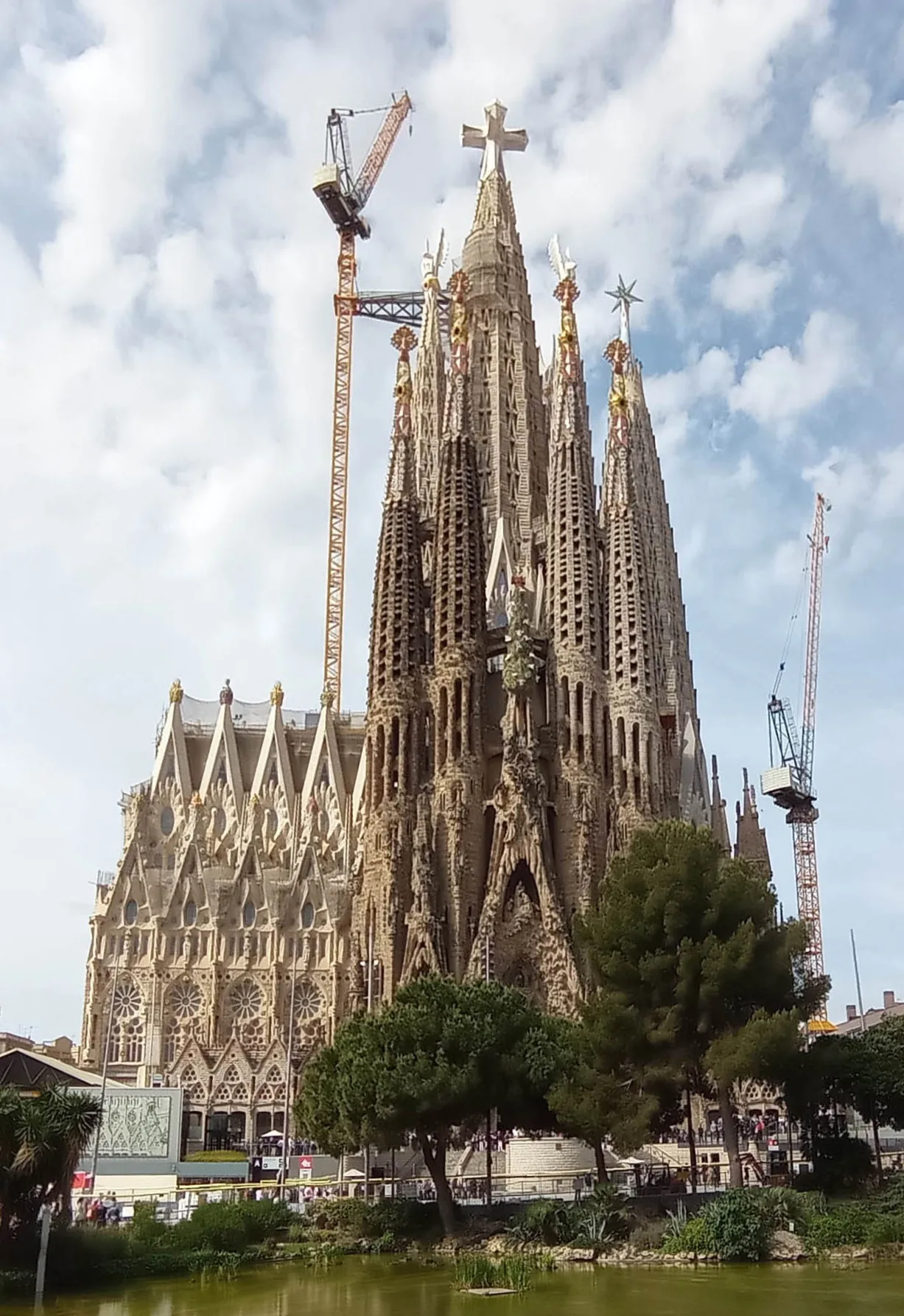
Sagrada Familia, Spain
Gaudí was not the original architect , he inherited a project already underway and transformed it so completely that little of his predecessor's work remains. He developed his design through physical models, hanging chain models that generated the catenary curves he later translated into stone, and spent decades refining the structural logic. He was killed by a tram in 1926, with the building roughly a quarter complete. Work continued after his death using his models and drawings, many of which were damaged or destroyed in 1936 during the Spanish Civil War. Reconstruction of the lost plans and completion of the building using modern computer modelling has continued ever since; the central tower of Jesus Christ is scheduled to top out in the mid-2020s.
The interior is the revelation most visitors don't anticipate from the exterior. Gaudí designed the nave columns as a branching forest, with each column splitting into smaller supports as it rises, the effect of standing inside is of being in a stone woodland filled with colored light filtered through stained glass designed to shift from cool blues in the east to warm ambers in the west throughout the day. The facades tell different stories: the Nativity facade on the east is richly decorated in natural imagery; the Passion facade on the west is angular, sparse, and confrontational. Tower access by lift offers close views of the stone pinnacles. La Sagrada Família has its own Metro station (L2 and L5) in the Eixample district of Barcelona. Pre-booked timed tickets are mandatory, walk-up entry is not available during peak months, and queues without pre-booking are extremely long.
The Experience
Passing through the nave's branching column forest in shifting stained-glass light, compare the richly naturalistic Nativity facade with the angular austerity of the Passion facade, and ascend a tower by lift for close views of the stone pinnacles over Barcelona.
Why It Matters
Spain's most visited monument and a UNESCO World Heritage Site, Gaudí's most ambitious work and one of the most structurally original religious buildings ever attempted.
Why Visit
The interior light is the thing photographs consistently underrepresent. The experience of standing in the nave as afternoon light moves through the amber glass of the western clerestory needs to be encountered to be understood.
Insider Tips
- 1
Pre-book tickets with a specific entry time at least two weeks ahead in summer, spontaneous visits are not possible in peak season.
- 2
The audio guide is worth the extra cost; the structural explanation of the column branching system adds significant depth to the visit.
- 3
The Nativity facade faces east, morning light from that direction is the best time to study its detail.
- 4
The crypt where Gaudí is buried is accessible and free; it's easy to miss but worth finding before you leave.