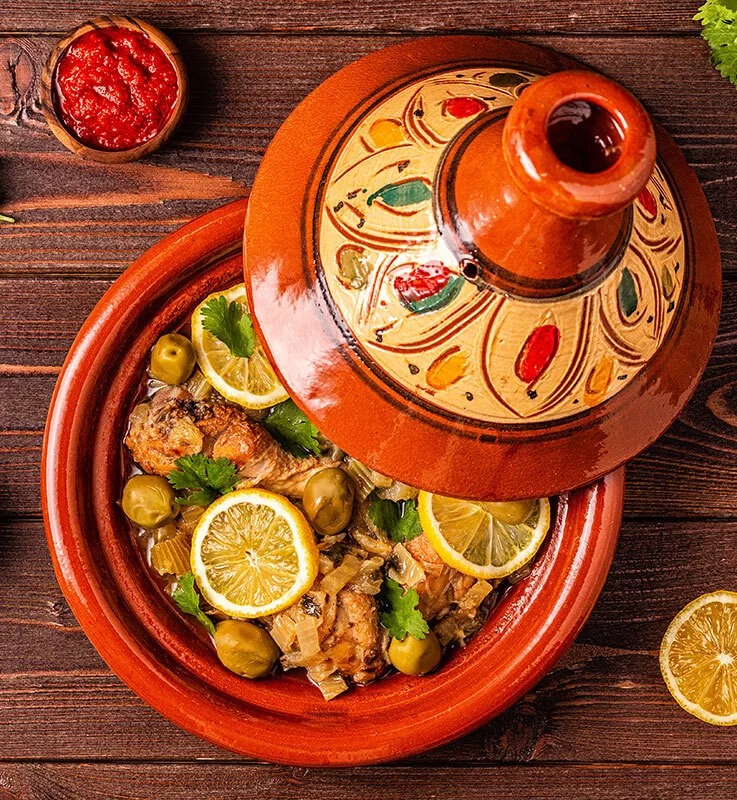
"Morocco's clay pot traps steam in a self-basting cycle and slow-cooks lamb, chicken or meatballs for three hours. The conical lid is functional, not decorative."
About Tagine
Morocco's slow-cooked masterpiece named for its conical clay vessel, lamb with prunes, almonds and ras el hanout; chicken with preserved lemon and olives; or kefta (spiced meatballs) with egg and tomato; the conical lid recirculates the steam in a self-basting cycle; cooked over charcoal for three hours; served with khobz bread for the communal scoop.
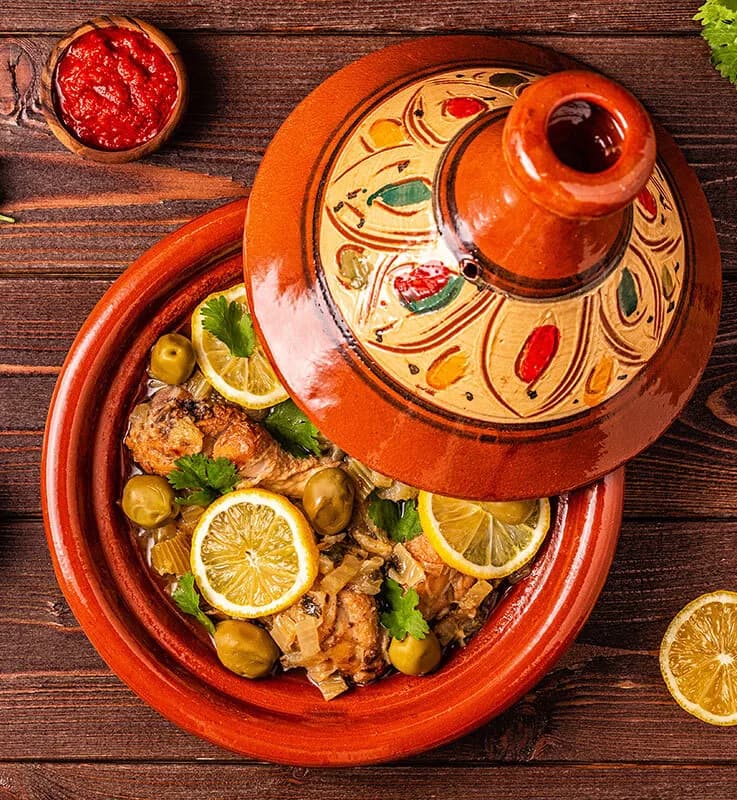
Tagine, a staple of Morocco's cuisine
The Vessel
The tagine is named for the clay pot it is cooked in, whose tall conical lid traps rising steam and returns it to the dish in a self-basting cycle. Cooked slowly over charcoal, the contents stay moist through hours of gentle heat. The vessel is function, not decoration, and it shapes the dish as much as any ingredient.
The Classic Combinations
A tagine can be many things: lamb with prunes and almonds, chicken with preserved lemon and olives, or kefta meatballs poached with egg and tomato. Warm spices, saffron, ginger, cumin and cinnamon, run through them, balanced often by something sweet or sour. The long, sealed cook melds these into something fragrant and complex.
The Preserved Lemon
One of Morocco's signature ingredients is preserved lemon, fruit cured in salt for weeks until soft and mellow. Its flavour is quite unlike fresh lemon: softer, fermented and faintly briny, and it appears in the classic chicken tagine, in salads and in couscous. A few slivers transform a dish.
Cooked Over Charcoal
A real tagine is cooked low and slow over charcoal, which gives a depth that a gas flame cannot match. Brought to the table sealed and opened with a rush of fragrant steam, it is meant to be eaten communally with khobz bread used to scoop. It is Moroccan home cooking made physical, turning modest ingredients and time into something memorable.
What to Expect
The tagine arrives at the table still sealed, the clay warm. The lid is lifted and steam rises with the smell of cumin, saffron and preserved lemon. The lamb falls from the bone. The prunes are soft and sweet.
Why Try It
Tagine is Moroccan home cooking made physical, a technique that produces extraordinary results from inexpensive ingredients and time.
✦ Photo Gallery
Insider Tips
The chicken-preserved lemon-olive version is the most classic. Order it first.
Eat with khobz bread, not a fork. Bread is the traditional utensil for scooping from the communal pot.
Real tagines are cooked over charcoal, not gas. The flavour difference is real, ask at the restaurant.