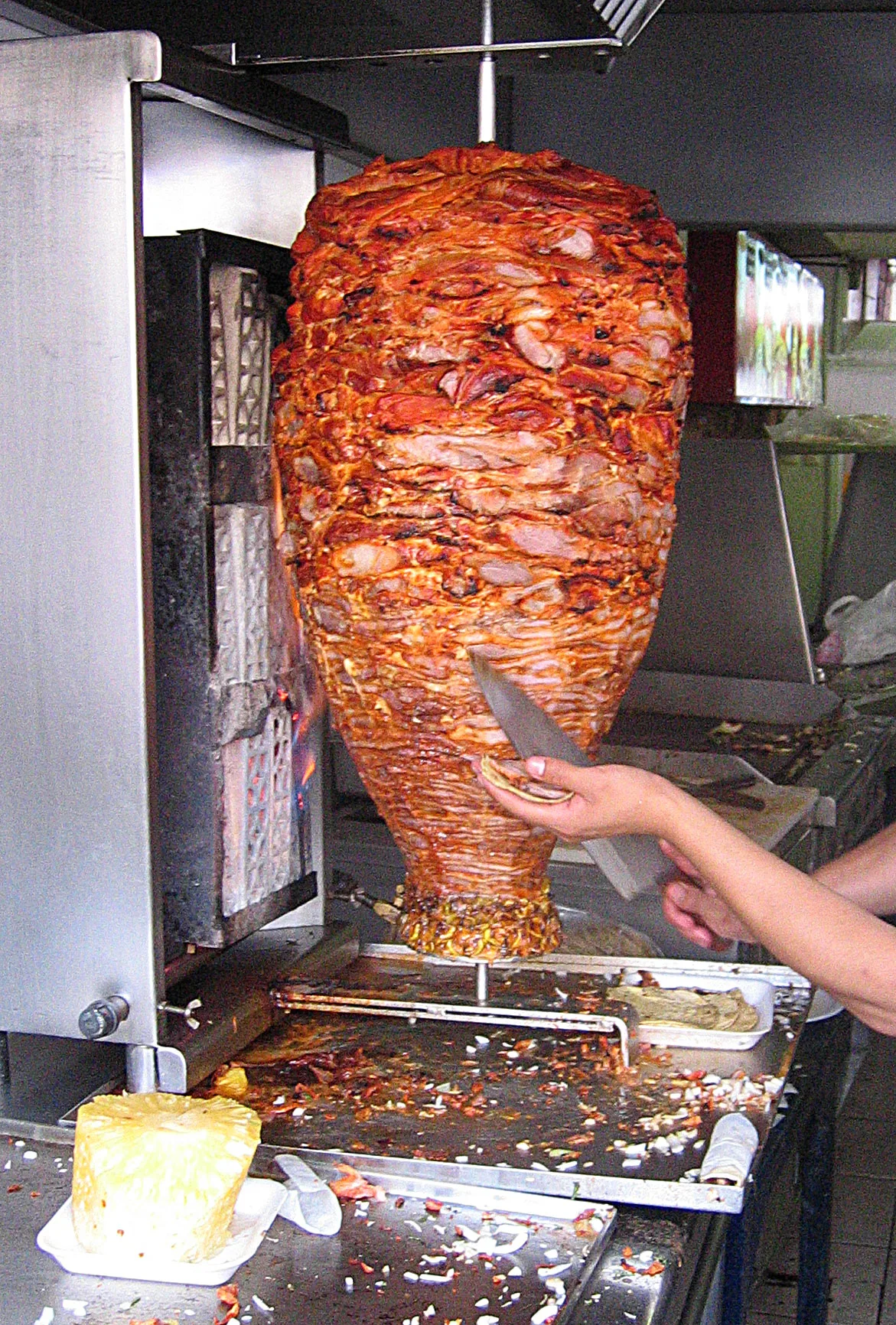
Mexico City's most important street food comes from a Syrian shawarma technique adapted to pork, dried chillies and pineapple. The taquero shaves the trompo spit with one hand and catches the meat in a tortilla with the other.
About Tacos al Pastor
Mexico City's greatest street food and one of the world's most perfect portable meals: pork marinated in dried chillies, achiote and pineapple, stacked on a vertical spit (trompo) of Lebanese origin introduced by Syrian immigrants in the 1930s, shaved off with a knife onto a small doubled corn tortilla with raw onion, coriander and a pineapple sliver; the Surquillo and El Huequito stands are legendary.
The Trompo
Tacos al pastor are Mexico City's defining street food: pork marinated in dried chillies, achiote and spices, stacked on a vertical spit, the trompo, and roasted as it turns. The meat is shaved onto small doubled corn tortillas, with a slice of pineapple cut from the top of the spit. The caramelised edges of the pork are the prize.
“Tacos al pastor are Mexico City's defining street food: pork marinated in dried chillies, achiote and spices, stacked on a vertical spit, the trompo, and roasted as it turns.”
A Syrian Origin
The dish descends from the shawarma brought to Mexico by Lebanese and Syrian immigrants in the early twentieth century, the vertical spit adapted to local pork and chillies. What began as an imported technique became wholly Mexican, reworked with achiote, dried chilli and pineapple. It is a story of migration written into a taco.
The Technique
A skilled taquero works the trompo with one hand and a tortilla in the other, shaving the meat in a single motion and catching it directly in the tortilla, the pineapple slice falling last. The speed and precision take months to learn. It is street cooking as performance.
The Toppings
A pastor taco is finished simply: chopped onion, coriander, a little of the pineapple and a green salsa, on two corn tortillas. The doubled tortilla keeps the juicy meat from tearing through. Salsa verde is the classic first pairing, its sharpness cutting the rich, caramelised pork.
What to Expect
In a Mexico City taquería, the trompo spins slowly, the pork dark and caramelised at the edges. A taquero shaves a portion with a single stroke and catches it in two corn tortillas. The pineapple slice falls last. Onion, coriander and salsa verde are added immediately.
Why Try It
Tacos al pastor is Mexico City's most specific food: the technique, the trompo, the doubled tortilla and the toppings make it irreplaceable.
Insider Tips
- El Huequito on Ayuntamiento Street (since 1959) is the most historic Mexico City address.
- Always use two corn tortillas, the single tortilla tear is what doubled tortillas prevent.
- Add salsa verde, not roja, for the first taco. It's the correct pairing for pastor.