A prehistoric volcanic explosion left behind a sea of stone so porous it floats in water, now carved into a frozen white labyrinth by the relentless Andean winds.
About Campo de Piedra Pómez
The Blanco Volcano, situated just a few kilometers away, provided the raw material for this landscape during a massive Pleistocene eruption. Across centuries, this area was a silent void on the maps of Spanish colonizers, known only to the nomadic peoples who traversed the Puna with llamas. It was the scientific curiosity of geologists in the 1970s that finally categorized these ignimbrite deposits as one of the most significant pumice fields on the planet. In 2012, the province of Catamarca declared it a protected area, finally recognizing that the delicate, brittle formations were a geological heritage that could not be replaced once broken by human footprint or tire track.
Campo de Piedra Pómez in Argentina
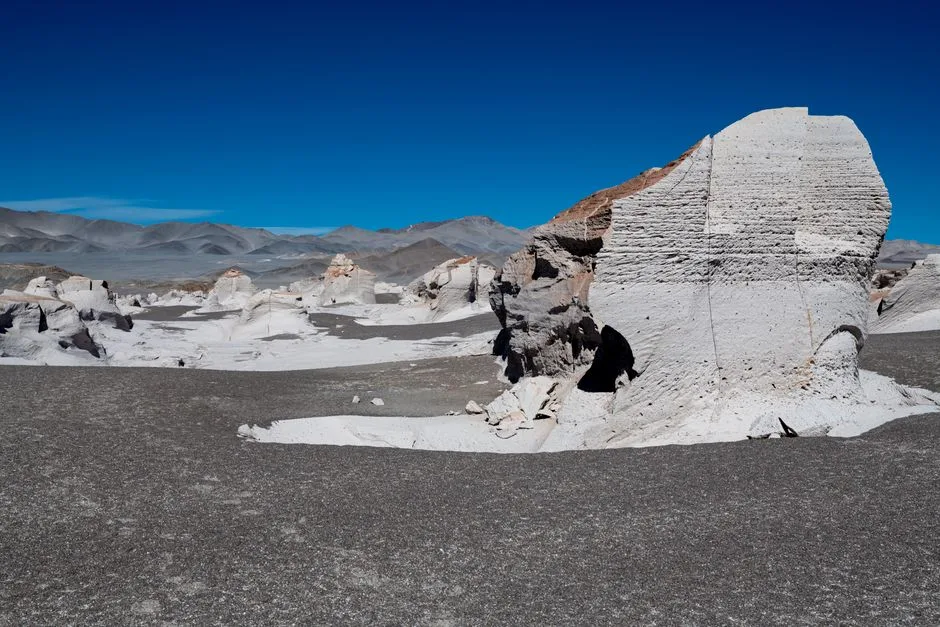
High in the Puna of Catamarca, the earth erupts into a frozen sea of white waves that look more like a dream of the moon than a terrestrial desert. Campo de Piedra Pómez spans a staggering twenty-five kilometers, a labyrinth of pumice stone carved by the abrasive grit of the Andean winds into jagged crests and smooth, porous hollows. The scale here is difficult to process at first glance; you are standing in a volcanic graveyard where the rock is so light it feels as though a strong gust might lift the smaller fragments and carry them away. Under a cobalt sky that never seems to produce a cloud, the white stone glows with a brilliance that demands squinted eyes even behind the darkest lenses. You get no water, no vegetation, and no sound but the dry whistle of the wind through the stone labyrinths, creating a sense of isolation that is both humbling and strangely liberating.
“High in the Puna of Catamarca, the earth erupts into a frozen sea of white waves that look more like a dream of the moon than a terrestrial desert.”
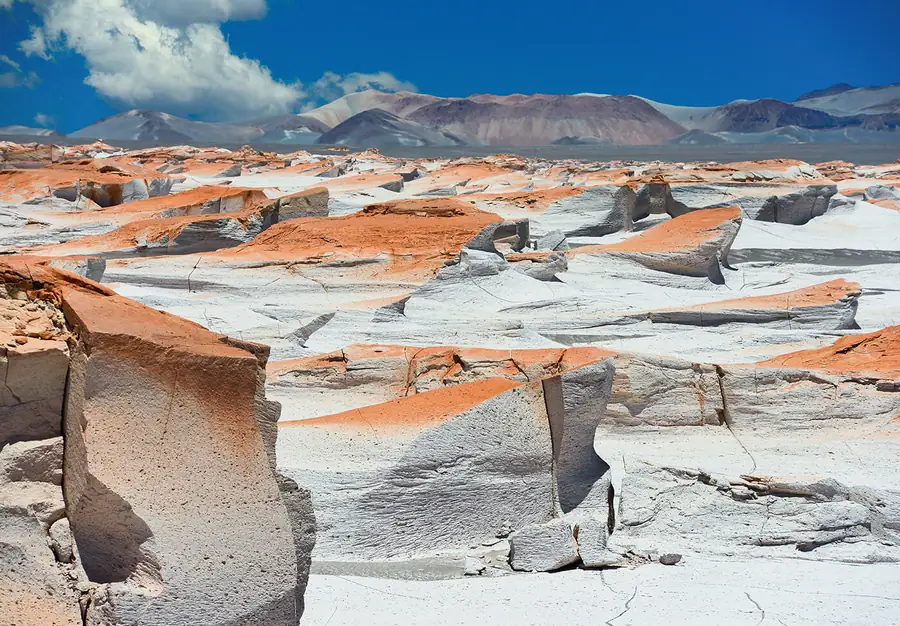
Campo de Piedra Pómez, Argentina
Roughly one hundred thousand years ago, the Blanco
Roughly one hundred thousand years ago, the Blanco Volcano decided to rewrite the geography of this high plateau in a single catastrophic event. An explosive eruption sent massive clouds of ash and incandescent gas into the atmosphere, which then settled and cooled into this thick blanket of pumice. For millennia, the fierce Zonda winds have acted as a sculptor’s chisel, exploiting the fragility of the volcanic glass to create the parallel corridors and 'giant's teeth' that define the field today. Local shepherds have long moved their flocks along the periphery of this stone ocean, but the interior remained largely unexplored by outsiders until the late twentieth century. It was only when 4x4 vehicles became more robust that the world began to see the surreal complexity of this high-altitude maze.
El Peñón is the dusty, sun-bleached
El Peñón is the dusty, sun-bleached way into this wilderness, a tiny village where the few remaining trees lean permanently eastward from the wind. At the field from the town of Belén requires a long journey along the legendary Route 40 followed by Provincial Route 43, a road that climbs through red canyons and yellow grasslands. The final stretch to the Campo is impossible without a high-clearance four-wheel-drive vehicle and a driver who understands the shifting sands of the Puna. Those visiting arrive with a guide from El Peñón, who navigates by landmarks only they can recognize in the white-on-white horizon. The approach is a cinematic slow-burn, as the distant white smudge on the horizon grows into a towering wall of volcanic bone.
Visiting Campo de Piedra Pómez
Walking into the heart of the field, the silence is so heavy it feels physical, punctuated only by the occasional sharp 'clack' of a loose stone shifting under your boot. What you catch first is the texture of the pumice is surprisingly sharp, like walking on a giant, dried-out sponge made of glass. The light at mid-afternoon creates deep, ink-black shadows that plunge into the white hollows, giving the landscape a high-contrast, graphic quality. There is a thinness of the air at 3,000 meters above sea level, which makes every small climb over a stone ridge a deliberate, heart-thumping effort. Visitors often miss the tiny obsidian fragments scattered among the white rock, black glass 'tears' that provide a dark counterpoint to the blinding brightness. What sticks with you is the realization that the landscape is still changing; the wind is constantly shedding the skin of these rocks, ensuring that the view you see today will never be exactly the same for the next traveler.
The Experience
The temperature drop the instant you step into the shadow of a stone tower, even as the sun feels like it is burning through your clothing. The interior is bone-dry, carrying a faint, dusty scent of minerals that parches your throat within minutes. You get like a tiny intruder in a landscape that was never meant for human habitation, where the lack of any living thing makes you hyper-aware of your own breath and heartbeat. The most striking thing is the color palette; it is a world stripped of green, leaving only the blinding white of the pumice, the deep navy of the sky, and the occasional golden hue of the surrounding sand dunes. It is a place that feels like the very end of the world, or perhaps the beginning of a new one.
Why It Matters
Campo de Piedra Pómez is a rare, large-scale example of wind-eroded volcanic ignimbrites, providing a living laboratory for geomorphologists. It represents a pristine high-altitude ecosystem that has remained virtually unchanged since the last ice age. Culturally, it stands as the crown jewel of Catamarca's Puna, symbolizing the raw, unyielding power of the Argentine northwest.
Why Visit
While the salt flats of Jujuy are famous for their flatness, this field offers a three-dimensional architecture that defies belief. You visit because you want to lose your sense of scale in a place that looks like it was designed by a surrealist architect. It is the only place in Argentina where you can walk through a forest of stone that is technically made of hardened bubbles.
Insider Tips
- 1
Deflate your tires slightly before entering the sandy approaches to the field to avoid getting bogged down in the 'fesh-fesh' volcanic dust.
- 2
Pack a high-quality buff or scarf to cover your mouth and nose, as the wind-blown pumice dust is essentially powdered glass and can be highly irritating.
- 3
Bring a polarizing filter for your camera to manage the extreme glare reflecting off the white stone against the dark Andean sky.
- 4
Check the wind forecast specifically for the Zonda; if the gusts are over 60km/h, the blowing sand will make visibility zero and the experience miserable.
- 5
Walk only on the sand paths between the formations, as the pumice is incredibly brittle and a single heavy footstep can snap a thousand-year-old crest.