Twenty stories of pressurized blue ice groan with the weight of five hundred years while most of the world’s glaciers quietly vanish into the sea.
About Perito Moreno Glacier
European eyes first settled on this icy frontier in 1879 when Chilean captain Juan Tomás Rogers sighted the frozen mass. However, the naming rights fell to Argentina and Francisco Moreno, a man who ironically never actually saw the glacier that bears his name. He spent his life surveying the Andes to settle border disputes, viewing the ice fields as strategic anchors for a young nation. In the early 20th century, the site was merely a remote curiosity for hardy sheep farmers and explorers. It wasn't until 1937 that Argentina formally protected the area, recognizing that the Southern Patagonian Ice Field was a prehistoric survivor worth more than just territory. Today, it is still a sentinel of climate stability in a rapidly warming world.
What Perito Moreno Glacier actually is
Glaciers usually evoke a sense of static, frozen antiquity, yet Perito Moreno behaves more like a living, breathing beast. Resting within the Los Glaciares National Park in southern Patagonia, this sapphire-tinted expanse of ice stretches five kilometers across the Argentino Lake, forming a jagged wall that rises seventy meters above the water. Unlike the vast majority of the world's ice fields which are currently in retreat, this particular titan remains in a state of equilibrium. It advances steadily, locked in a perpetual cycle of growth and collapse that makes it one of the most dynamic spectacles on the planet. Visitors do not come here to see a relic of the ice age; they come to witness the raw, noisy mechanics of the earth still in motion.
“Glaciers usually evoke a sense of static, frozen antiquity, yet Perito Moreno behaves more like a living, breathing beast.”
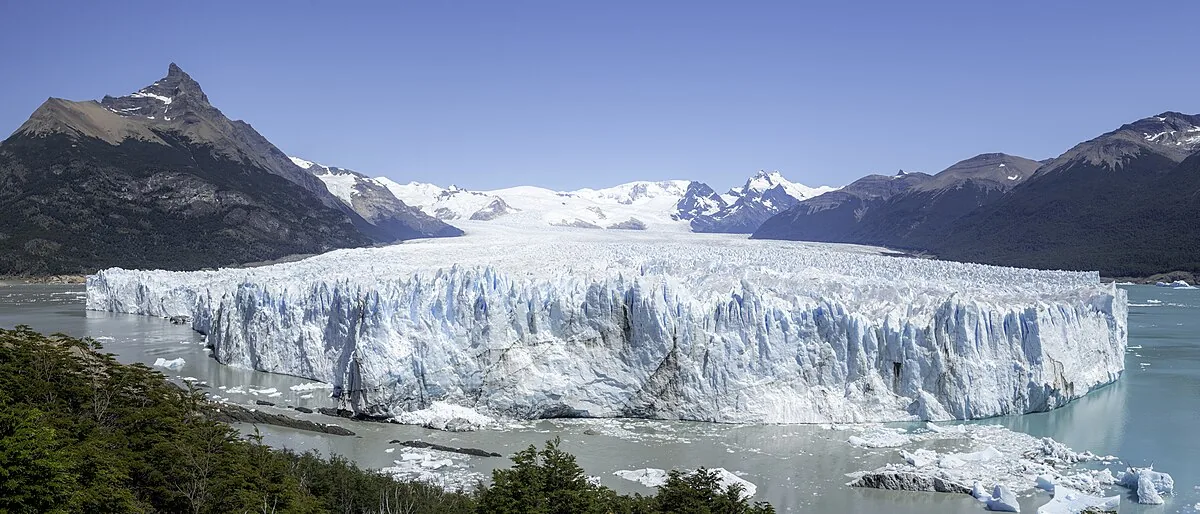
Perito Moreno Glacier, Argentina
Named after Francisco Moreno, the 19th-century explorer who defended Argentina’s territorial claims in this rugged frontier, the glacier has long been a focal point of Patagonian identity. Its formation began during the last glacial maximum, and it is a major outlet for the Southern Patagonian Ice Field, the world’s third-largest reserve of fresh water. The physics of the site are uniquely dramatic. As the ice pushes forward, it eventually reaches the Magallanes Peninsula, effectively damming the Rico Arm of the lake. Water levels on one side can rise thirty meters above the main lake, creating immense hydrostatic pressure. Every few years, this tension culminates in a 'rupture,' where the ice bridge collapses in a cataclysmic event that draws observers from across the globe to witness the water reclaiming its path.
Walking along the tiered steel catwalks built into the opposing peninsula, you first notice the sound. It begins as a sharp, rifle-like crack that echoes through the beech forest, followed by a low, rhythmic grumble. This is the sound of deep ice shifting under its own weight. The space carries a distinct chill that smells of nothing but absolute purity. When a house-sized block finally shears off the face, it falls in slow motion. The impact sends a thunderous boom across the water, followed by a turquoise swell that tosses icebergs the size of cars like driftwood. During the height of the afternoon, the sun hits the ice at an angle that reveals deep, electric-blue veins within the translucent walls, a color created by the extreme compression of air bubbles over centuries. El Calafate is the gateway, located roughly eighty kilometers to the east. The drive across the basalt-strewn steppe offers a stark contrast to the verdant forest that suddenly appears entering the park. While tour buses arrive in waves, the most intimate way to see the ice is via the trekking excursions that depart from Bajo de las Sombras port. Outfitted with metal crampons, you can actually walk upon the glacier’s surface. This perspective reveals a labyrinth of deep moulins and sapphire pools that are invisible from the shore. Regardless of how you arrive, staying until the late afternoon provides the best light and the quietest atmosphere, as the shadows of the Andes begin to stretch across the serrated white horizon.
The Experience
Standing on the metal balconies, you feel the temperature drop by ten degrees the moment the wind shifts off the ice. The scale is impossible to gauge until a boat sails near the face, appearing like a tiny toy against a skyscraper of frozen glass. The smell of the Nothofagus forest mingling with the sterile, metallic scent of the ice. The most profound moment happens when the crowd falls silent; you hear the glacier 'singing,' a series of pops and groans that vibrate in your chest. Deep in the crevasses, the light turns a shade of indigo so saturated it looks artificial, a reminder that you are looking at water frozen before the industrial revolution.
Why It Matters
Beyond its status as a UNESCO World Heritage site, Perito Moreno is a rare scientific anomaly. It is one of the few glaciers on Earth that is not actively shrinking, providing glaciologists with a vital control group for studying ice shelf mechanics. It represents the raw power of the Pleistocene era surviving into the modern age, acting as a massive, functional dam that physically alters the geography of the surrounding lake system every few seasons.
Why Visit
Other glaciers require long, arduous treks or expensive cruises to see, but Perito Moreno offers a front-row seat to the end of the world from a comfortable boardwalk. You aren't just looking at a view; you are watching a geological event. The sheer frequency of the ice calving means you are almost guaranteed to see the planet reshaping itself in real-time, a violent and beautiful spectacle found nowhere else on this scale.
Insider Tips
- 1
Book the earliest boat crossing to the glacier's edge to witness the ice before the wind picks up and disturbs the mirror-like reflections on the lake.
- 2
Pack a pair of high-quality binoculars to spot the condors that frequently circle the updrafts created by the massive ice wall.
- 3
Seek out the lower trekking paths at the very end of the boardwalk system where the roar of the calving ice is loudest and tourists are fewest.
- 4
Bring a waterproof shell even on sunny days because the glacier creates its own microclimate and sudden ice-mists are common.
- 5
Sample a glass of whiskey cooled with 'ancient ice' harvested from the lake during a trekking tour for a literal taste of the past.