Eleanor Roosevelt allegedly looked at these three hundred crashing crests and could only whisper, 'Poor Niagara,' realizing that a single river had just redefined the scale of the earth.
About Iguazú Falls
Guarani tribes held these waters sacred for millennia before European contact, viewing the horseshoe-shaped abyss as a physical scar from a divine betrayal. In 1541, Álvar Núñez Cabeza de Vaca became the first European to document the site, though his discovery did little to disturb the deep jungle for centuries. The border between Argentina and Brazil was finalized along the river’s deepest channel in 1881, effectively splitting the falls between two nations. It wasn't until the early 20th century that the wilderness began its transition into a protected monument. Military officer Gregorio Levalle and botanist Carlos Thays spearheaded the movement to create a National Park in 1934, ensuring the basalt cliffs wouldn't be lost to hydroelectric greed or unchecked logging.
What Iguazú Falls actually is
Nature rarely presents itself with such deliberate theatricality as it does at the border of Argentina and Brazil. While most waterfalls are single threads of silver against stone, Iguazú is an unruly semi-circle of nearly three hundred individual cascades that span almost three kilometers. The subtropical rainforest of Misiones wraps around these falls like a heavy green velvet curtain, damp with humidity and vibrating with a low-frequency hum. This isn't just a scenic vista; it is a sprawling, multi-sensory labyrinth of water and basalt where the air itself feels liquid. To stand at the edge of the Garganta del Diablo, or Devil’s Throat, is to lose the ability to hear your own voice beneath the roar of one and a half million liters of water plummeting every second.
“Nature rarely presents itself with such deliberate theatricality as it does at the border of Argentina and Brazil.”
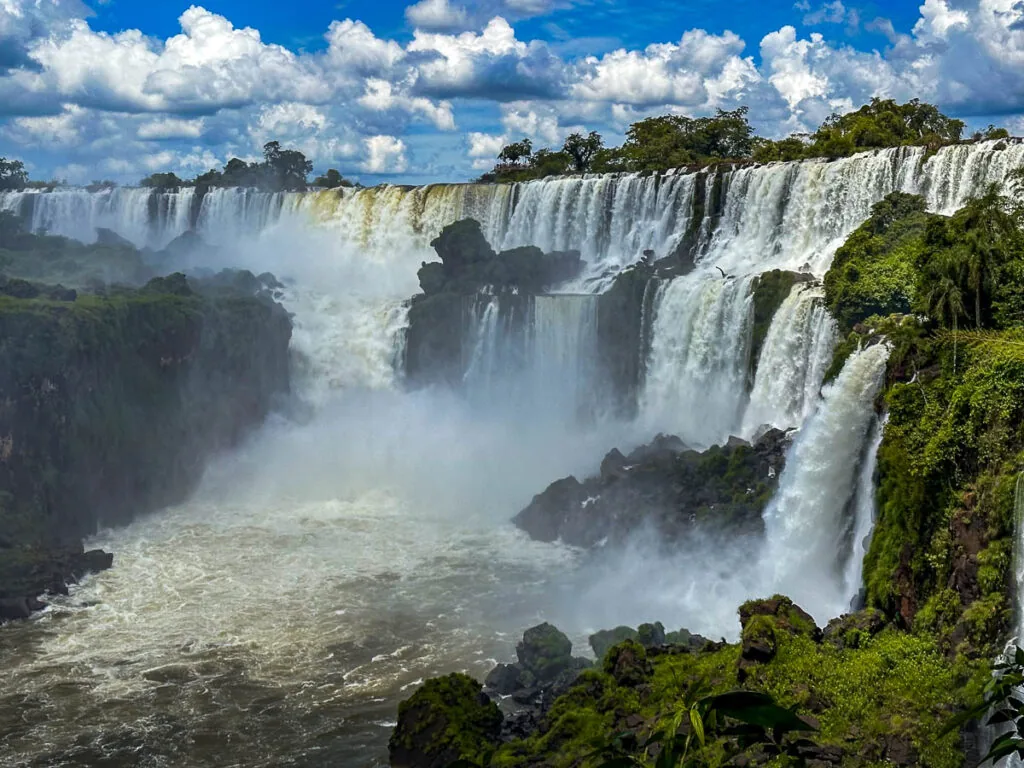
Iguazú Falls, Argentina
upon this roar, 1541
Long before the Spanish explorer Álvar Núñez Cabeza de Vaca chanced upon this roar in 1541, the Guarani people named the site 'Big Water.' Their legends speak of a jealous serpent god, M'Boi, who sliced the riverbed in a fit of rage to prevent a pair of lovers from escaping in a canoe. Geologically, the story is just as dramatic. Around 130 million years ago, massive volcanic eruptions smothered the region in thick basalt. When the Iguazú River eventually met the edge of these hard volcanic layers, the softer earth beneath eroded away, creating the sheer drop we see today. The Argentine side was formally protected in 1934, thanks in large part to the advocacy of landscape architect Carlos Thays, who insisted that the jungle catwalks be designed to immerse visitors rather than just offer a distant view.
Drenched in a fine, persistent mist, you begin to notice that Iguazú is as much about the jungle as it is about the river. The Lower Circuit places you at the feet of the giants, where the spray from the Bosetti fall hits your face with a cool, sharp pressure. Above, the Upper Circuit offers a god’s-eye view, looking down into the churning white foam where rainbows form and vanish in seconds. You get a ground shudder beneath your feet on the long steel walkway leading to the Devil’s Throat. Brightly colored Great Dusky Swifts dart directly into the thundering water to nest on the wet cliffs behind the falls, a sight that defies logic. The smell is a heady mix of wet moss, crushed ferns, and the metallic tang of highly oxygenated water.
Puerto Iguazú is the Argentine hub, located
Puerto Iguazú is the Argentine hub, located just twenty minutes from the park entrance. A small ecological train chugs slowly through the forest from the visitor center, depositing you at the start of the primary trailheads. While the Brazilian side provides the wide-angle postcard shot, the Argentine side is where you get your hands dirty. Narrow paths weave through the canopy, often shared with scavenging coatis and the occasional plush-crested jay. To feel the river’s power, the Gran Aventura boat trips drive directly into the spray of the San Martín fall, leaving every passenger soaked to the skin and laughing with a strange, primal adrenaline.
“Puerto Iguazú is the Argentine hub, located just twenty minutes from the park entrance.”
The Experience
First up is the vibrations before you see the white water, a deep-tissue bass that settles in your ribcage. The mist is a constant companion, turning the jungle air into a soft, cool sauna that smells intensely of crushed greenery and wet stone. While the crowds gravitate toward the Devil’s Throat, you find the most haunting moments on the Sendero Macuco, where the sound of the falls fades into the chatter of capuchin monkeys. Watch for the Great Dusky Swifts; these small birds perform a daily miracle by flying straight through the vertical wall of water to reach their nests. The sheer volume of the spray often creates a permanent circular rainbow that seems to hover just inches from your fingertips on the Upper Circuit.
Why It Matters
Iguazú represents one of the world's last great Atlantic Forest remnants, a biodiversity hotspot where jaguars still roam the shadows of the falls. Beyond the physics of the water, it is born from binational cooperation, managed as a seamless ecological unit by both Argentina and Brazil. It echoes of the raw, tectonic power of the Mesozoic era, preserved in a state of beautiful, violent motion.
Why Visit
Niagara is a city attraction and Victoria is a seasonal giant, but Iguazú is an immersive jungle labyrinth that lets you walk over the very lip of the abyss. It is the only place where you can spend an entire day lost in a network of islands and walkways, surrounded by 275 different waterfalls. You don't just visit Iguazú; you inhabit its mist for a few hours.
Insider Tips
- 1
Take the first train of the morning to the Devil’s Throat to stand at the precipice before the heat and the mid-day tour groups arrive.
- 2
Look for the 'Great Dusky Swifts' nesting behind the water; they are the only birds that can penetrate the heavy spray without drowning.
- 3
Zip your passport and electronics into double dry-bags before boarding the nautical adventure boats, as 'water-resistant' gear will fail under these high-pressure falls.
- 4
Watch your bags around the coatis; these raccoon-like creatures have learned how to operate zippers to steal snacks from unsuspecting hikers.
- 5
Check the lunar calendar for the Full Moon Walk, a rare night tour where the falls are illuminated only by a ghostly silver lunar rainbow.