“Death in Buenos Aires is not an ending so much as a final, permanent move into a neighborhood where the rent is paid in Carrara marble and social status lasts forever.”
About Recoleta Cemetery
The origins trace to a humble garden for Recollect friars in 1732 before a 1822 decree by Governor Martín Rodríguez transformed it into the city's primary burial ground. Following the 1871 yellow fever outbreak, the wealthy elite migrated to the Recoleta district and began an architectural arms race to build the most elaborate funerary monuments. Names like Alvear, Mitre, and Sarmiento, the architects of modern Argentina, found their way here, ensuring the cemetery became a stone-carved history book of the republic. In 1946, the cemetery gained its most famous resident, Eva Perón, whose body only arrived after a bizarre, years-long odyssey across Europe, finally resting five meters underground in a tomb designed to be impenetrable.
What Recoleta Cemetery actually is
Real estate in Buenos Aires has never been more contested than within the high walls of this miniature stone city. Spanning four city blocks in the centre of the capital’s most aristocratic neighborhood, the cemetery is a dense labyrinth of nearly 5,000 vaults, where the nation’s presidents, generals, and poets rest in structures that often outshine the houses of the living. This isn't a place of grassy knolls and quiet grief; it is a grand, crowded exhibition of neoclassical pride and Art Deco ambition. Dust motes dance in the light of stained-glass windows, and the scent of damp stone and wild cats permeates the narrow corridors. Visitors find themselves navigating a grid of streets like a parallel version of Buenos Aires, one where time has been bargained away for marble.
Real estate in Buenos Aires has never been more contested than within the high walls of this miniature stone city.
Monks of the Order
Monks of the Order of the Recoletos once tilled these grounds as simple vegetable gardens surrounding their convent in the early 18th century. When the order was disbanded in 1822, the garden was repurposed as the city’s first public cemetery, though it soon shed any semblance of modesty. As the yellow fever epidemic of the 1870s drove the wealthy from the south of the city to the high ground of Recoleta, the graveyard became the ultimate social ledger. Families spent fortunes to secure their legacies, importing Italian marble and French bronze to build mansions for their dead. The 1881 remodel by architect Juan Antonio Buschiazzo solidified its current form, turning a burial ground into a curated monument to the Argentine elite's golden age.
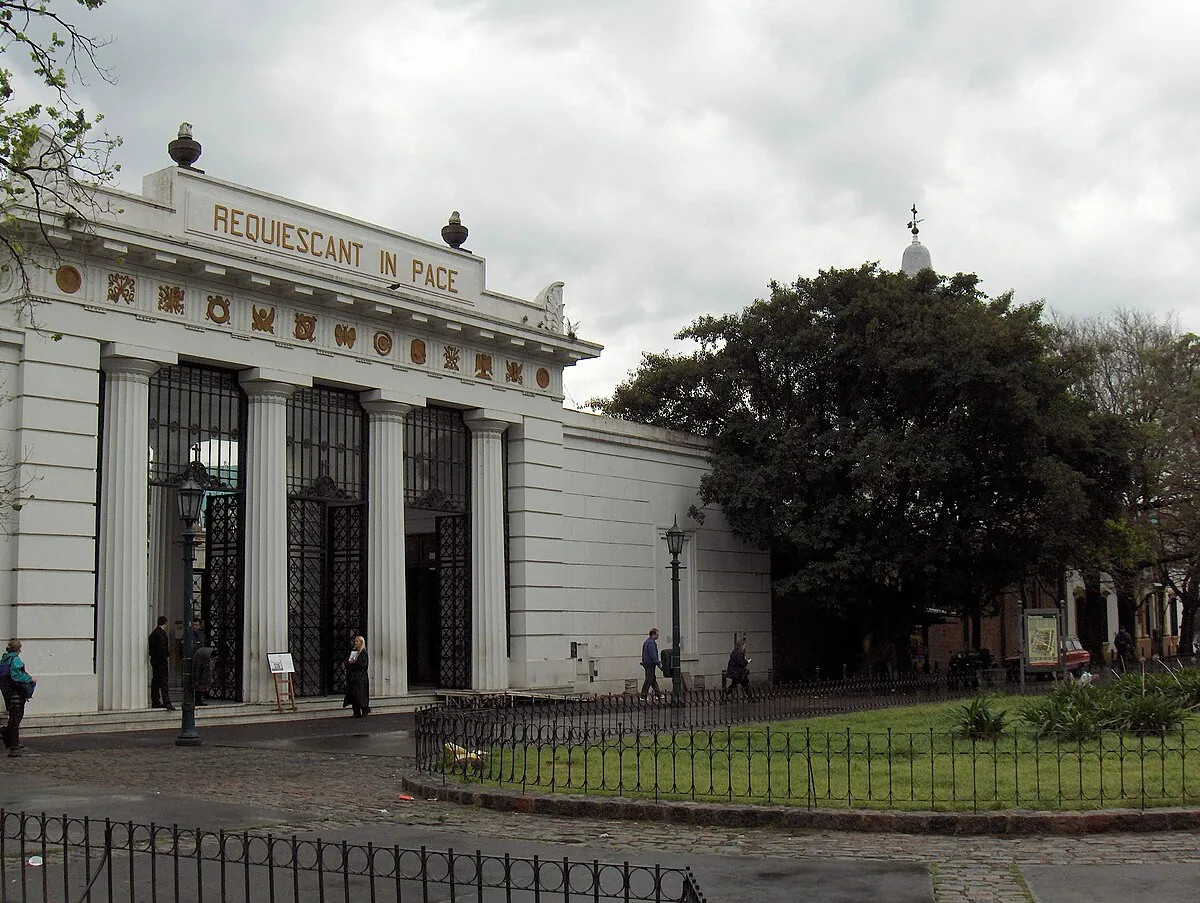
Walking through the neo-classical gates, the city’s traffic noise immediately muffles into a heavy, respectful silence. Part of the temperature drop as the shadows of massive granite towers close in. The light here is particularly fickle, casting long, dramatic silhouettes across the faces of stone angels and grieving widows. While crowds naturally gravitate toward the Duarte family vault to pay respects to Eva Perón, the real magic lies in the nameless side alleys. The standout is the paradox of opulence and decay; some tombs are perfectly polished, while others have cracked glass doors revealing dusty coffins and rusted ironwork. Stray cats, the undisputed guardians of the site, sun themselves on the pedestals of fallen heroes, indifferent to the history beneath their paws.
The iron gates sit
The iron gates sit at the end of Junín Street, easily accessible by a short walk from the Las Heras subway station on Line H. Those visiting weave through the sprawling Recoleta flea market that occupies the neighboring Plaza Francia on weekends before entering the sanctuary. Entering during the final hour before closing provides the most evocative atmosphere, as the security guards begin to ring heavy handbells to signal the exit. This clanging sound, echoing through the marble halls as the sun dips below the tomb-lines, creates a cinematic transition between the city of the dead and the vibrant, steak-scented nightlife waiting just outside the walls.
The iron gates sit at the end of Junín Street, easily accessible by a short walk from the Las Heras subway station on Line H.
The Experience
Something strange, voyeuristic intimacy as you peer through the wrought-iron grilles of family vaults, noticing faded photographs of 19th-century debutantes resting atop velvet-lined caskets. You catch of your own footsteps on the polished paving stones becomes the primary soundtrack, occasionally interrupted by the distant chime of church bells from the neighboring Basilica of Our Lady of Pilar. Most people overlook the 'Liliana Crociati' tomb, where a bronze statue of a young woman in her wedding dress stands with her dog; touching the dog's nose has become a quiet, unofficial ritual for luck. The late afternoon light is the true master here, turning the gray granite into a warm, glowing amber that briefly softens the grim reality of the necropolis.
Why It Matters
More than a graveyard, Recoleta is a physical manifestation of the 'Generation of '80' and their desire to see Argentina as the Europe of the Americas. It is a dense concentrated archive of every major architectural movement from the last two centuries, including Gothic, Baroque, and Modernist styles. For the people of Buenos Aires, it is a site of pilgrimage and a stark reminder of the fragile, fading grandeur of their nation's wealthiest era.
Why Visit
Forget the sterile, sprawling cemeteries of Europe or the overgrown ruins of the tropics; Recoleta is a vertical, urban masterpiece. It offers a chance to walk through a city of ghosts that is as meticulously planned as a Parisian arrondissement. You come here to see how humans attempt to cheat oblivion through sheer, heavy, unmoving art.
✦ Insider Tips
- 1
Locate the tomb of Rufina Cambaceres to see the haunting Art Nouveau sculpture of a girl peering through the door of her own grave.
- 2
Avoid the central avenues during the midday heat and instead cut through the narrowest 'streets' where the tombs provide a natural wind tunnel and deep shade.
- 3
Look for the official bell-ringer at 5:45 PM; the sound of his bell echoing through the tombs is a centuries-old tradition that signals the day's end.
- 4
Search for the tomb of the cemetery’s former caretaker, David Alleno, who allegedly saved his life’s wages to build a space here and committed suicide the day it was finished.
- 5
Check the small bronze plaques on the tomb doors; they often list the names of everyone inside, spanning five or six generations of a single family.