“A master shipbuilder used Paraguayan cedar and raw cowhide to build a cathedral ceiling that has stayed afloat on dry land for nearly four centuries.”
About Manzana Jesuítica
The Society of Jesus secured this land in 1599, intending to create a spiritual and intellectual powerhouse in the middle of the Spanish viceroyalty. They founded the University of San Carlos in 1613, establishing a rigorous curriculum that attracted the brightest minds from across the continent. To support this massive educational infrastructure, the Jesuits managed a network of outlying estancias, or ranches, which provided the funds for their ambitious building projects in the city. The sudden expulsion order signed by King Charles III in 1767 forced the priests to abandon their libraries and classrooms overnight, leaving behind a legacy of stone and parchment that survived the subsequent centuries of civil war and national reorganization. Today, the block remains a vibrant part of the National University of Córdoba, still serving the students who flock here from across South America.
What Manzana Jesuítica actually is
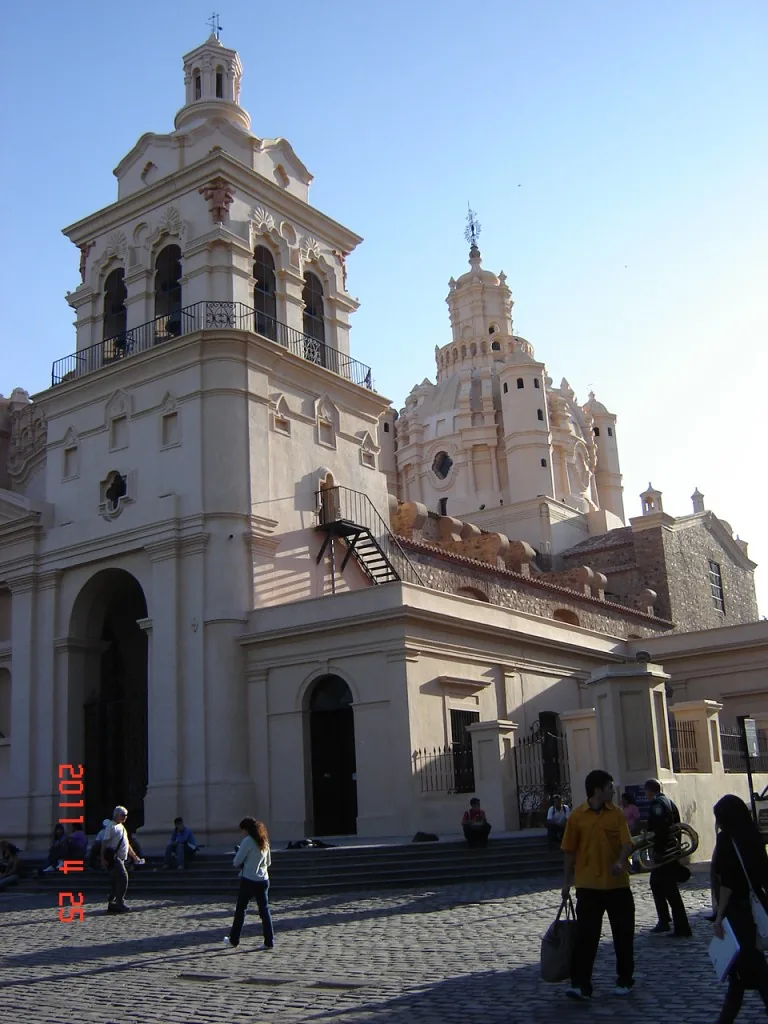
Walk just a few blocks from the glass towers of modern Córdoba and the air suddenly cools, hemmed in by stone walls that have stood for four hundred years. The Manzana Jesuítica, or Jesuit Block, functions as a quiet, scholarly heart within Argentina’s second city. This single city block contains the University of Córdoba, the Monserrat Secondary School, the Church of the Society of Jesus, and the residence for the priests. It feels like stepping into a monastic version of Oxford, where the austerity of the Jesuit Order meets the Baroque ambition of the New World. The thick granite walls and heavy cedar doors create a sanctuary of intellect and faith that effectively birthed the educational soul of the nation.
Walk just a few blocks from the glass towers of modern Córdoba and the air suddenly cools, hemmed in by stone walls that have stood for four hundred years.
Jesuit missionaries arrived in the late
Jesuit missionaries arrived in the late 16th century with a mission that was as much about high-level education as it was about conversion. By 1613, they had established the university, the oldest in Argentina and one of the first in the Americas, turning Córdoba into a signal of knowledge that earned the city its nickname, La Docta. The construction was a feat of local engineering, utilizing the labor of indigenous artisans and enslaved people who carved the massive stones and worked the intricate woodwork. The entire enterprise operated like a city within a city until 1767, when the Spanish Crown abruptly expelled the Jesuits from South America. The buildings sat in a strange limbo before being handed over to the Franciscans and eventually the state, yet they never lost that specific, studious atmosphere of the original Ignatian vision.
Entering the Church of the Society of Jesus
Entering the Church of the Society of Jesus, You end up staring up at a ceiling that looks like the hull of a massive cedar ship. This incredible barrel vault was crafted by a Jesuit brother using timber from the Paraguayan jungle, held together by wooden pins and cowhide because iron was too expensive to import. The standout is the scent of old wood and incense that seems to have seeped into the very pores of the stone over the centuries. In the university cloisters, the light plays across the arched galleries, casting long shadows that invite you to slow your pace. Part of the weight of the thousands of rare, vellum-bound books in the Great Library, where the air is kept strictly dry to protect volumes that date back to the early days of the printing press. Córdoba sits in the geographic center of Argentina, well-connected by frequent flights from Buenos Aires or scenic bus routes from the Andean northwest. The Jesuit Block is situated in the city’s historic core, easily accessible on foot from the Plaza San Martín. A large share of visitors choose to explore the university and library via guided tours, which are essential for gaining access to the more secluded courtyards and the precious book collections. Walking these streets in the late afternoon is particularly evocative, as the limestone glow of the facades begins to soften and the bells of the nearby cathedral mark the end of the university day.
The Experience
The standout is how the city’s car horns and street vendors seem to vanish the moment you step into the central courtyard of the Rectorate. The interior is defined by a profound, academic stillness, broken only by the muffled voices of students debating in the corridors. There is a cool, rough texture of the hand-hewn granite blocks that form the foundation of the university, a stark contrast to the delicate, gilded carvings of the church altarpieces. The highlight for many is the Jesuit Library, where the specific smell of aging leather and old ink creates an intoxicating atmosphere of preserved time. Within the middle of the block, you realize you are in a place where the pursuit of God and the pursuit of physics once occupied the same stone rooms.
The standout is how the city’s car horns and street vendors seem to vanish the moment you step into the central courtyard of the Rectorate.
Why It Matters
The Manzana Jesuítica is the core of Argentine intellectual history, representing the moment the country moved from a colonial frontier to a center of higher learning. It is a UNESCO World Heritage site that perfectly illustrates the fusion of European Baroque architecture with local materials and craftsmanship. Culturally, it remains the anchor of Córdoba’s identity, proving that the city’s prestige is built on four centuries of continuous academic tradition.
Why Visit
Don't just go for the architecture; go to see the birthplace of the Argentine mind. While the ruins in the jungle show the Jesuit's social experiments, this block shows their intellectual peak. It offers a rare chance to see a 400-year-old university that is still a functioning part of a modern city’s daily life.
✦ Insider Tips
- 1
Book a library tour in advance, as access to the 'Librería Mayor' is strictly controlled and limited to small groups to protect the fragile manuscripts.
- 2
Look for the 'sun dial' carved into the stone in the central courtyard, which students have used to check their time between classes for centuries.
- 3
Visit the nearby Jesuit Estancia of Santa Catalina if you have an extra day to see how the rural ranches funded this urban masterpiece.
- 4
Attend a morning mass in the Church of the Society of Jesus to hear the incredible acoustics of the ship-hull ceiling in action.
- 5
Pay close attention to the door frames in the Monserrat School, where the original carvings still show the distinct marks of the indigenous Guaraní craftsmen.