The indigenous Tehuelche believed this granite spire was an active volcano, unaware that the permanent 'smoke' at its peak was actually a cloud trapped by the sheer ferocity of the wind.
About Mount Fitz Roy
While the world obsessed over the highest peaks, Fitz Roy remained an enigma due to its terrifying technical difficulty and the 'roaring forties' winds that lash its faces. Francisco Moreno gave it its modern name in 1877, but the mountain remained unmapped and unclimbed until the mid-20th century. The 1952 French expedition marked a turning point in mountaineering history, employing tactical maneuvers that opened the door for future legends like Yvon Chouinard to forge their own paths up the stone. The surrounding Los Glaciares National Park was declared a UNESCO World Heritage site in 1981, protecting the massive ice field that feeds the turquoise lakes at the mountain's feet and ensuring the spire remains a pristine monument to tectonic ambition.
What Mount Fitz Roy actually is
Patagonia has a way of making everything else feel small, and nowhere is this more evident than at the jagged, granite teeth of Mount Fitz Roy. Rising 3,405 meters above the Southern Patagonian Ice Field, this mountain behaves more like a living creature than a geological formation. It hides for days behind a thick, swirling cloak of clouds, only to reveal its vertical towers in a sudden, violent burst of golden light at dawn. To the Tehuelche people, it was Chaltén, the smoking mountain, named for the permanent cloud plume that clings to its summit like chimney smoke. The surroundings here carries the scent of ancient ice and damp southern beech forests, while the wind often arrives in sudden, freight-train gusts that remind you exactly who is in charge of this landscape.
“Patagonia has a way of making everything else feel small, and nowhere is this more evident than at the jagged, granite teeth of Mount Fitz Roy.”
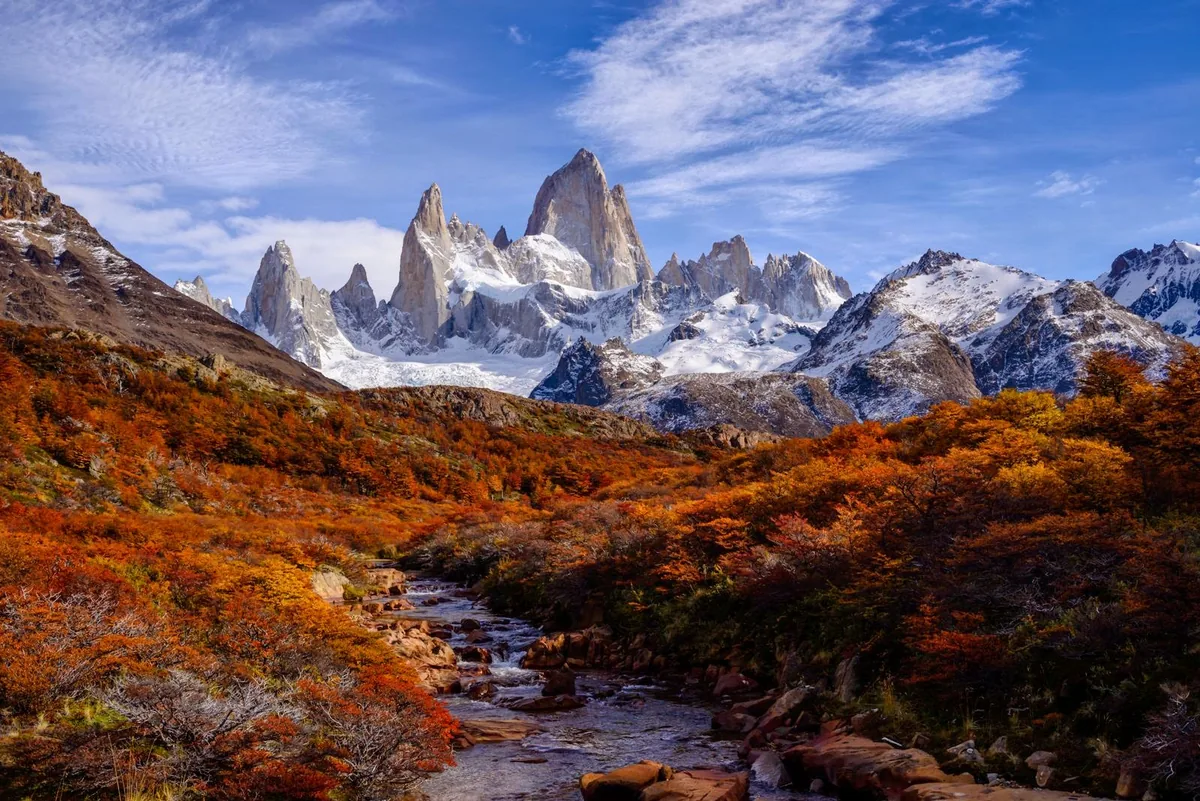
Mount Fitz Roy, Argentina
renamed the peak, 1877
Francisco Moreno, the pioneering Argentine explorer, renamed the peak in 1877 to honor Robert FitzRoy, the captain of the HMS Beagle who had surveyed these coasts decades earlier. For a long time, the mountain was considered unclimbable, a terrifying wall of smooth diorite and unpredictable weather that repelled the world's best alpinists. Everything changed in 1952 when French climbers Lionel Terray and Guido Magnone finally reached the summit, proving that the sheer faces were not impossible, merely punishing. Since then, the nearby village of El Chaltén has evolved from a lonely outpost established in 1985 to settle a border dispute with Chile into a pilgrimage site for those who worship at the altar of vertical stone. The history of this peak is written in the legends of mountain guides and the quiet resilience of the pioneers who first braved the Patagonian winter to map its glaciers.
Stepping onto the trail toward Laguna de los
Tres, The springy resistance of forest mulch and the occasional slick of glacial mud. The final kilometer is a brutal, vertical scramble over loose scree that demands every bit of your lung capacity. When you finally crest the ridge, the sudden appearance of the mountain against the cobalt blue sky hits with the force of a physical blow. Leading with the deep, electric turquoise of the glacial lake at its base, a color so saturated it looks artificial. The silence at the top is rarely absolute; it is filled with the distant, thunderous crack of shifting ice or the sharp whistle of the wind through the granite spires. Just about everyone focus solely on the peak, but The hardy calafate bushes and the way the lenga trees twist into fantastic shapes to survive the gales.
El Chaltén is the basecamp for all
El Chaltén is the basecamp for all adventures, a three-hour drive across the desolate, guanaco-filled steppes from El Calafate. The journey along Route 40 and then Route 23 offers a cinematic slow-burn, as the silhouette of the Fitz Roy massif gradually grows from a tiny notch on the horizon into a towering wall of rock. Unlike many national parks, the trails here begin at the very edge of the village streets, allowing you to walk from your morning espresso directly into the wild. There are no entrance fees or shuttle buses required to reach the primary trailheads. This accessibility creates a unique atmosphere where the boundary between civilized comfort and the raw, unyielding power of the Andes is virtually non-existent.
“El Chaltén is the basecamp for all adventures, a three-hour drive across the desolate, guanaco-filled steppes from El Calafate.”
The Experience
At the front is the temperature drop by ten degrees the moment you enter the shade of the beech forest, where the air is still and heavy with the smell of wet earth. As you reach the exposed ridges, the wind becomes an active participant in your hike, leaning against you with a steady, invisible hand. The dawn light is the mountain's most famous trick; for about twenty minutes, the gray granite turns a burning, molten copper that reflects perfectly in the still waters of the tarns. A strange sense of camaraderie with the other hikers, a shared understanding of the physical toll required to stand in the presence of such raw geography. What stays with you is looking back from the valley floor at night, seeing the silhouette of the peaks under a sky so crowded with stars that the Milky Way looks like a solid band of light.
Why It Matters
Mount Fitz Roy is the spiritual heart of world-class trekking, representing the ultimate intersection of technical beauty and accessible wilderness. It works as a sentinel over the Southern Patagonian Ice Field, the third-largest continental ice mass on Earth. Humanly, it embodies the spirit of exploration and the Argentine commitment to preserving landscapes that are as dangerous as they are beautiful.
Why Visit
Torres del Paine in Chile has the fame, but Fitz Roy has the soul and the grit. Here, the trails are free, the village is authentically geared toward hikers, and the granite towers are more dramatic in their sheer, vertical isolation. It is the only place where you can find world-class alpine scenery with the ease of walking out your front door.
Insider Tips
- 1
Start your hike at 3:00 AM in total darkness to reach Laguna de los Tres before the first light hits the granite, as the 'Alpenglow' effect lasts only minutes.
- 2
Fill your water bottle directly from any fast-flowing stream; the water is melting glacial ice and is arguably the purest liquid you will ever taste.
- 3
Pack a high-quality windshell even if the sky is clear, because the 'Chaltén weather' can transition from summer sun to a horizontal snowstorm in twenty minutes.
- 4
Walk to the 'Chorrillo del Salto' waterfall on your rest day to see how the glacial melt carves its way through the lower valley's volcanic rock.